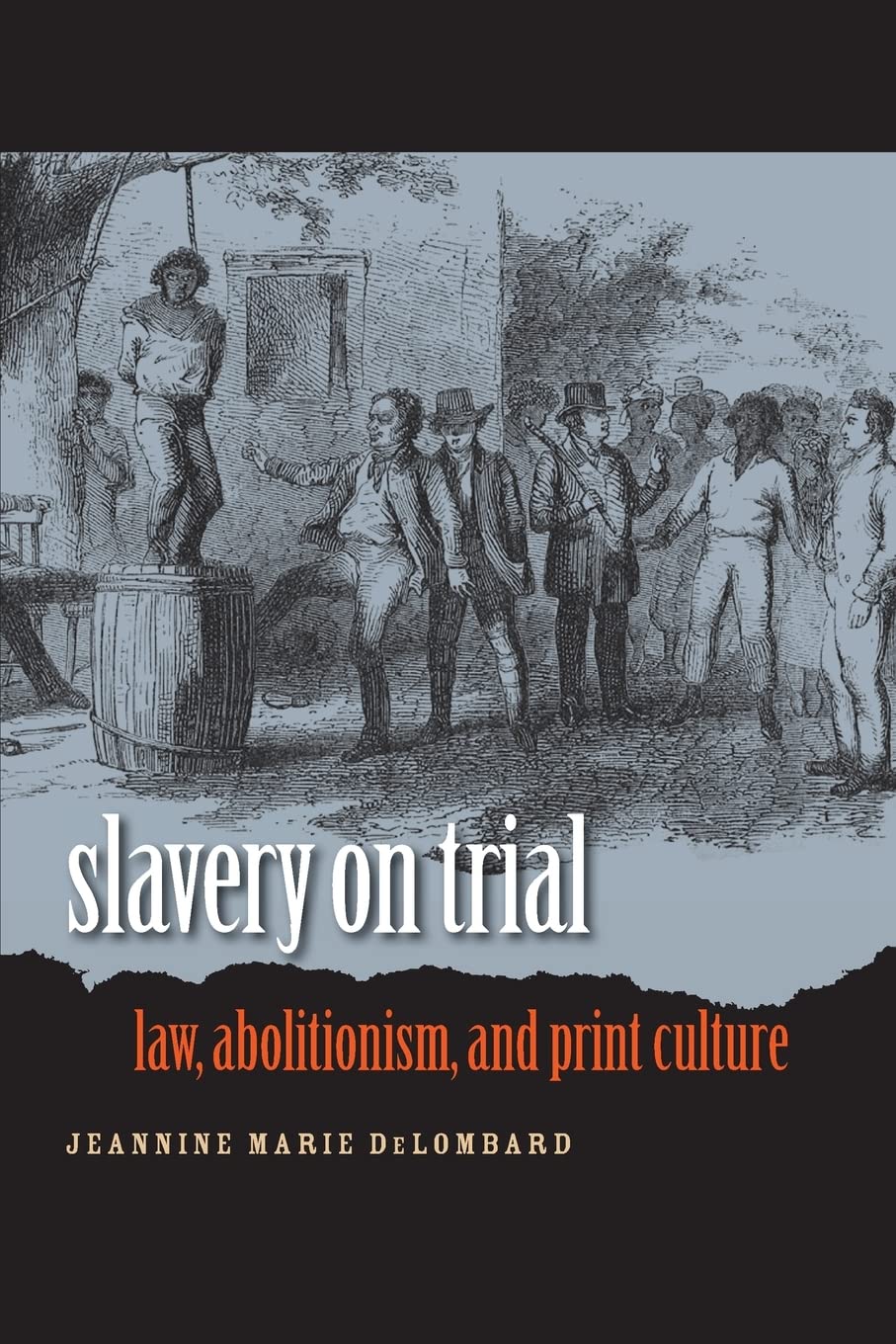
Slavery on Trial: Law, Abolitionism, and Print Culture (Studies in Legal History)
$29.21
by Jeannine Marie DeLombard



America’s legal consciousness was high during the era that saw the imprisonment of abolitionist editor William Lloyd Garrison, the execution of slave revolutionary Nat Turner, and the hangings of John Brown and his Harpers Ferry co-conspirators. Jeannine Marie DeLombard examines how debates over slavery in the three decades before the Civil War employed legal language to “try” the case for slavery in the court of public opinion via popular print media. Discussing autobiographies by Frederick Douglass, a scandal narrative about Sojourner Truth, an abolitionist speech by Henry David Thoreau, sentimental fiction by Harriet Beecher Stowe, and a proslavery novel by William MacCreary Burwell, DeLombard argues that American literature of the era cannot be fully understood without an appreciation for the slavery debate in the courts and in print. Combining legal, literary, and book history approaches, Slavery on Trial provides a refreshing alternative to the official perspectives offered by the nation’s founding documents, legal treatises, statutes, and judicial decisions. DeLombard invites us to view the intersection of slavery and law as so many antebellum Americans did — through the lens of popular print culture. “Succeeds admirably. . . . DeLombard’s keen insights serve not as the defining word on print culture and abolition but as an inspiration to further interdisciplinary research.” — Journal of Social History “[A] pathbreaking work. . . . [DeLombard] ably integrates the methodologies of literature, history, and law to make a convincing argument that the debate over slavery contributed to the development of print culture in antebellum America. . . . Provides compelling evidence.” — Civil War History “Set[s] forth a bold new reading of antislavery print activism.” — The Book-American Antiquarian Society Slavery in the court of public opinion DeLombard examines how debates over slavery in the three decades before the Civil War employed legal language to "try" the case for slavery in the court of public opinion via popular print media. The country's legal consciousness was high during the era that saw the imprisonment of abolitionist editor William Lloyd Garrison, the execution of slave revolutionary Nat Turner, and the hangings of John Brown and his Harpers Ferry coconspirators. DeLombard discusses how this consciousness was evident in the "trials" over slavery found in the autobiographies of Frederick Douglass, a scandal narrative about Sojourner Truth, a speech by Henry David Thoreau, fiction by Harriet Beecher Stowe, and a proslavery novel by William McCreary Burwell. DeLombard examines how debates over slavery in the three decades before the Civil War employed legal language to "try" the case for slavery in the court of public opinion via popular print media. The country's legal consciousness was high during the era that saw the imprisonment of abolitionist editor William Lloyd Garrison, the execution of slave revolutionary Nat Turner, and the hangings of John Brown and his Harpers Ferry coconspirators. DeLombard discusses how this consciousness was evident in the "trials" over slavery found in the autobiographies of Frederick Douglass, a scandal narrative about Sojourner Truth, a speech by Henry David Thoreau, fiction by Harriet Beecher Stowe, and a proslavery novel by William McCreary Burwell. Jeannine Marie DeLombard is associate professor of English at the University of Toronto, where she is affiliated with the Centre for the Study of the United States and the Collaborative Program in Book History and Print Culture. SLAVERY ON TRIAL Law, Abolitionism, and Print Culture By Jeannine Marie DeLombard The University of North Carolina Press Copyright © 2007 The University of North Carolina Press All right reserved. ISBN: 978-0-8078-5812-7 Contents Acknowledgments..................................................................................................xiIntroduction.....................................................................................................1Part I Banditti and Desperadoes, Incendiaries and Traitors1 The Typographical Tribunal.....................................................................................352 Precarious Evidence: Sojourner Truth and the Matthias Scandal..................................................71Part II At the Bar of Public Opinion3 Eyewitness to the Cruelty: Frederick Douglass's 1845 Narrative.................................................1014 Talking Lawyerlike about Law: Black Advocacy and My Bondage and My Freedom.....................................1255 Representing the Slave: White Advocacy and Black Testimony in Harriet Beecher Stowe's Dred.....................1516 The South's Countersuit: William MacCreary Burwell's White Acre vs. Black Acre.................................177Conclusion All Done Brown at Last: Illustrating Harpers Ferry....................................................199Notes.....................