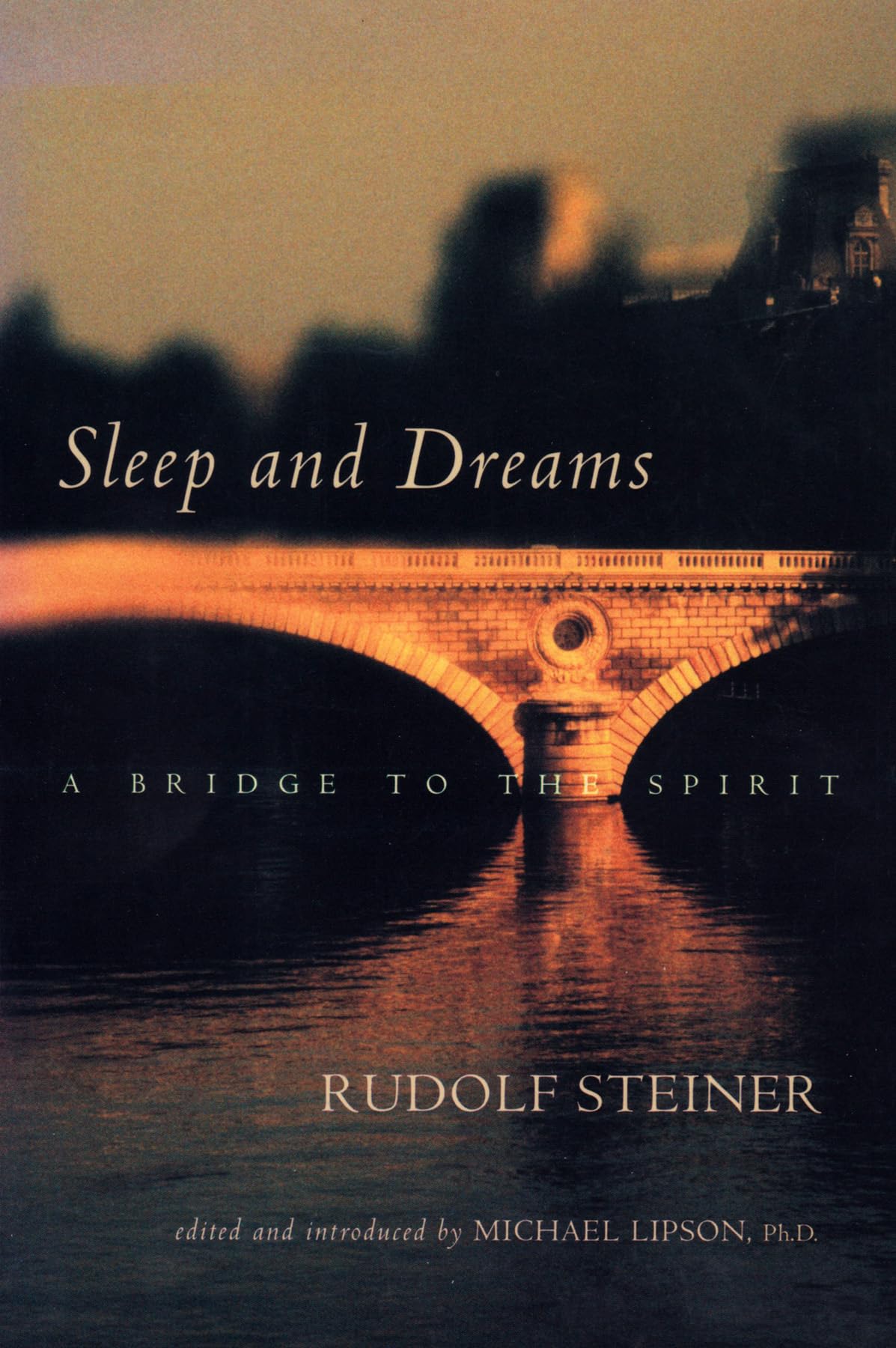



What are Dreams? Every age, every culture, perhaps every person, have different answers. We can at least agree on one thing, however: dreams are other. Their presence in our lives demonstrates that we are not limited to a single mode of consciousness. The world of sleep is largely a blank for us, an abyss of non-consciousness, yawning between one day and the next, but the very fact that we can dream announces our potential for awareness within that abyss. We spend a third of our life asleep―a fact that dream theorists rarely consider. This startling collection of lectures by Rudolf Steiner, selected and introduced by the psychologist Michael Lipson, provides a truly unique way of approaching dreams, based on an understanding of the spiritual nature of human beings. A radically new view of dreams “as the threshold to spiritual reality” arises, once we acknowledge that physical existence is only the tip of an iceberg hidden largely in the spiritual world. Sleep, death, and meditation are the three realms in which consciousness has the opportunity to deepen its immersion in the divine flow of existence. In principle, we can become infinitely more self-aware in each of them, since human consciousness is not fixed―neither in contents nor in terms of alertness. All day long, the contents of our consciousness change, and during the night, the level changes. These lectures permit readers to glimpse the fantastic depths of experience we normally “sleep through” and to contemplate Steiner's astounding program: to maintain self-aware consciousness through sleep, through death, through all being. Rudolf Steiner (b. Rudolf Joseph Lorenz Steiner, 1861–1925) was born in the small village of Kraljevec, Austro-Hungarian Empire (now in Croatia), where he grew up. As a young man, he lived in Weimar and Berlin, where he became a well-published scientific, literary, and philosophical scholar, known especially for his work with Goethe’s scientific writings. Steiner termed his spiritual philosophy anthroposophy , meaning “wisdom of the human being.” As an exceptionally developed seer, he based his work on direct knowledge and perception of spiritual dimensions. He initiated a modern, universal “spiritual science” that is accessible to anyone willing to exercise clear and unbiased thinking. From his spiritual investigations, Steiner provided suggestions for the renewal of numerous activities, including education (general and for special needs), agriculture, medicine, economics, architecture, science, philosophy, Christianity, and the arts. There are currently thousands of schools, clinics, farms, and initiatives in other fields that involve practical work based on the principles Steiner developed. His many published works feature his research into the spiritual nature of human beings, the evolution of the world and humanity, and methods for personal development. He wrote some thirty books and delivered more than six thousand lectures throughout much of Europe. In 1924, Steiner founded the General Anthroposophical Society, which today has branches around the world. Michael Lipson , PhD, worked with children with HIV/AIDS for nine years in New York City’s Harlem Hospital before moving with his wife and two children to the Berkshires in western Massachusetts. Dr. Lipson conducts a practice in Clinical Psychology and teaches meditation internationally. He has been a frequent host of the radio call-in show VOX POP on WAMC, an NPR affiliate station in Upstate New York. He is the author of several books and the translator of Rudolf Steiner’s Intuitive Thinking as a Spiritual Path: A Philosophy of Freedom and several books by Georg Kühlewind. Used Book in Good Condition