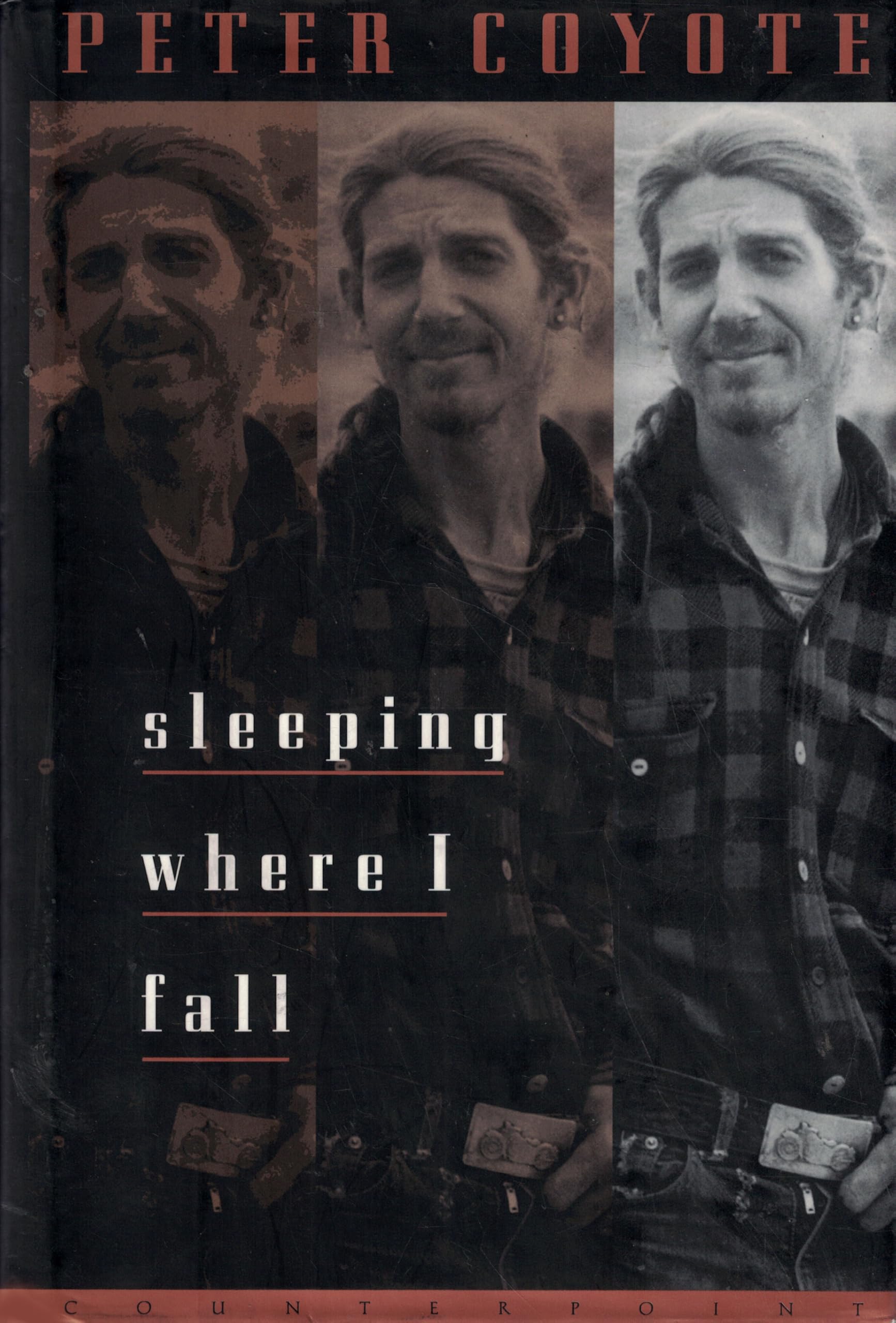



The author looks back on his journey through the counterculture of the 60s and 70s, offering portraits of his fellow activists and hippies As the generation that launched America's counterculture in the 1960s matures into its gray ponytails and 401(k) plans, one might expect the autobiographies of its celebrities to be tinged with apology for goals unrealized. Indeed, with only a few notable exceptions, such as Peter Fonda's Don't Tell Dad , most celebrity autobiographies from '60s pop culture icons seem rooted in either bitterness or desperation. Fortunately, in Sleeping Where I Fall , Peter Coyote neither apologizes for his wild days nor waxes romantic for them. Nor should he. This wise and witty, tightly crafted narrative reports on the turbulence of that era with philosophical integrity, wry humor, and unmitigated honesty. Looking back over his days with the San Francisco Mime Troupe, a street theater group that sought to break the conventional boundaries between performer and audience, Coyote rhapsodizes with equal vigor about the company's artistic triumphs and the pulchritude of its actresses. While his developing acting career and romantic misadventures comprise a great deal of the narrative, an even larger part dwells on his life as one of The Diggers, the band of anarchistic counterculturalists who fought against commercial culture's ability to co-opt the superficial elements of youthful rebellion by rejecting the very notions of ownership and extrinsic value. "The Diggers," writes Coyote, "understood that style is infinitely co-optable. What could not be co-opted was doing things for free-without money." And what things they did! Coyote recounts the lives and times of poets, actors, farmers, and philosophers who participated in a profound cultural experiment that tested the very limits of human consciousness and fell--eventually--to the excesses of personal indulgence. Coyote's evolution from callow thespian to revolutionary communard to seasoned philosopher is fascinating, as much a social and political history as it is a reminiscence. The stories unravel like tender after-dinner tales in prose that captures the rasp and tickle of Coyote's corduroy voice. In the end, Sleeping Where I Fall reveals a man as complex and unpredictable as the totem animal from which he takes his name. --L.A. Smith Coyote not only survived the excesses of the Sixties and Seventies but emerged from years of journeying through the counterculture to achieve success as an actor. Considering the numerous casualties among radicals, who, like Coyote, were heroin junkies living on the edge of society, this is a rare feat. In this frank yet sensitive memoir of those years, Coyote contradicts romantic notions of communes by recalling the discord and petty disagreements typical in his own communal living experiences at Olema ranch and Red House. He describes the chaos created by the Diggers, an antiestablishment group of which he is usually considered a founding member and leader, famous for their stores where everything was given away free, and he remembers his stoned life in Haight-Ashbury. Eventually, he surfaced to work with the San Francisco Mime Troupe, for which he received a special Obie Award. Coyote's thoughtful, articulate writing displays a compassionate wisdom that puts this chronicle in a class above the typical actor's autobiography. Highly recommended for relevent subject collections in academic as well as public libraries.?Richard W. Grefrath, Univ. of Nevada Lib., Reno Copyright 1998 Reed Business Information, Inc. Film actor Peter Coyote recounts his exploits in the 1960s and '70s in this literate insider's account of the San Francisco/Northern California hippie scene. As a member of the San Francisco Mime Troupe and, later, the Diggers, Coyote (the name is totemic) was at the center of the action and a witness to many of the era's countercultural events. He colors the historical perspective of those events with highly personal memories of his life on the road and in various urban and rural communes. He also resurrects long-dead ghosts: Emmett Grogan, Janis Joplin, John Lennon, poet Lew Welch, not to mention the idealism that propelled the whole movement. While avoiding the pitfalls of nostalgia, Coyote reflects on the serendipity of his own life, from upper-middle-class upbringing to heavy drug-user to Wall Street broker to chairman of the California Arts Council to respected and sought-after film actor. He is at once contented and optimistic, and occasionally apologetic; the zeitgeist that informed Coyote 30 years ago has not abandoned him. Frank Caso This autobiographical look at 1960s hippie culture from the point of view of actor Coyote (E.T., Outrageous Fortune, etc.) tends more toward observation than introspection. Coyote began his sojourn in the counterculture with the San Francisco Mime Troupea ground-breaking experiment in political theater that led almost immediately to Coyote's long-st