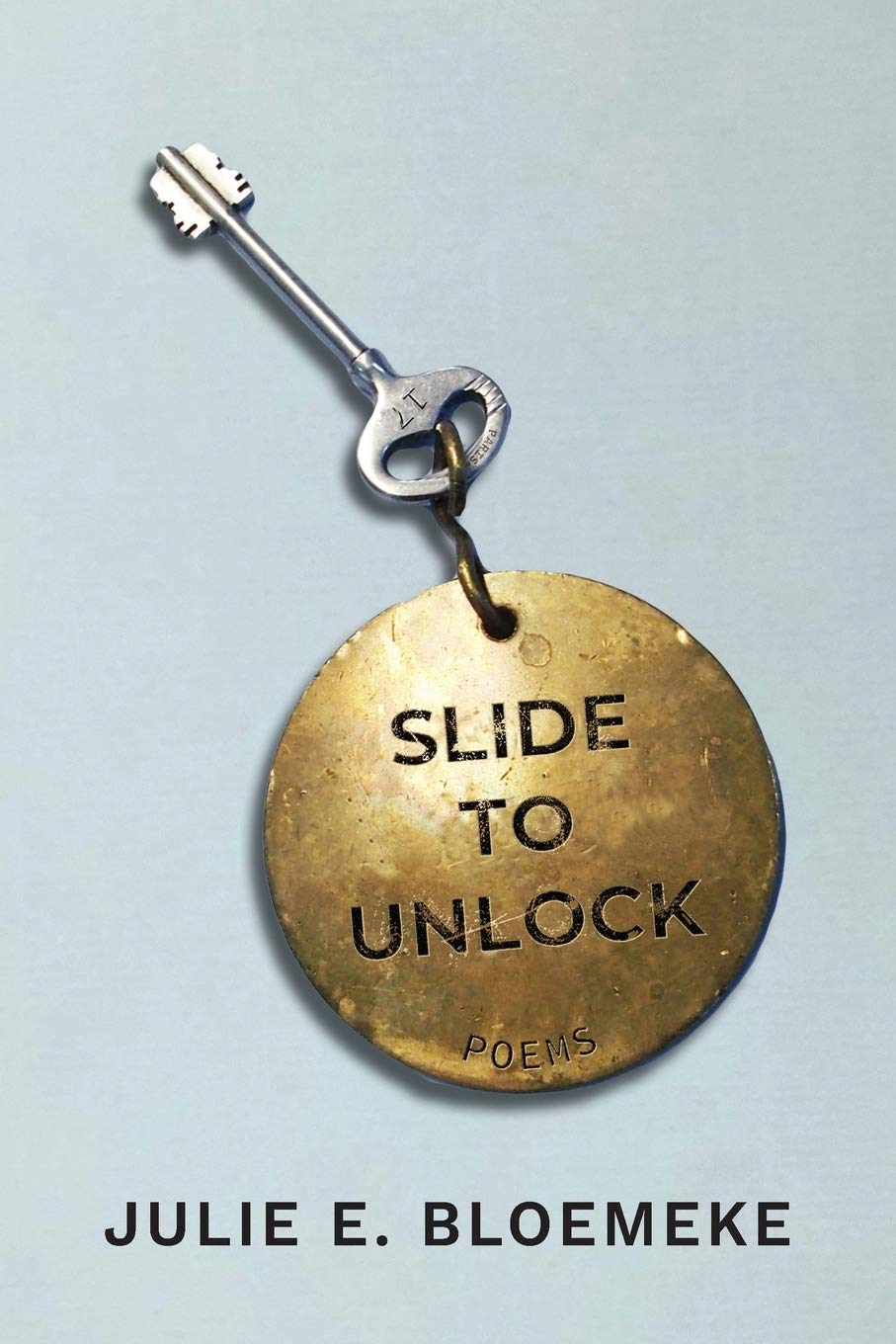



In Slide to Unlock , Julie E. Bloemeke investigates how modern technology redirects our erotic and familial lives, including phones that open with the swipe of a finger and text messages that move the speaker toward startling self-discovery--the "bright trick of letters" that can ignite memory and desire. Each poem explores the sacred and sacrilege within the large and small worlds we navigate--the chimeric ache of a Georgia thunderstorm, the "unseen union" in a Monet painting, a girlhood bedroom in Toledo, a letter secreted in a Paris bookshop--to reveal how digital language and communication, while designed to create intimacy, can leave us adrift. With a lush, hypnotic writing style at once precise and liquid, romantic and ruthless, Bloemeke presents a topography of all the possible ways to carry another person--to "build /the membrane / body ourselves / into each other"--to unlock the lost art of face-to-face connection, and to free ourselves to be "so so bad in how [we] want." PRAISE FOR SLIDE TO UNLOCK "Is it possible for a lyric poet to bring the rawest complications of the adult heart, an orchestra-conductor's authority of syntax, a pristinely liberating imagination, and a virtual mixtape's range of voices, reference, and places together into a single, unified, seemingly narrative, utterly dazzling whole? Julie E. Bloemeke's Slide to Unlock confirms: it is." - Jane Hirshfield "Julie E. Bloemeke's Slide to Unlock is a kind of philosophical love poetry, and in it, the poet locates in the body the satisfactions of the mind: 'There is no place but here, / submerged, the flower of me, / the flower of you, both coded to open, / but brought instead to salt, / converted to everlasting.' Lines like these spiral and unwind in Bloemeke's opus. This is a lovely book." - Jericho Brown, winner of the Pulitzer Prize in Poetry --- Julie E. Bloemeke received her MFA through the Bennington Writing Seminars and an MA from the University of South Carolina. She has been a fellow at the Virginia Center for the Creative Arts and also in residency at the Bowers House Literary Center. Her poems have been widely anthologized and appeared in numerous literary journals including Gulf Coast , Prairie Schooner , Poet Lore , and others. Her ekphrastic work has been published and showcased in collaborations with the Toledo Museum of Art and Phoenix Museum of Art. A freelance writer, editor, and guest lecturer, her interviews have recently appeared in The AWP Writer's Chronicle and in Poetry International . Slide to Unlock was a finalist and semi-finalist for multiple book prizes including the May Swenson Poetry Prize in 2016. It is her first full-length poetry collection. "In Slide to Unlock (Sibling Rivalry Press), Julie E. Bloemeke explores the ways in which the sometimes cold touch of technology can connect us to our deeper desires, even when it threatens to disconnect us from the people around us. Phones provide a clever and compelling through-line, starting with the eponymous first poem: "Once, we could depend / on the corded spiral of miles, // delay ourselves with the orbit / of finger wheel...." The present, though, is faster-moving and far less certain. Smartphone screens that unlocked with the swipe of a finger only a few years ago now demand thumbprints and facial recognition to reveal their "bright trick of letters." The body itself has been turned into a key; the phone, a door to the past and future. Divided into four sections, Slide to Unlock guides us through a speaker's personal history that is also a history of modern communication. The section "Call Waiting" moves us from the beginnings of self-awareness and sexuality into the first years of a marriage; in the poem "Scar Season" from that section, a girl with chicken pox is warned to ignore the "threat of my body / tied to itch." The adult speaker in the final section, "Cellular," fully inhabits her body yet longs for physical and emotional intimacy. In the poem "Infidelity," the speaker addresses her husband not with an admission or accusation, but rather a frank awareness about her own family history: [...] I came to our marriage with flagrant truths, progeny of ancestors openly in other beds, ruined vows, the choice sometimes to break, the choice sometimes to endure. This is not the story of a marriage unraveling, but the more complicated, particular, and moving story of a woman reconciling herself to an undeniable, almost genetic, desire for self-expression; she is steeling herself for both the connection and alienation that may result from this authenticity. The final poem, "Slide to Unlock: Blue Note," provides consolation rather than pat resolution. "Some things in me cannot be held. / I married a man that knew this and somehow // blessed my brokenness." Bloemeke's language throughout her debut collection is both precise and dynamic, tangible and dreamlike. By finding the balance between extremes, Bloemeke thus provides the lyrical