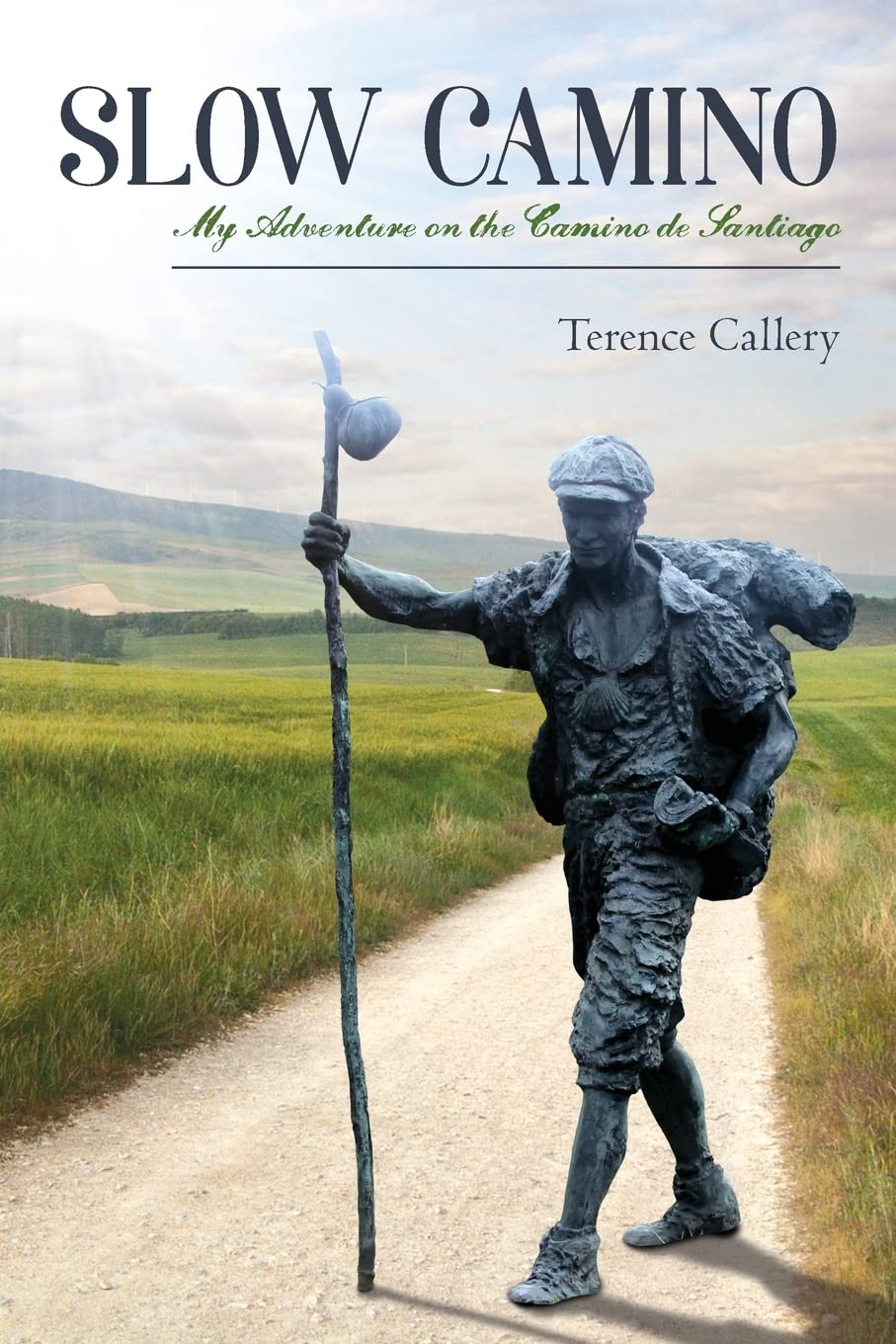



"A marvelous reflective meditation!""The ending is superb."At 63 years of age, Terence Callery sets out on a personal quest to conquer the grueling 500 mile Camino de Santiago pilgrimage which ends at the tomb of St. James the Apostle in northwest Spain. After months of preparation, including daily three-hour training walks on coastal Maine roads near his home, he arrives in the spectacular Pyrenees Mountains. By the time he reaches Pamplona on the third day of his seven-week spiritual journey, he empties his backpack of several pounds excess belongings and begins the pilgrim’s fearless exercise of also shedding psychological baggage along the way. The author spins the riveting tale of two odysseys taken in tandem; one is the story of a walking meditation where he learns to live more in “the infinite moment” and the other is a well-researched and detailed account of the geography, history, and culture that he encounters on the Route Frances of the Camino de Santiago. He finds his fellow pilgrims to be profoundly open and the impactful and often humorous dialogue with his walking companions acts as a microscope revealing the intimate inner universal voyage they are taking together. He writes of the deep sense of place he experiences as he walks along Roman roads, sleeps in a 12th century monastery, visits massive Gothic cathedrals, and walks in the foot steps of Charlemagne, Dante, Queen Isabella and Saint Francis of Assisi. By the time he reaches the Rioja wine-growing region, he has learned to Chi walk. Walking correctly aligned and in balance, he slows down his pace to conserve energy so that he can walk all day. The author is taking a decidedly Zen approach to Christianity’s most important pilgrimage. The Camino becomes a metaphor for life’s journey and he begins to think of this approach as “Slow Camino”. “It is not a race to the end but rather it is about finding the ‘Easter eggs’ along the way.” And so he takes time to stop and to visit the magnificent Cathedral in Leon and Gaudi’s Bishop’s Palace in Astorga. He gets off the Camino route to find regional foods such as octopus-- and to find upgrades in hotel, pension and casas rurales accommodations. Finally after the difficult walking through the wheat fields of Spain’s bread basket, he arrives in the mountains of Galicia, his favorite section of the journey. Mr. Callery was educated by Benedictine monks before going to Yale where he received a Bachelor of Arts in philosophy. He had a long career in Maine's aquaculture industry before starting an alpaca farm. Book Review for Slow Camino from The Free Press: There are several major categories of books written about walking the Camino de Santiago, or the Way of St. James, a network of ancient pilgrim routes stretching across Europe for roughly 500 miles, from St. Jean Pied de Port in France, through the Pyrenees Mountains to their final destination, the tomb of St. James in Santiago de Compostela in northwest Spain. One category is the guidebooks that discuss what to bring and where to stay, including some with suggestions for those traveling by bicycle. There's even a 2017 version of a 12th-century guide for pilgrims -- possibly the earliest travel guide ever written -- a translation of the "Codex Calixtinus," originally published in Latin. Another division of books covers subjects of interest along the routes: sundials of the Camino, flowers of the Camino, architecture of the Camino, etc. And, because of the original religious impetus driving the pilgrims, many Camino books cover the spiritual journeys of the pilgrims through the ages, right to the present day. So while the majority of Camino literature is either nuts-and-bolts guidebook or introspective memoir, Terry Callery's recent release, "Slow Camino: My Adventure on the Camino de Santiago," is a surprisingly adroit combination of the two, guidebook and spiritual memoir, that ambles and trudges along the winding roads until a late reveal in the story -- it comes on page 125 of a 159-page book -- makes the reader suddenly rear up and mentally say, "Whoa! Didn't see that one coming." The idea of traveling the Camino came to Callery after seeing the 2011 film "The Way," in which Martin Sheen plays the part of a doctor whose son is killed while in the midst of the pilgrimage and continues the walk in his son's honor. I've seen the film, which is very Hollywood but still compelling, certainly enough to inspire anyone at a crossroads in their life, and more than enough for someone who, like Callery, was educated by Benedictine monks and received a bachelor of arts degree in philosophy from Yale. Callery calls his work "Slow Camino" because he takes his time on the trip, several weeks more than most pilgrims spend, making of it a walking meditation. He includes interactions with other pilgrims from the world over, depictions of his surroundings and a good bit of introspective musing. Callery has the ability to draw the reader in and keep thing