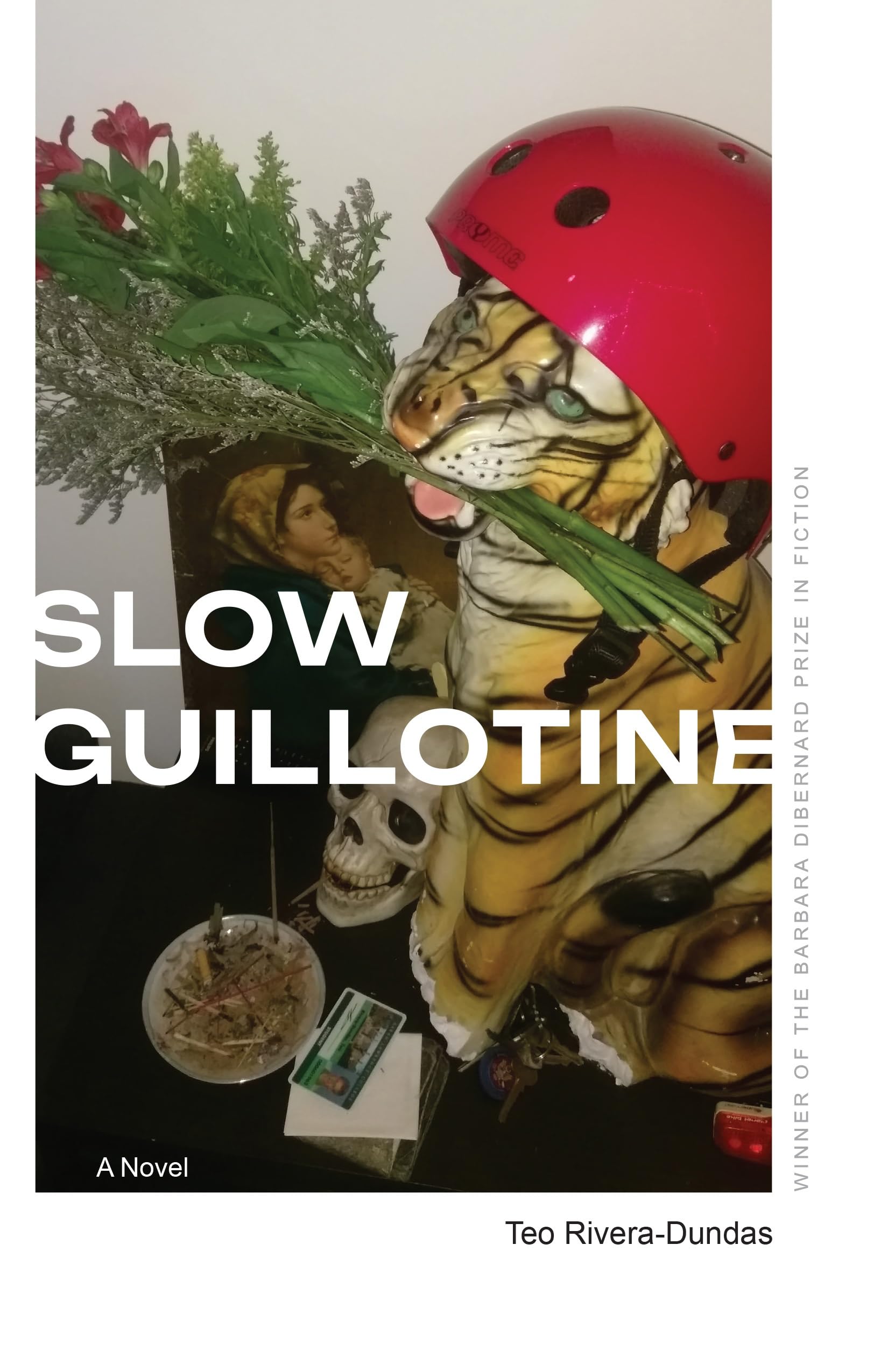



Winner of the Barbara DiBernard Prize in Fiction Slow Guillotine follows three broke weirdos whose collective desire to make and think about art is constantly interrupted by their art-industry-adjacent minimum-wage jobs. Throughout the novel, the three friends’ day jobs in a failing independent bookstore, a sterile gallery in downtown Manhattan, and miscellaneous living rooms across the Long Island birthday-party-clown circuit interweave with their attempts to come to terms with their precarity, gender-dysphoric embodiment, and the floating dream of collective liberation. Spanning one year and told through an obsessive first-person present tense, Slow Guillotine brings the bildungsroman structure through the autofictional looking glass, questioning how “coming of age” could be feasible in a society of debtors, wage laborers, and renters. “ Slow Guillotine ’s subversive, heat-seeking pulse is defiantly pro-ennui, embracing projectile vomit and the thing we want most besides love, that is―language at the very edge, and the shedding of our perpetually too-snug skins.”―Jess Arndt, author of Large Animals: Stories “An incisive, fluid, and absurdly funny portrait of both the bookselling industry and of what it’s like to try to piece a life together in Manhattan while young(ish) and poor. Whether talking about book-return scams, clowns, social media, cooking, the awfulness of searching for an apartment, tattooing, or pop-ups, Slow Guillotine is sharply observant as it eviscerates the movie myth of New York and replaces it with something less romantic but much more real, current, and painfully hilarious.”―Brian Evenson, author of Song for the Unraveling of the World “Teo Rivera-Dundas makes the banal shine brilliantly―because when you’re young and in New York, geared with friendship, queerness, and art, even the most mundane trivialities can turn into bold misadventures. Slow Guillotine is a tender, slithering threat: hope hovering, ready to strike.”―Lily Hoang, author of A Bestiary Teo Rivera-Dundas is a writer in western Massachusetts. His work has received support from the Wassaic Project, Anderson Center at Tower View, California Institute of the Arts, and the University of California, San Diego. His writing has appeared in Gulf Coast , Meridian , Tupelo Quarterly , and Desperate Literature’s annual Eleven Stories anthology, among other publications. Ten Notes about Work before We Can Get Started 1. Here are the types of packing material: bubble wrap, butcher paper scraps, wiggly cardboard scraps, packing peanuts (blue polystyrene), packing peanuts (biodegradable thermoplastic starch, a corn derivative, edible), and weird bone-or meat-cross-section-looking cardboard chunks. Also there’s the filler Hachette Book Group sends with their cookbooks, a solid foam in the perfect negative space shape of whatever was―or wasn’t, I guess―in the box. These are uncanny, art object-type pieces, basically useless unless you’re prepared to pack an outgoing shipment the exact size and shape of the negative space foam. We throw this (nonbiodegradable, immortal) foam away, and try not to think about it. Hachette happens to be the least evil of the five big publisher-distributors, apart from their use of hyperobject packing filler. I learn this from Dima. HarperCollins is owned by Rupert Murdoch, Simon and Schuster is Viacom, Penguin Random House is an endlessly consumptive monopoly blob, and Macmillan Publishing Services is some inscrutable British company that Dima tells me has ties to weapons manufacturing. Is this actually true? I don’t know. 2. I really like books. Ford hired me for the receiving room after I told him so. I wanted to work the sales floor, as a regular bookseller, but the back room had an opening and I needed the job. Now I internalize corporate gossip, shipping and receiving jargon―I guess knowing all this can become a kind of skill, or hobby, eventually, too. 3. Within the packing material, the book. Beyond the receiving room, the bookstore. 4. Today, it’s me and Arthur. Arthur is singing. I grip the tape roller with both hands. He sings, but his voice has nowhere to land. It rummages through the receiving room and crashes, flailing, onto the floor. I grip the blue plastic handle of the tape roller, which is indented at the fingers, with both hands. {~?~: Repetition of “with both hands” intentional? Or consider cutting the first sentence and retaining this one.}{~?~: yes, intentional! } The in-progress box I hold between my legs. My feet I plant on the floor, knees buckling against the standing desk. The sound made by the tape roller as it peels over a cardboard box’s two central flaps. The long pull of plastic, then a rip. Arthur shelves the returns. Music plays over his singing. The two songs―one from the speakers above my computer and the other issuing out of Arthur’s mouth―have, as far as I can tell, decoupled. I finish the last box and heave it to the top of its pile.