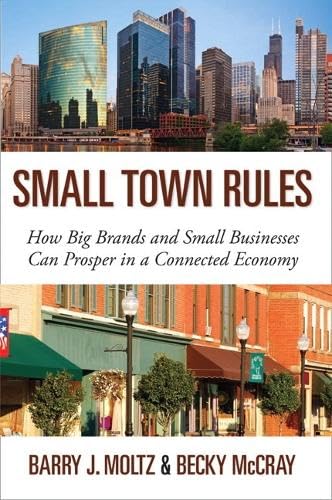
Small Town Rules: How Big Brands and Small Businesses Can Prosper in a Connected Economy (Que Biz-Tech)
$17.50
by Barry J. Moltz



Technology and economics are transforming business in a completely unexpected way: suddenly, even the largest companies must compete as if they were small, local businesses. Suddenly, your customers can talk to everyone else across the nation, and people listen to them, not your carefully crafted advertising or branding. It's just like doing business in a small town, where "reputation is forever." Suddenly, communities and personal connections are critical to your success - just as they've always been in small towns. The best small-town and rural entrepreneurs have been successfully overcoming these challenges for centuries. Their lessons and techniques are suddenly intensely valuable to even the largest companies, most dominant brands, and most cosmopolitan businesses. Small Town Rules adapts these lessons and techniques for today's new "global small town": one knitted together through the Web, Facebook, and Twitter. Two pioneering entrepreneurs and social media experts show how to: * Survive seasonal cycles and year-to-year fluctuations the way rural farmers and businesses do * Use "small town entrepreneur secrets" for coping with limited access to people and capital * Reduce risk by "piecing together" multiple income sources * Start using customer-driven communication to your advantage * Interact with customers on a more human scale, no matter how big you are * Rediscover your company's local roots, and more Named one of the Best Small Business Books Published in 2012 by the National Federation of Independent Business. Named a Winner in the 2013 Small Business Book Awards by Small Business Trends. Who Should Read Small Town Rules Big Brands and Urban Businesses: Small Town Rules was written to help large brands and urban businesses that are struggling with the uncertain economy, radical changes in technology, and seismic shifts in society. Today, brands find themselves trying to compete for local customers, while being bombarded by inbound messages from consumers and fans, while also coping with drastic changes in revenue. Small town businesses have been juggling this set of challenges for decades. Small towns become the learning labs for business today. - Small Business Owners: Because Barry and Becky are both entrepreneurs, Small Town Rules addresses the challenges of small businesses, no matter how urban or sophisticated. Special resources address small business, and the Appendix includes small business ideas that were inspired by the Small Town Rules. Special Features Small Town Rules contains some things different from most books. Between chapters, Powerhouse Small Town Brands are profiled, including L.L. Bean, Walmart, Winnebago Industries, and Viking Range. - To help readers implement the ideas, an appendix of Resources includes specific tools, references and links for each small town rule. - An appendix of Business Ideas Inspired by the Small Town Rules profiles more than 20 different business ideas. Businesses of any size can use these ideas for expansion, innovation or to change the game. Technology and economics are transforming business in a completely unexpected way: even the largest companies must compete for customers as if they were small, local businesses. Your customers are talking to their peers everywhere--and listening to each other, not your carefully crafted advertising or branding. Suddenly, communities and personal connec¿tions are critical to your success. It’s just like doing business in a small town, where “reputation is forever.” Great small town and rural entrepreneurs have been successfully overcoming these challenges for centuries. Their solutions have become invaluable to even the largest companies, most dominant brands, and most cosmopolitan businesses. In Small Town Rules , Barry J. Moltz and Becky McCray show how to adapt proven “rural” and “local” approaches for today’s new “global small town”: one knitted together through the Web, Facebook, and Twitter. You won’t just learn why these techniques are so valuable; you’ll learn how they’re being applied right now by companies like L.L. Bean, Viking Range, and Walmart. • Going local, even when you’re global A seven-step plan for building crucial connections with culture and place • “Planning for zero”: surviving worst case scenarios that kill your competitors Questioning hidden assumptions, knowing your “seasons,” and investing for the long term • Sustaining profits and growth with limited resources “Rural-style” approaches to growth and profitability in resource-constrained environments • Adapting to the new economic realities of self-reliance Marketing and managing when there won’t be any bailouts or safety nets Small Town Rules • You now compete in one “global small town,” where all your customers can talk directly to each other, wherever they are • Local community and individual human voices matter most • Your personal reputation counts for more than your marketing, size, or r