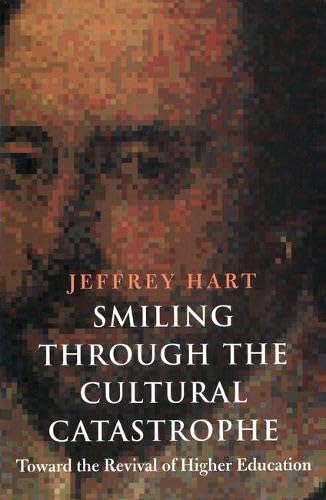
Smiling Through the Cultural Catastrophe: Toward the Revival of Higher Education
$32.95
by Jeffrey Hart



Although the essential books of Western civilization are no longer central in our courses or in our thoughts, they retain their ability to energize us intellectually, says Jeffrey Hart in this powerful book. He now presents a guide to some of these literary works, tracing the main currents of Western culture for all who wish to understand the roots of their civilization and the basis for its achievements. Hart focuses on the productive tension between the classical and biblical strains in our civilization-- between a life based on cognition and one based on faith and piety. He begins with the Iliad and Exodus, linking Achilles and Moses as Bronze Age heroic figures. Closely analyzing texts and illuminating them in unexpected ways, he moves on to Socrates and Jesus, who "internalized the heroic," continues with Paul and Augustine and their Christian synthesis, addresses Dante, Shakespeare (Hamlet), Molière, and Voltaire, and concludes with the novel as represented by Crime and Punishment and The Great Gatsby. Hart maintains that the dialectical tensions suggested by this survey account for the restlessness and singular achievements of the West and that the essential books can provide the substance and energy currently missed by both students and educated readers. According to Hart (English, Dartmouth Coll.), the interaction between Athens and Jerusalem, between philosophical-scientific ideas and scriptural-moral thought, has made Western civilization unique. Similarly, the literature of Western civilization from the Iliad and Exodus, to the Divine Comedy and Hamlet, and on to Crime and Punishment and The Great Gatsby has continued this "dialectical tension," the melding of these two seemingly opposite premises. Hart believes that it is imperative that college students continue to study Western civilization and its literature but asserts that more and more institutions of higher learning have pushed such courses aside, favoring the more politically correct concept of multiculturalism. Hart's ideas aren't necessarily new, but his call to arms is justified. Studying the dichotomy between Athens and Jerusalem forces us to examine not only other cultures but also our own prejudices. The tension created between intellect and faith, Hart rightfully suggests, aids freedom and democracy. Primarily for academic and larger public libraries. Terry Christner, Hutchinson P.L., KS Copyright 2001 Reed Business Information, Inc. Not all academics are riding the wave of multiculturalism. Hart, professor emeritus at Dartmouth, stubbornly holds out for the primacy of Western culture. To justify his intransigence, he invokes the distinctively Western tension between Athens and Jerusalem, between rationality and faith, which has fostered in Western culture an artistic and political dynamism found nowhere else. Wearing his erudition with the ease of a senior scholar, Hart first establishes how the dialectic between the classical and biblical strains of Western culture began, Achilles' wrath against the Trojans answering to Moses' defiance of the Egyptians. He then plumbs the imaginative significance of this dialectic in Western literature, from Augustine's Confessions to Fitzgerald's Great Gatsby . Though daring in its sweep, Hart's synthesis leads readers not toward new and original insights, but rather back to valuable old ones, now catastrophically neglected. In predicting that academe will soon shake off the ideologies regnant since the 1960s, Hart may be indulging in wishful thinking. But if his prediction does prove correct, no book will offer more help in guiding the project of cultural reclamation. Bryce Christensen Copyright © American Library Association. All rights reserved "Hart's broad perspective gives his book a richness and depth seldom seen in literary criticism these days." -- Paul Cantor, University of Virginia "[N]o book will offer more help in guiding the project of cultural reclamation." -- Bryce Christensen, Booklist Hart energetically pursues central Western insights. . . [with]. . . dazzling cultural commentary along the way. Abandon all hopelessness ye who enter here. -- Robert Royal, Weekly Standard Jeffrey Hart is professor of English emeritus at Dartmouth College. The author of many books, he is also senior editor for the National Review.