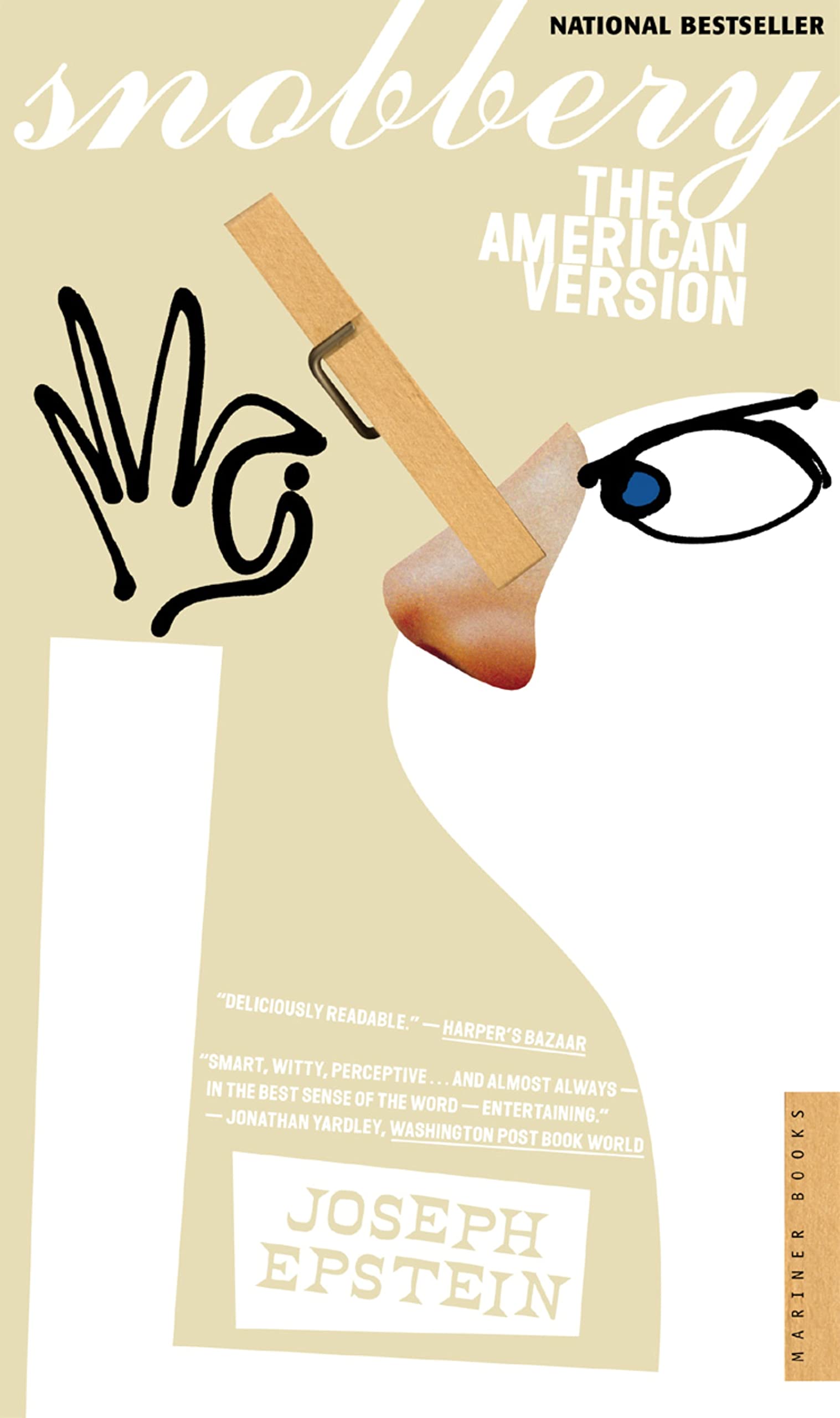
Snobbery: The American Version – The National Bestseller Skewering Elitism in Food, Fashion, and Politics
$10.60
by Joseph Epstein



A national bestseller, Snobbery examines the discriminating qualities in all of us. With dishy detail, Joseph Epstein skewers all manner of elitism in contemporary America. He offers his arch observations of the new footholds of snobbery: food, fashion, high-achieving children, schools, politics, being with-it, name-dropping, and much more. Clever, incisive, and immensely entertaining, Snobberyexplores the shallows and depths of status and taste -- with enviable results. "[SNOBBERY is] like a chorus line of wonderful observational one-liners . . . All these gems add up to a fun and funny read." --Joan O'C. Hamilton Business Week "[SNOBBERY] is a captivating jeu d'esprit of a book, one that brims over with illuminating perceptions . . ." --Daphne Merkin Elle "It's hard to criticize a writer who can make you laugh out loud on every third page . . ." --Martha Bayles The New York Times Book Review "[E]ngaging . . . Epstein [is] one of America's best essayists . . ." --Richard Stengal Time Magazine ". . . [W]onderfully engaging . . . marvelous . . ." --David Brooks The Wall Street Journal ". . . [Epstein] has a wickedly wonderful sense of humor and keen observational skills . . ." Publishers Weekly "A deliciously readable analysis of the origins of snobbery and its myriad cultural manifestations . . ." Harper's Bazaar JOSEPH EPSTEIN is the author of the best-selling Snobbery and of Friendship , among other books, and was formerly editor of the American Scholar . His work has appeared in The New Yorker , Harper’s Magazine , the Atlantic Monthly , and other magazines. He lives in Evanston, Illinois. Snobbery The American Version By Joseph Epstein Mariner Books Copyright © 2003 Joseph Epstein All right reserved. ISBN: 0618340734 Excerpt 1 It Takes One to Know One Rather than imply his superiority to his subject, the author of a book about snobbery ought to set out, fairly briefly, his own experience of snobbery. He ought to let his readers know if he has been a victim of snobbery, and of the sorts of snobbery to which he is susceptible, to allow them to judge his own relationship to the subject. Perhaps the best way for me to begin, then, is to explain my social origins. These are a bit complicated. They seem to have been culturally lower middle class but with middle- and, later, upper- middle-class financial backing. Neither of my parents went to college. My father, growing up in Canada, in fact never finished high school; my mother took what was then known as "the commercial course" at John Marshall (public) High School in Chicago. They were both Jewish, but, against the positive stereotype of Jews loving culture and things of the mind, my parents had almost no cultural interests apart from occasionally going to musical comedies or, in later years, watching the Boston Pops on television. Magazines — Life, Look, later Time — and local newspapers came into our apartment, but no books. I don"t recall our owning an English dictionary, though both my parents were well spoken, always grammatical and jargon-free. Politics was not a great subject of family conversation. The behavior of our extended family and neighbors, money, my father"s relations with customers at his business, these made up the main conversational fare — unspeculative, nonhypothetical, all very specific. Education was another subject of little interest; no time was spent, say, discussing the differences between Amherst and Williams colleges, for the good reason that neither of my parents had ever heard of such places. My father, I believe, hadn"t a speck of snobbery. It would not have occurred to him to want to rise socially in the world, and the only people he looked down upon — apart from crooks of one kind or another — were people who seemed to be without the ambition to take measured risks in business. We had a distant cousin who was a lieutenant colonel in the U.S. Army, and my father was baffled by the notion of a Jewish man settling for a career in the regular army. It pleased my father to give ample sums to charities (many of them Jewish charities) and, in later years, to travel to foreign countries — once, with my mother, to Paris on the Concorde and back from London on the QE2. Above all, it pleased him to have made enough money to help out his family and be able to establish his financial independence, which he did at the age of seventeen. But he barely acknowledged the social realm in which snobbery takes place. For him the world of status, where style, rank, and social climbing were central, was a mystery he felt no need to fathom. My mother, though no snob either, had a greater awareness of snobbery. She was on the alert for snobberies used against her, and could be vulnerable to them. In her friendships she sought out women who were goodhearted, for she was goodhearted and generous herself. She also had an unashamed taste for what, by her standard, p