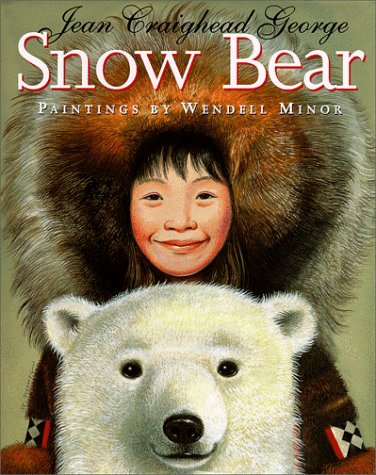



Bessie and a polar bear cub named Snow Bear play on the ice, while her older brother and the mother bear watch to make sure that everyone is safe Kindergarten-Grade 2 A ship-shaped upthrust of ice entices Bessie to pull on her parka and set off for imaginary voyages. She encounters Snow Bear, a polar bear cub, and they become instant companions, frolicking happily in the Arctic snow. Watched over separately by the cautious mother bear, Nanuq, and Bessie's wary older brother Vincent, the little ones enjoy one another's company until a large male bear appears. His predatory intrusion sends Bessie and Vincent off toward home, and Nanuq and Snow Bear to safety in another direction, while the great ice "ship" slips into the sea. The simple, pleasing text is accompanied by luminous watercolors that faithfully record this charming (if improbable) chance meeting. The pictures are brilliantly colored, detailed even to depicting frosty breaths among the icy blues, frigid greens, and snowy whites, with the two Inuits as rich dark spots in the landscape, in their beautifully decorated fur parkas. While the story calls to mind Robert McCloskey's Blueberries for Sal (Viking, 1948), Bessie and Snow Bear's delightful meeting stands foursquare on its own booted feet (or furry paws). Patricia Manning, formerly at Eastchester Public Library, NY Copyright 1999 Reed Business Information, Inc. This arctic encounter between a polar bear cub and an Eskimo child carries echoes of Robert McCloskey's Blueberries for Sal . Young Bessie Nivyek and little Snow Bear meet by chance on an upthrust crag of ice and proceed, under the watchful eyes of mother Nanuq and Bessie's brother, Vincent, to slide and tumble gleefully together. The adventure ends suddenly when a big, dangerous male bear appears; although the scent of Vincent's rifle sends it retreating into the water, the playmates part company to rejoin their respective caregivers. Gorgeously ruffed and decorated, the humans' parkas stand out with eye-catching brilliance against muted, blue-green backgrounds, and although Snow Bear's apparent smile in response to Bessie's grin is an anthropomorphic touch, the evident delight that the pair take in each other's presence creates a special warmth. Pair this with other tales of people and wild creatures displaying parallel behavior, such as Nancy Luenn's Otter Play (1998). John Peters PLB 0-7868-2398-4 In this sweetly sentimental story set in the frozen twilight of an Arctic spring, George (Morning, Noon, and Night, p. 699, etc.) tells of an Inuit girl who goes out to hunt. Bessie Nivyek sets out with her big brother, Vincent, to hunt for food; in a twist out of McCloskey's Blueberries for Sal, Bessie bumps into a young bear, and they frolic: climbing, sliding, somersaulting, and cuddling. Vincent spies the tracks of his little sister and follows, wary of the mother bear; the mother bear is just as wary of Vincent. Out of the water rears danger to both the child and cuba huge male polar bear. The mother bear warns her cub; it runs away, as does Bessie. Brother and sister head back home, ``to eat, go to school, and learn the wisdom of the Arctic like Eskimo children do.'' The brief text is lyrical and the illustrations are striking, with an impressively varied palette of white, in blue, green, yellow, and gold. Children who note that Vincent goes home empty-handed will wonder why he didn't hunt any of the polar bears that were within range. While children will enjoy this romantic view of Bessie and the bear, those seeking a more realistic representation of life in this harsh environment will be unsatisfied. (Picture book. 5-8) -- Copyright ©1999, Kirkus Associates, LP. All rights reserved. Used Book in Good Condition