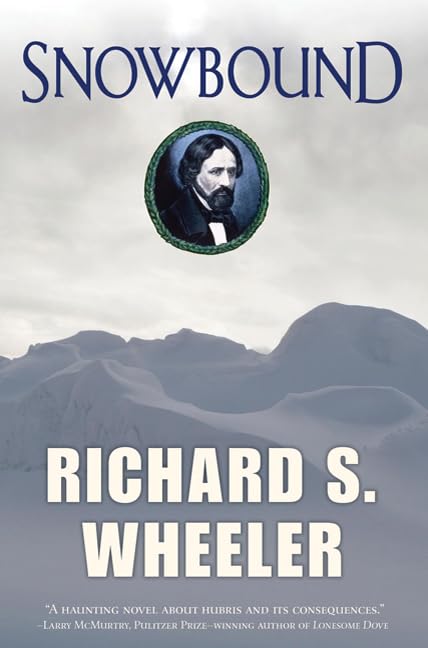



In this powerful biographical novel, Richard Wheeler—winner of the Owen Wister Lifetime Achievement Award and five Spur Awards—tells the amazing tale of the American explorer and hero, John Fremont, and his attempt to find a railway route to the west along the 38th parallel. Trapped in the snowbound Colorado mountains, Fremont must fight his way out. He battles the frigid elements in a harrowing journey over the backbone of the continent. In this tale of desperate danger and fierce courage, Wheeler presents the reader with a survival saga par excellence—a struggle of man against man, man against nature, man against himself—and a novel you will never forget. John Charles Fremont (1813–90), the mathematics teacher, military man, presidential candidate, and explorer, lived a storied life. In this novel, Wheeler focuses on Fremont’s fourth expedition to forge a railway route along the thirty-eighth parallel, connecting St. Louis with San Francisco. Wheeler, who notes that accounts of Fremont’s life vary greatly, portrays the explorer as a deeply contradictory man: courageous but self-centered; remote but highly respected; reckless but methodical. Fremont’s fourth expedition was his most disastrous (several members of his team died), and Wheeler’s decision to concentrate on it, rather than an episode from Fremont’s military or political career, makes perfect sense: it allows the author to show us the man in all his mercurial glory, the famed explorer who will risk everything, including his own life, to break new ground. Good reading both for western-genre fans and readers of historical fiction. --David Pitt RICHARD S. WHEELER is the author of over fifty novels of the American West. He holds five Spur Awards and the Owen Wister Award for lifetime contributions to the literature of the West. He lives in Livingston, Montana, near Yellowstone Park, and is married to Sue Hart, an English professor at Montana State University in Billings. CHAPTER ONEJohn Charles FréMont General Kearny killed the baby. I would never say it publicly, but I knew right down to my bones that it was true. Jessie would come to it also; she thought that Benton was sickly because of the court-martial. Ten weeks was all the life allotted my firstborn, named after Jessie’s family. The ordeal in Washington City was more than Jessie could endure, and it afflicted the child she was carry ing, and now the bell tolls. Stephen Watts Kearny and his cronies brought the charge, mutiny and disobedience in California; put me and my family through the ordeal; and triumphed. He who was a friend of the Bentons, supped at their table, could not contain a raging envy of me, and now the bell tolls. Benton was a sickly infant, delivered by a worn woman, though Jessie was but twenty-four. Even Kit Carson, almost a stranger to children, said as much. He had visited Jessie in Washington only a few weeks ago, having completed his courier duty for the army, and thought that Benton would not live long. I watched the pewter river slide past in the dawn. We were aboard the Martha, plying its slow way to Westport from Saint Louis. Most of my men were there, awaiting me, receiving and guarding the expedition’s materiel and mules. I didn’t much care to go on this expedition. It would not be the same. A great weariness has afflicted me ever since the verdict—no, ever since General Kearny marched me to the States as the rear of his column, in disgrace. I had read in the press that I have changed: “Colonel Frémont looks weary and gray since his ordeal,†according to all reports. I have not changed and nothing bends me, and soon the republic will see what I am made of. The army will see what I am made of. So will President Polk. And their brown claws will not touch me this time. The Martha vibrated more than most river packets do, and I wondered if Captain Rolfe knew his main bearings were out of true. The hooded shores, heavy with mist-shrouded trees wearing their yellow October colors, slid by. I would need to talk to Rolfe; I would need to help Jessie out of her world and into the real one. I had left her in the gloomy stateroom, sitting in her ivory nightclothes on the bunk, crooning to Benton at her breast. The boy was dead. Sometime in the small hours his weak heart had failed. Kitty, her colored maid, had discovered it. Now the infant hung limp in her arms, while she whispered and sang and clutched the still, cold infant. I would have to disturb her. It is not in me to flee from any duty. I retreated from the deck rail and entered our dank stateroom. Jessie sat on the edge of the bunk, rocking softly, the child still clamped to her breast. She eyed me, and then the shadows, where Kitty sat helplessly. “Jessie, it’s time to let go.†She nodded. “He’s dead, I know.†“Yes. May I take him?†“I had him for such a little while.†But she handed the cold infant to me. It didn’t resemble anyone I knew. I stood, holding it. She turned awa