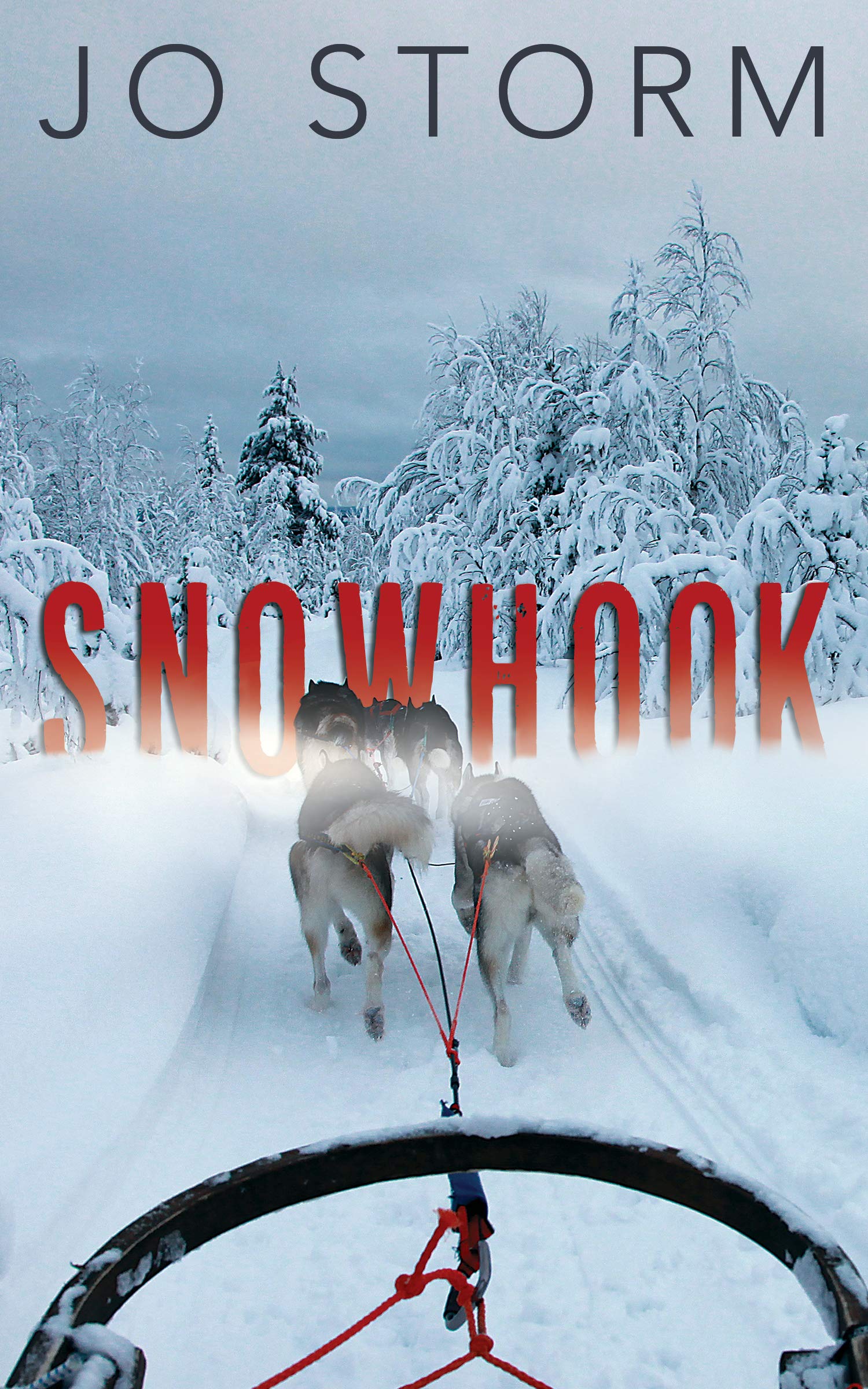



Hannah must rely on her survival instincts to endure a brutal ice storm and save her family. At first, when a massive ice storm traps fourteen-year-old Hannah and her family in a remote cabin, it feels like a game to practise the survival skills she's been learning. That all changes when an accident leaves her mother desperately low on insulin. With no power and no way to contact the outside world, Hannah steals away with the four family dogs tied to an old dogsled. All she has to do is make it to the nearest cabin and find a working phone to save the day. But a wrong turn and worsening weather leave her in grave danger and saddled with an unexpected passenger. Hannah must use all her skills and resourcefulness to get help for her family ― before they all freeze to death in the wilderness. ✭ Storm amazingly creates a complex story with strong, complex characters set in her native northern Ontario. Readers will feel the cold, as well as Hannah's fear and determination, ensuring they are riveted until the last page. ― Booklist (starred review) Storm's novel is fast paced and engaging, with a realistic plot that is not always seen in other YA survival/adventure novels. While Hannah starts off as immature, she grows in a realistic character arc and has a believable amount of skill and knowledge given the plot circumstances. Storm also balances descriptions of Northern Ontario, background information on running a sled dog team, and plot well enough for readers to be engaged and informed. Recommended for fans of adventure and survival fiction. ― School Library Journal Anything that could go wrong does, but Hannah keeps moving forward in a learn-as-you-go adventure ― Kirkus Reviews The author does a good job of creating conflict and tension… kids will definitely appreciate the unexpected dangers that [the characters] face and their ability to think on their feet. Recommended. ― CM: Canadian Review of Materials Jo Storm is a writer, dog trainer, and dogsledder. She has trained dogs in agility, competitive obedience, and scent detection. She lives in Sudbury, Ontario. Chapter One Hannah’s parents would not let her go to town. It was barely a town anyway, Timmins. It was so far from Toronto that her friends would ask her, “Didja see Santa?” every time she came home. Timmins was essentially a crappy mall, a hospital, and a bus station. At eight, she hadn’t cared; at ten, she couldn’t go to town without an adult; at fourteen, she couldn’t go because ― “Hannah,” called her father. He stood by the woodpile, removing his mitts and pulling a hatchet from his belt loop. “Give me a hand?” She went over and helped him lift the tarp that covered the kindling. It was birch kindling, the kind that smelled sharp and tangy when it burned, but the tarp had ripped overnight and now the wood was soaked and useless. Hannah looked up at the chimney stack that rose over the cabin. There was no smoke, but she could see waves of heat rising off the brick mouth. That meant the fire was burning well and they wouldn’t need kindling. “We’ll need more kindling,” said her dad. “Why? The fire’s already going. It hasn’t been out since we got here.” Hannah’s father looked at her with his Learning Face. That was what her younger sister Kelli called it, the Learning Face. It was a seriously annoying face. “What if we need a fire outside, to smoke fish?” he said. “Gross.” “What if we want to use the wood oven?” “What if we need to make smoke signals?” said Hannah sarcastically. “Hannah, don’t be smart,” said her father. “Look, I’m going to show you something.” He dropped the tarp, hooked the hatchet onto his belt, and put his snowshoes back on, stuffing his mitts in his pocket. She could see the nametag, “G. Williams,” that was sewn inside of them; hers said “H. Williams.” Hannah was already wearing her snowshoes, so she followed his wider tracks easily as he moved to the edge of the clearing where their cabin sat, past the tarpedover snowmobile and the SUV. They hadn’t brought the other vehicle; it was a car and would never have made it down the back roads to get here. Even in the summer, they always brought the four-wheel-drive vehicle. Her parents called this place “camp.” When she was younger, Hannah had fooled some of her friends by saying that she went “to camp” for almost every school vacation, but then stupid Kelli had blabbed and then everyone knew that it was just a cottage ― a three-room, dingy cottage with an outhouse in the backyard, on the edge of a smelly pond. They wended their way through the bush until they came to a little stand of poplar trees with a few frozen yellow leaves still clinging to them, almost hidden in the bigger, bushier arms of the blue spruce and waxy green hemlock. Her father looked up into the branches of the poplar. “These should work.” He reached up with one hand and grabbed a branch, and with the other he loosed his hatchet and chopped the branch off. He held up th