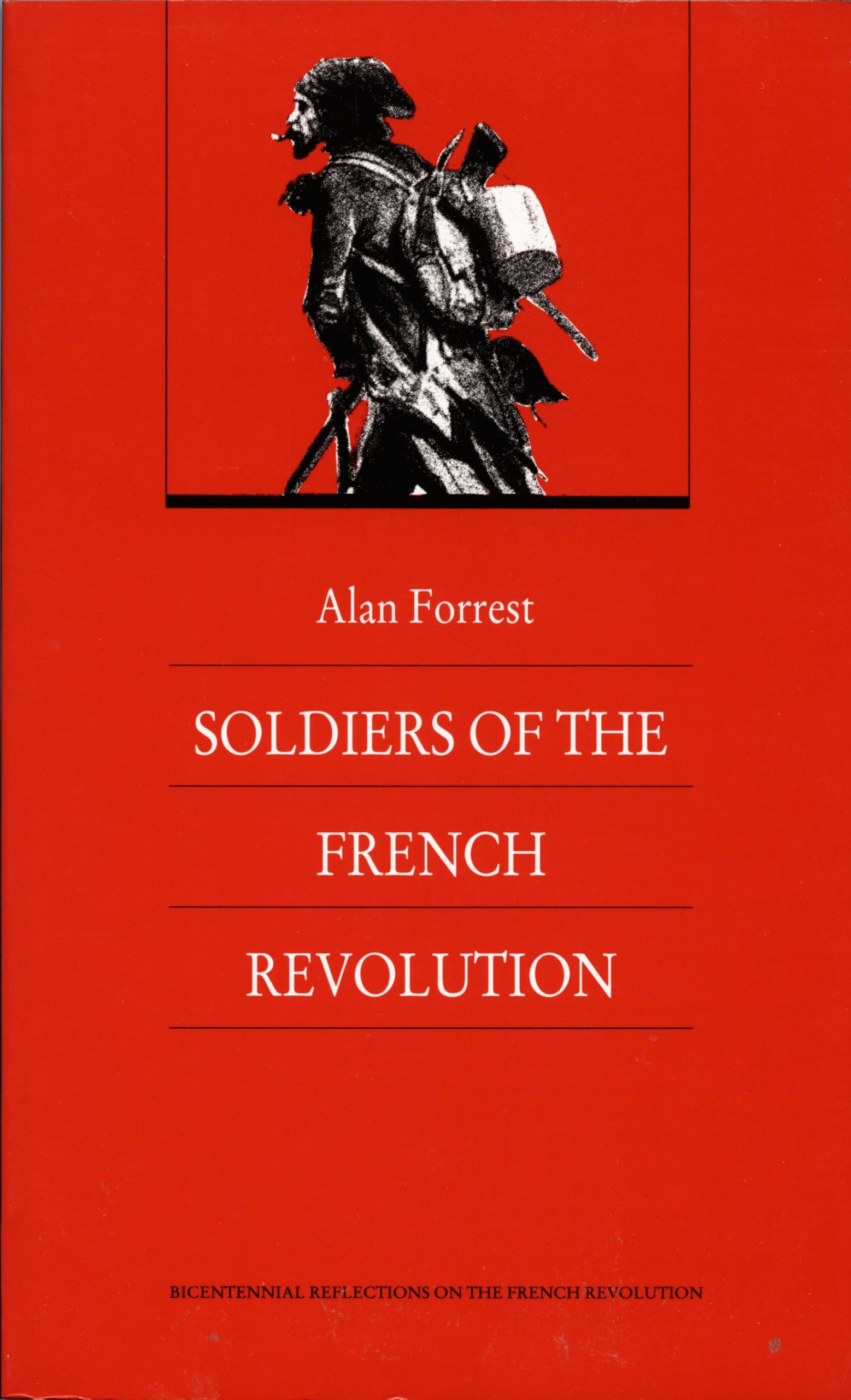
Soldiers of the French Revolution (Bicentennial Reflections on the French Revolution)
$30.95
by Alan Forrest



In this work Alan Forrest brings together some of the recent research on the Revolutionary army that has been undertaken on both sides of the Atlantic by younger historians, many of whom look to the influential work of Braudel for a model. Forrest places the armies of the Revolution in a broader social and political context by presenting the effects of war and militarization on French society and government in the Revolutionary period. Revolutionary idealists thought of the French soldier as a willing volunteer sacrificing himself for the principles of the Revolution; Forrest examines the convergence of these ideals with the ordinary, and often dreadful, experience of protracted warfare that the soldier endured. The Soldiers of the French Revolution By Alan Forrest Duke University Press Copyright © 1990 Duke University Press All rights reserved. ISBN: 978-0-8223-0935-2 Contents Acknowledgments, Editors' Introduction, 1 The Revolution and Its Soldiers, 2 Restructuring the Armies, 3 Recruiting the Soldiers, 4 Revolutionizing the Soldiers, 5 Providing for the Soldiers, 6 The Soldiers and Their World, 7 The Soldiers and the State, Conclusion, Notes, Note on Sources, Index, CHAPTER 1 THE REVOLUTION AND ITS SOLDIERS ON APRIL 20 1792, THE FRENCH GOVERNMENT DECLARED war on Austria and brought to an end a long period of uneasy coexistence between revolutionary France and the monarchies of Europe. It was to prove a momentous decision, affecting the domestic history of the French Revolution almost as crucially as it affected international relations throughout Europe. However confident contemporaries might be in predicting a speedy and successful outcome, this would not turn out to be a short war, to be won in a single glorious campaigning season. Hostilities were to last, virtually continuously, throughout the remainder of the decade, consuming an increasing part of the effort and resources of revolutionary governments and, in the process, changing the character of the Revolution itself. With the war came economic controls and special taxes, forced loans on the rich, requisitions of food and livestock, extensive recruitment, and finally annual conscription. Winning the war became, unavoidably, the major political priority of the day, with the result that other measures were dropped or distorted in order to provide for the armies. New levels of constraint and compulsion entered everyday life, often justified by military necessity or introduced as emergency expedients that must be endured for the duration of the war. Even political terror could be explained and popularized as an exceptional measure needed to ensure the success of French arms. In the process, the army itself gained new authority and status until, under the Directory, it came to represent an alternative focus of power to the constitutional government of the day and allowed Napoleon Bonaparte to launch his successful challenge on 18 brumaire. This book is not the place to consider in detail the military history of these years; others have done so, often at very great length. A general picture of the progress of the war is perhaps necessary, however, if only to provide a context for the social and political discussion that follows. The declaration of war in April 1792 was made in an atmosphere of some confusion, after months of saber rattling by both sides and amid bitter political disunity in France. Nor did the early news from the battle zones do anything to dispel that confusion. The first encounters were ominously unsuccessful for the French, deepening the political divisions within the country and increasing the levels of fear and panic that already existed among the population. Military defeats and indecisive campaigning during these early months convinced many that the Revolution was being deliberately undermined, that ministers and generals were betraying the trust placed in them, and that France was being projected on a path that would lead to humiliation and political chaos. A war that had been declared against Austria was extended to include the Prussians by early July; on July 11, the patrie was declared en danger; and during August French territory was invaded from both the North and the East. The revolutionaries who had launched the war with such confidence and bravado just a few months before were fighting for their very survival. Toward the end of 1792, it is true, the French armies staged a spectacular recovery, chased their enemies out of France, and were everywhere on the offensive—in the South they entered Nice and Savoy, in the East they attacked Mainz and Frankfurt, and in the North they had Brussels and Antwerp at their mercy. Two famous battles marked what many at the time saw as a great turning point in the war. At Valmy on September 19, the forces of Dumouriez and Kellermann used massed artillery to turn back the Prussians; and at Jemmapes on November 6, Dumouriez's army inflicted a