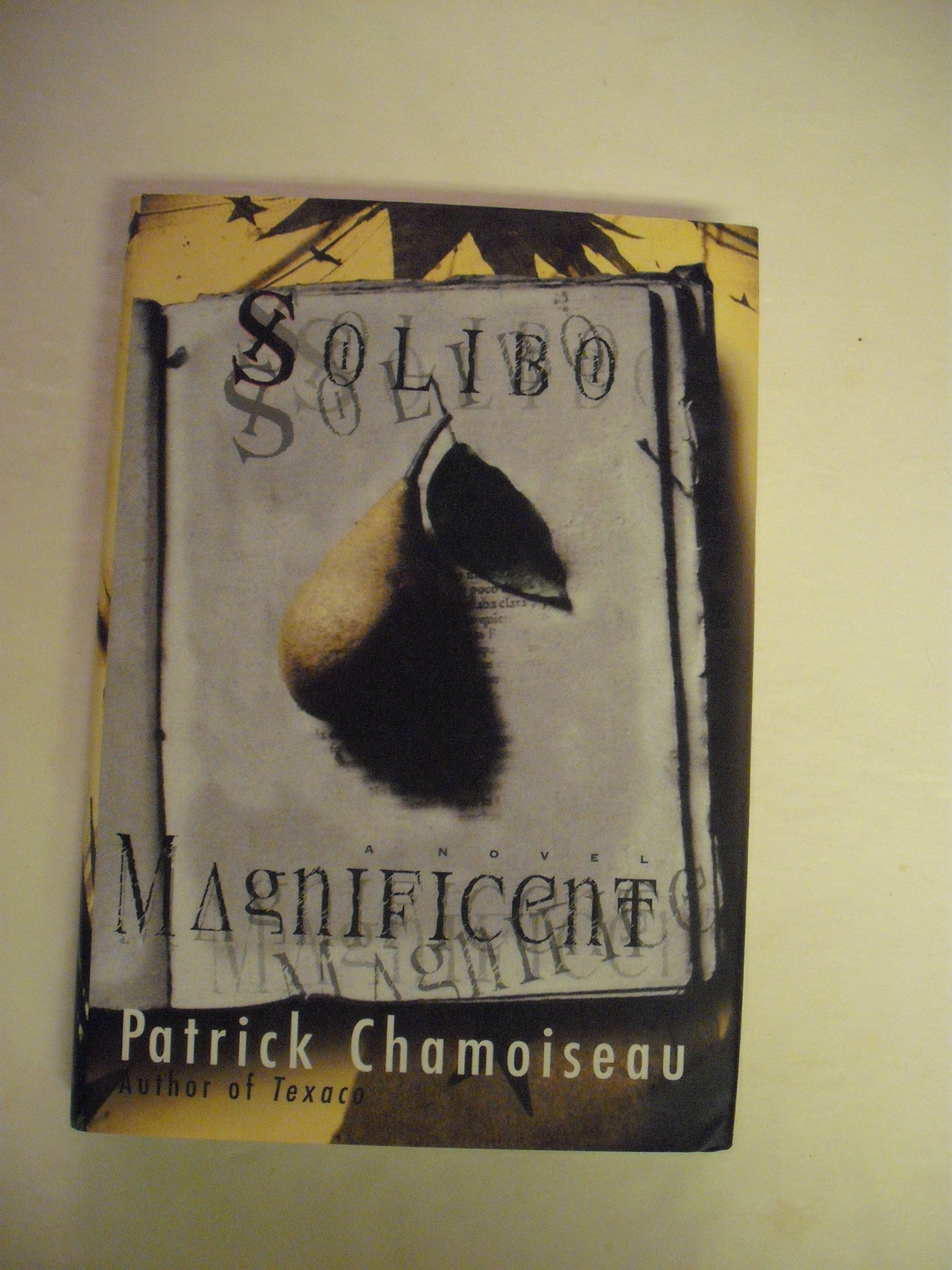



During carnival time in Martinique, a storyteller falls victim to a transitory underworld on the edge of oblivion When Patrick Chamoiseau, Martinican author of the brilliant, magical novel Texaco , turns his hand to writing a police procedural, you can be sure that the "usual suspects" won't be usual at all. In Solibo Magnificent the title character, a master storyteller, dies on the first page, having uttered the mysterious phrase patat'-si ("this potato"). Though it is evident to his Creole audience that Solibo's throat was "snickt by the Word," to the Fort-de-France police department it's a clear case of murder. Before you can say patat'-si , all the witnesses are in custody, where they are brutally mistreated in an attempt to wrest confessions from them. The first thing any reader notices about a Chamoiseau novel is the language (beautifully translated from the French by Rose-Myriam Réjouis and Val Vinokurov), which tends to tumble in cataracts of vivid imagery, almost as if it were being spoken instead of written. And given that this novel is really about the slow death of an oral tradition at the hands of a culture of literacy, the hurly-burly style is singularly appropriate. Though Solibo Magnificent can certainly be enjoyed simply as a tragicomic tale of mysterious death and police bungling, readers with even a superficial knowledge of Martinique's history as a French colony (and now departement ) will find plenty of philosophical gold in the deeper veins of meaning that lie beneath the surface of the novel. There is, for example, the conflict between the deeply rooted Creole culture--an orally transmitted tradition of stories, demons, magic, and community--and the imposed colonial system of logic, scientific proof, the written word, and French as the dominant language. In such a world, Solibo the storyteller cannot live, and Chamoiseau--himself a character in the novel--is fully aware of the irony of committing his tale to the page. As he says at the end of the novel, "I understood that to write down the word was nothing but betrayal, you lost the intonations, the parody, the storyteller's gestures.... I decided to squeeze out a reduced, organized, written version, a kind of ersatz of what the Master had been that night: it was clear now that his words, his true words, all of his words, were lost for all of us--and forever." Solibo's throat might be "snickt by the word," his "true words" lost forever, but fortunately Patrick Chamoiseau, the "word-scratcher," is still here to remind us of just how much we've lost. Was the Creole storyteller Solibo Magnificent killed by his own words or was he murdered by one of his friends? So begins Chamoiseau's (Texaco, Random, 1997) novel about the spiritual and political power of language. While frightened witnesses recount their memories of Solibo and the night he died, the ruthless and often brutal police attempt to solve the case neatly and logically. Their investigation, however, quickly degenerates into more violence and death. Originally written in Creole and French, the novel's depiction of the misunderstanding, distrust, and hatred between the French-speaking officials and the Creole-speaking residents of Martinique's slums is unfortunately lost in the English translation, in spite of an adequate explanation in the afterword by translator Rejouis. The characters are hidden in a confusing story that comes to a dry and unsatisfying conclusion, leaving the reader still wondering who Solibo Magnificent was and why he died. Recommended for libraries with a strong interest in Caribbean literature.?Ellen Flexman, Indianapolis-Marion Cty. P.L. Copyright 1998 Reed Business Information, Inc. It is carnival time in Fort-de-France, in Martinique, and Solibo Magnificent, master storyteller, holds forth, accompanied by a solo drummer, when suddenly he collapses, "snickt by the word" (choked by his words). A very odd death, so odd that it takes hours for his loyal following to discover that he is dead. What follows is a harrowing examination of the 12 witnesses, the author himself among them, by police, who insist on subjecting the death to an investigation based on nonexistent forensic evidence. Solibo's death signifies the end of a culture. Chamoiseau, winner of France's Prix Goncourt for Texaco , is a "word scratcher" extraordinaire and records the end of "Creole" culture, grounded in an oral tradition, in this hilarious story. Chamoiseau challenges readers with his liberal sprinklings of French and Creole expressions in his narrative, but a tiny glossary is appended and, besides, a little foreign language is good for us. This novel was among Chamoiseau's first published works and is clever, funny, and sad. Bonnie Smothers A captivatingly exotic earlier novel (written in 1988) by the Martiniquean author of the Prix Goncourtwinning Texaco (1993). As in that later book, Chamoiseau treats, with both rich humor and controlled fury, the imposition of F