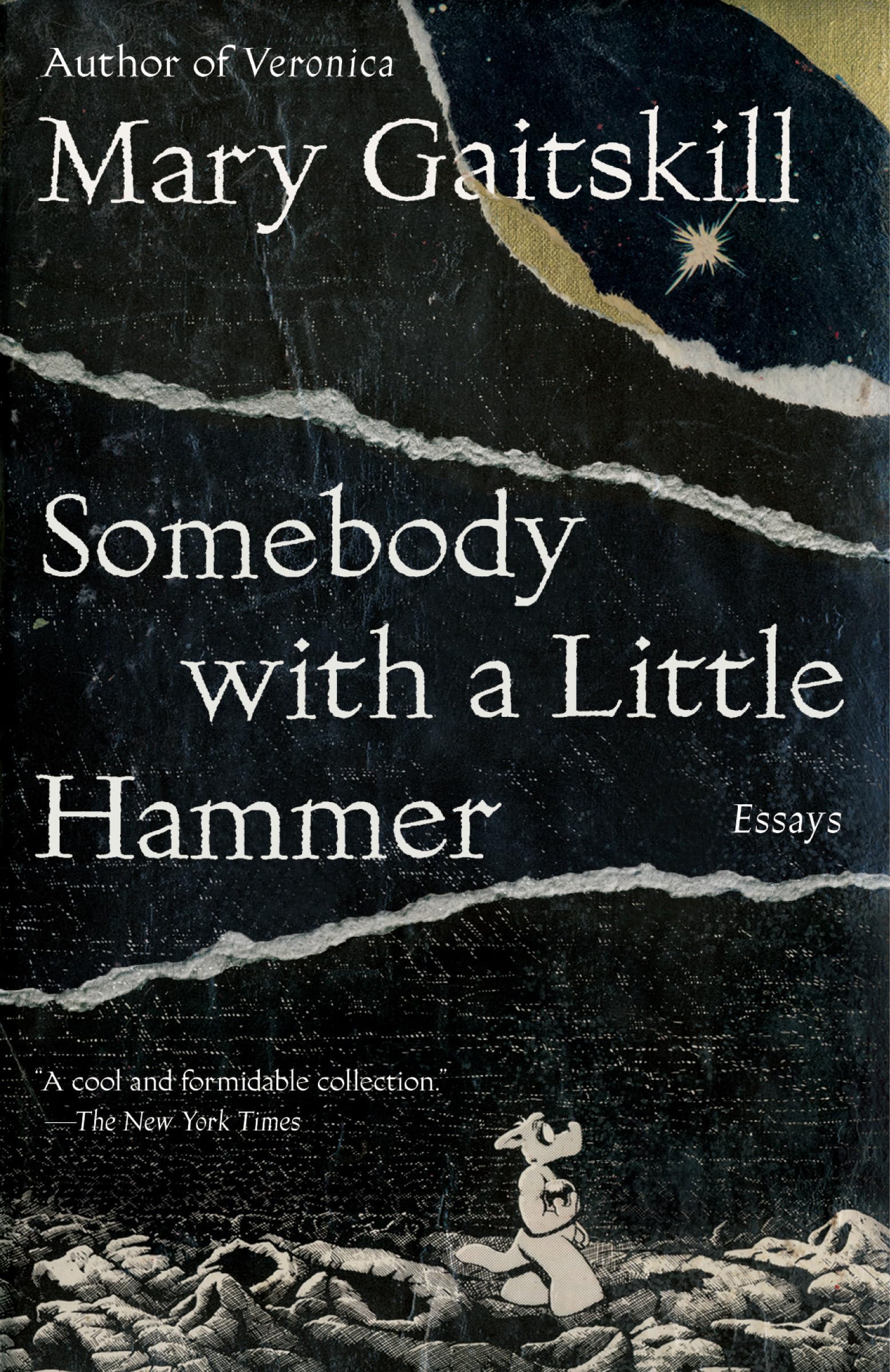



In essays on matters literary, social, cultural, and personal, Mary Gaitskill explores date rape and political adultery, the transcendentalism of the Talking Heads, the melancholy of Björk, and the playfulness of artist Laurel Nakadate. She celebrates the clownish grandiosity and the poetry of Norman Mailer’s long career and maps the sociosexual cataclysm embodied by porn star Linda Lovelace. Witty, wide-ranging, tender, and beautiful, Somebody with a Little Hammer displays the same heat-seeking, revelatory understanding for which Gaitskill’s writing has always been known. “A cool and formidable collection.” — The New York Times “Essential reading. . . . [Gaitskill] has a gift for traversing taboo territory with a subtlety that’s sometimes downright Jamesian, even if the shenanigans that catch her eye would have shocked the Old Master out of his wits.” — The Boston Globe “[Gaitskill’s] exceptionally discerning writings on women . . . make one wish she had (or even wanted) her own syndicated newspaper column.” — The New York Times Book Review “Gaitskill never fails to transport her reader . . . These essays not only embrace but define their subjects, making you rethink the way you interact with the things around you in a much more meaningful way.” — Newsweek “While Gaitskill is best known for her fiction, this collection demonstrates her power as an essayist, and thrums with the same sexual energy.” — The New Yorker “A beautiful, thought-provoking work [that] cements Mary Gaitskill as one of the sharpest critical thinkers and most important cultural critics of our time. . . . A deep-dive into everything from contemporary fiction to modern politics to American womanhood, [that] will shake you to your core.” — Bustle “If you have not yet worked through a thought with Gaitskill, Somebody with a Little Hammer is a primer. It makes entirely clear how seriously she takes the idea of fairness, in life and in fiction, and how averse she is to even the lightest thumb on the scale.” — Bookforum “Strewn with . . . pearls. . . . Readers of Gaitskill’s novels and short stories will recognize the shrewdness, and the themes.” — Harper’s Magazine “It feels refreshing to finally have a grownup in the room, laying down the law but not really caring whether you follow it or not.” — Boston Review “Gaitskill’s writing is somehow crucial in a way few of her peers can achieve. She says the things you didn’t know needed to be said until she says them, and only then do you know what you’ve been missing.” — The Buffalo News “When Gaitskill writes about any book, it’s a full-on contact sport, where the boundaries between her and the book are so fluid as to be barely there. . . . Immersing yourself in her world for a page or three has the bracing aliveness of throwing yourself into almost-freezing water.” — The Columbus Dispatch “The pages burst with insight and a candid, unflinching self-assessment.” — Publishers Weekly (starred review) “A voice of reason and sanity, of piercing intelligence and generous humanity.” — The Los Angeles Review of Books “The world is Mary Gaitskill’s nail in Somebody with a Little Hammer .” —Vanityfair.com Mary Gaitskill is the author of the story collections Bad Behavior , Because They Wanted To (nominated for the PEN/Faulkner Award), and Don’t Cry , and the novels The Mare , Veronica (nominated for the National Book Award), and Two Girls, Fat and Thin . Her stories and essays have appeared in The New Yorker , Harper’s , Artforum , and Granta , among many other journals, as well as in The Best American Short Stories and The O. Henry Prize Stories . The Trouble with Following the Rules On “date rape,” “victim culture,” and personal responsibility In the early 1970s, I had an experience that could be described as “date rape,” even if it didn’t happen when I was on a date. I was sixteen and staying in the apartment of a slightly older girl I’d just met in a seedy community center in Detroit, where I was just passing through. I’d been in her apartment for a few days when an older guy (he was probably in his mid-twenties) came over and asked us if we wanted to drop some acid. In those years, doing acid with strangers was consistent with my idea of a possible good time, so I shared a tab with them. When I started peaking, my hostess decided she had to go see her boyfriend, and there I was, alone with this guy, who, suddenly, was in my face. He seemed to be coming on to me, but I wasn’t sure. LSD is a potent drug, and on it, my perception was just short of hallucinatory. On top of that, he was black and urban-poor, which meant that I, being very inexperienced and suburban-white, did not know how to read him the way I might have read another white kid from my own milieu. I tried to distract him with conversation, but it was hard, considering that I was having trouble with logical sentences, let alone repartee. During one lon