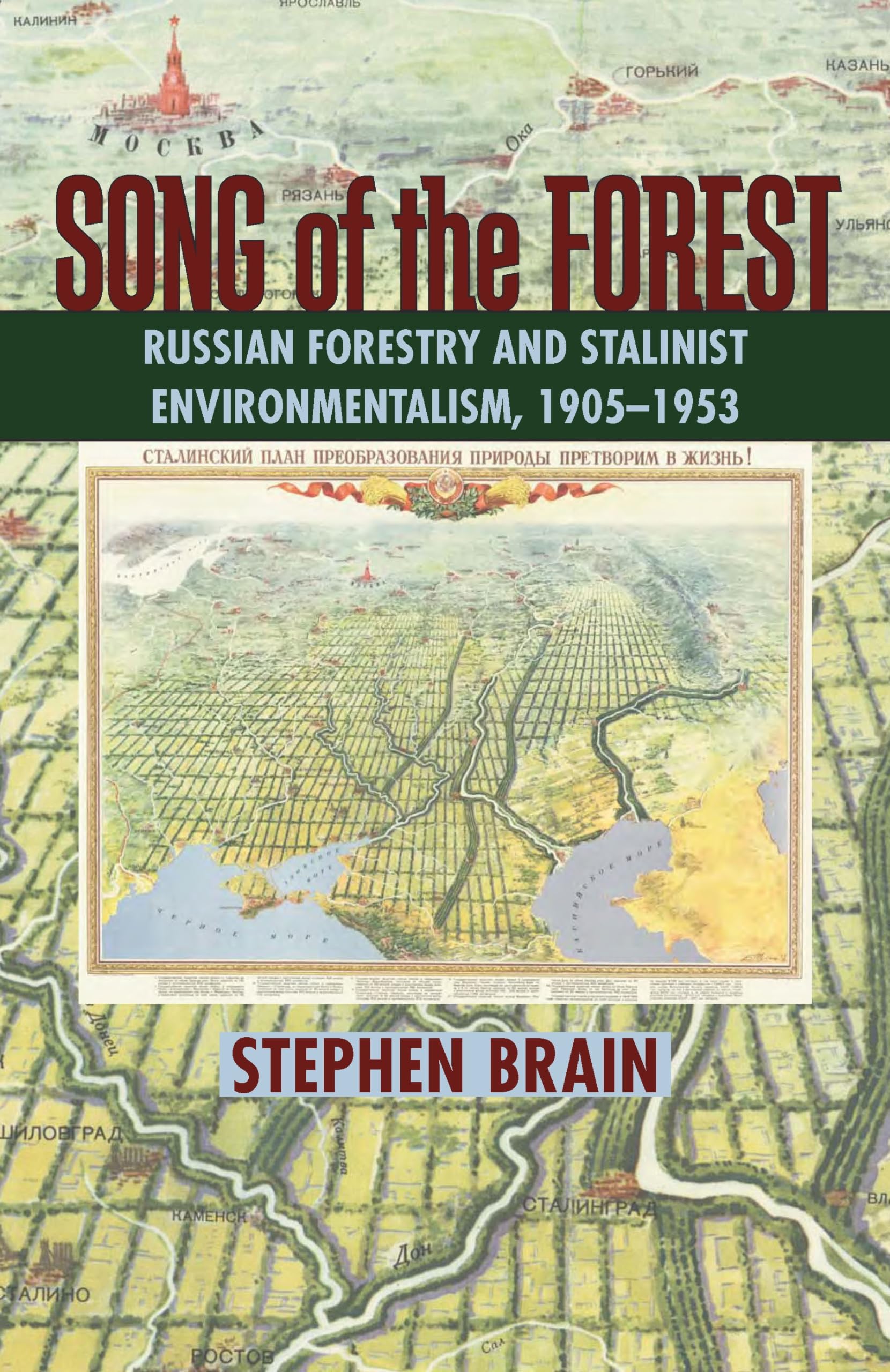
Song of the Forest: Russian Forestry and Stalinist Environmentalism, 1905–1953 (Russian and East European Studies, 233)
$36.26
by Stephen Brain



The Soviets are often viewed as insatiable industrialists who saw nature as a force to be tamed and exploited. Song of the Forest counters this assumption, uncovering significant evidence of Soviet conservation efforts in forestry, particularly under Josef Stalin. In his compelling study, Stephen Brain profiles the leading Soviet-era conservationists, agencies, and administrators, and their efforts to formulate forest policy despite powerful ideological differences. By the time of the revolution of 1905, modern Russian forestry science had developed an influential romantic strand, especially prevalent in the work of Georgii Morozov, whose theory of \u201cstand types\u201d asked forest managers to consider native species and local conditions when devising plans for regenerating forests. After their rise to power, the Bolsheviks turned their backs on this tradition and adopted German methods, then considered the most advanced in the world, for clear-cutting and replanting of marketable tree types in \u201cartificial forests.\u201d Later, when StalinÆs Five Year Plan required vast amounts of timber for industrialization, forest radicals proposed \u201cflying management,\u201d an exaggerated version of German forestry where large tracts of virgin forest would be clear-cut. Opponents who still upheld MorozovÆs vision favored a conservative regenerating approach, and ultimately triumphed by establishing the worldÆs largest forest preserve. Another radical turn came with the Great Stalin Plan for the Transformation of Nature, implemented in 1948. Narrow \u201cbelts\u201d of new forest planted on the vast Russian steppe would block drying winds, provide cool temperatures, trap moisture, and increase crop production. Unfortunately, planters were ordered to follow the misguided methods of the notorious Trofim Lysenko, and the resulting yields were abysmal. But despite Lysenko, agency infighting, and an indifferent peasant workforce, StalinÆs forestry bureaus eventually succeeded in winning many environmental concessions from industrial interests. In addition, the visionary teachings of Morozov found new life, ensuring that the forestÆs song did not fall upon deaf ears. Stephen Brain's book is truly revelatory. Dispensing with simplistic models, Brain has uncovered a uniquely Russian approach to forestry and explains how that approach survived and even partially guided forest management under Stalin―truly a counterintuitive proposition! This is the richest and savviest account of Russian and Soviet forestry in any language and is essential reading for those interested in environmental history, forestry, the history of science, and, not least, Russia and the Soviet Union. ― Douglas R. Weiner, University of Arizona "Song of the Forest provides an important new interpretation of the impact of Stalinism on Soviet environmentalism. Brain indicates how forestry policies developed under Stalin that were in their own way strongly conservationist. Well-written and easy to read, Brain's study is a welcome contribution to the expanding field of environmental history and will be of interest to specialists in Soviet history, too, for shedding light on the dynamics of Stalinist society." ― Paul Josephson, Colby College Demonstrates the continuing importance of the forest, such a quintessential part of life in czarist Russia, in the Soviet period. Highly recommended. ― Choice Makes for a lively read . . . is extensively researched, and it is an important contribution to the small but growing field of Soviet environmental history. ― The Russian Review Will change profoundly how [scholars] understand the environmental legacy of the Soviet Union. Offers the most important contribution to Soviet environmental history made to date in the twenty-first century. . . . Engagingly written and well-priced. ― The NEP Era A significant contribution to the small but growing and important field of Soviet environmental history. . . . a rich and thought-provoking work. ― Environmental History With an extensive examination of bureaucratic records and forestry journals, Stephen Brain has written the remarkable story of the romantic, prerevolutionary Russian forester Georgii Morozov and his posthumous contribution to the unique strain of environmentalism that developed in Joseph Stalin's Soviet Union. In this lucid and engaging book, Brain has recovered a little-known chapter in the history of forestry and significantly reshaped our understanding of the Soviet Union's conservation record. ― The Historian A rich and thought-provoking work that is recommended reading for anyone interested in intellectual debates and the environment in Russia and the Soviet Union across the revolutionary divide. ― Environmental History An important book for students of Soviet Russia and for environmentalists. It is rich in information about Stalin time and insights for anyone who would learn how little genuine positive change took place in Ru