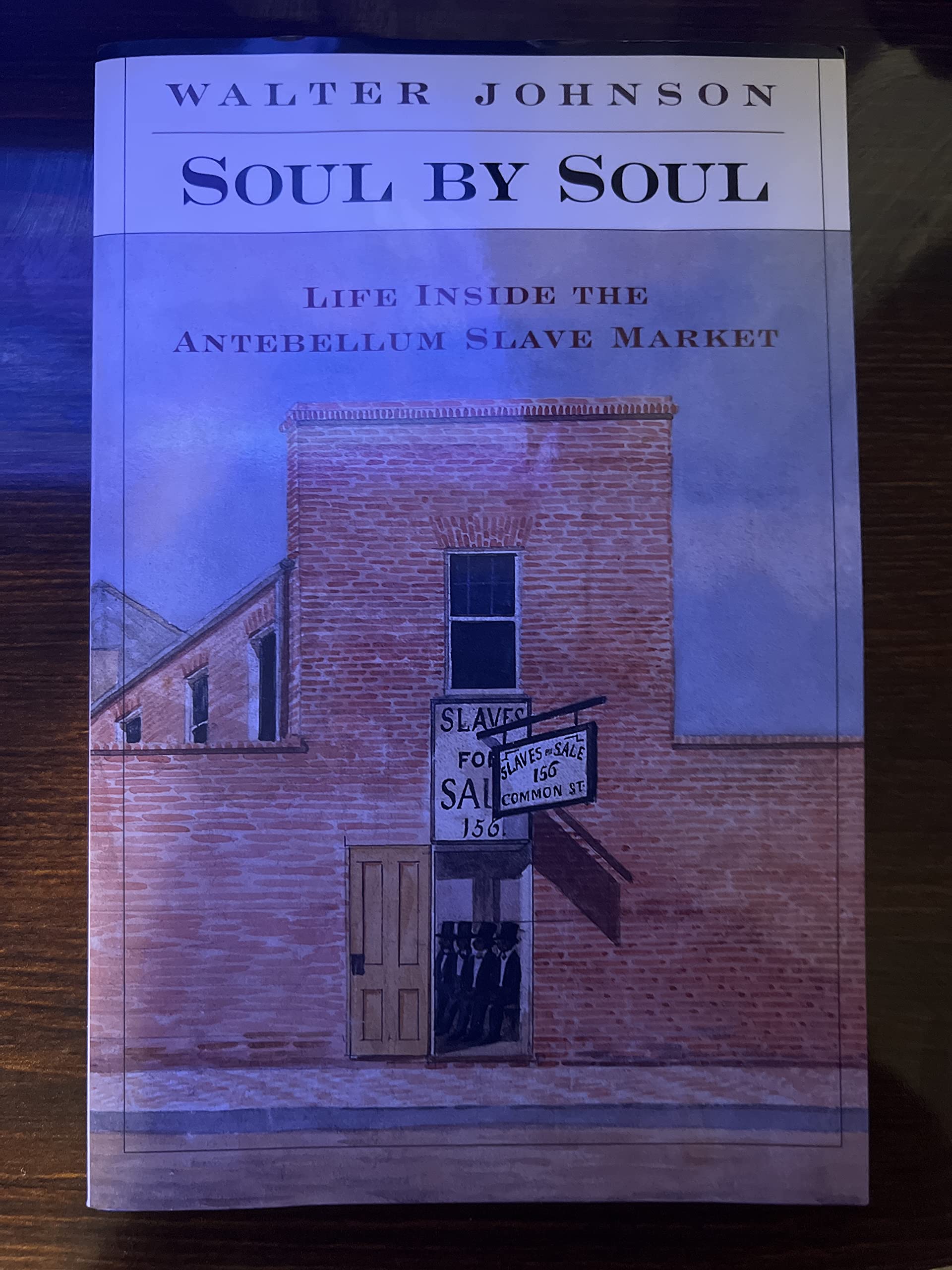



Soul by Soul tells the story of slavery in antebellum America by moving away from the cotton plantations and into the slave market itself, the heart of the domestic slave trade. Taking us inside the New Orleans slave market, the largest in the nation, where 100,000 men, women, and children were packaged, priced, and sold, Walter Johnson transforms the statistics of this chilling trade into the human drama of traders, buyers, and slaves, negotiating sales that would alter the life of each. What emerges is not only the brutal economics of trading but the vast and surprising interdependencies among the actors involved. Using recently discovered court records, slaveholders' letters, nineteenth-century narratives of former slaves, and the financial documentation of the trade itself, Johnson reveals the tenuous shifts of power that occurred in the market's slave coffles and showrooms. Traders packaged their slaves by "feeding them up," dressing them well, and oiling their bodies, but they ultimately relied on the slaves to play their part as valuable commodities. Slave buyers stripped the slaves and questioned their pasts, seeking more honest answers than they could get from the traders. In turn, these examinations provided information that the slaves could utilize, sometimes even shaping a sale to their own advantage. Johnson depicts the subtle interrelation of capitalism, paternalism, class consciousness, racism, and resistance in the slave market, to help us understand the centrality of the "peculiar institution" in the lives of slaves and slaveholders alike. His pioneering history is in no small measure the story of antebellum slavery. In his first book, Johnson (history, New York Univ.) provides the fullest, most penetrating examination of the antebellum slave market to date. Using slave narratives, court records, planters' letters, and more, Johnson enters the slave pens and showrooms of the New Orleans slave market to observe how slavery turned men and women into merchandise and how slaves resisted such efforts to steal their humanity. He tracks the slaves from their march to the market to the terrifying moments of sale and adaptation to new masters, places, and work. Johnson's original, important, and brilliantly presented book makes a case for the slave market as "best place to see slavery." It was there that self-interest, concepts of race, and the slave "community" came together to reveal how white men traded their own souls for a stake in human property. An essential book for anyone who wants to understand why slavery matters.ARandall M. Miller, St. Joseph's Univ., Philadelphia Copyright 1999 Reed Business Information, Inc. The rejuvenation of U.S. slavery from the 1820s onward due to the South's cotton boom is Johnson's starting point for this pellucid study of people, shackles, prices, and society. Cotton induced a mass forced migration of owned people from the tobacco-exhausted Tidewater lands to the fertile Mississippi Valley, about one million of them between the 1820s and 1850s, according to Johnson, an academic historian. A grim sight was common in this period--coffles of slaves walking to the Deep South destined for market, mainly the one at New Orleans. Johnson selects the operations of the market to depict the variegated processes that turned a person into a commodity. Sales could be complicated transactions. Their objects, the enslaved persons, could always ruin value by escape or suicide, and consequently traders and purchasers of people sometimes conceded minimal humanity to placate those in their thrall. Organized with a blessed eschewal of academese, Johnson's work is a superior examination of the speculation in slaves as individuals conducted it. Gilbert Taylor Johnson (History/NYU) argues that, at least by the late antebellum era, the slave market holds the key to answering the question, What is slavery? There were, Johnson acknowledges, other places one could go to see slaverythe Southern churches where the white clergy preached on Ham, the whipping posts where overseers scarred African-Americans backs with crisscrossing lines. But drawing on J.W.C. Penningtons 1849 observation that the being of slavery . . . lives and moves . . . in the bill of sale principle, Johnson finds its microcosm in the New Orleans slave market. Following the fashionable argument that power is everywhere dispersed, he shows that the slaves were able to shape, albeit in small measure, the outcomes of sales. Slave sellers told the chattel how to behave: to appear civil, not strong; stupid, not smart. But slaves did not always follow the sellers instructions. Overhearing their potential owners conversations with other white folks at the market, slaves sometimes tailored their answers to questions about skills and life histories accordingly: They would make themselves sound attractive to a buyer who was looking for a house servant, or try to dissuade a planter who lived in those regions of the Deep South