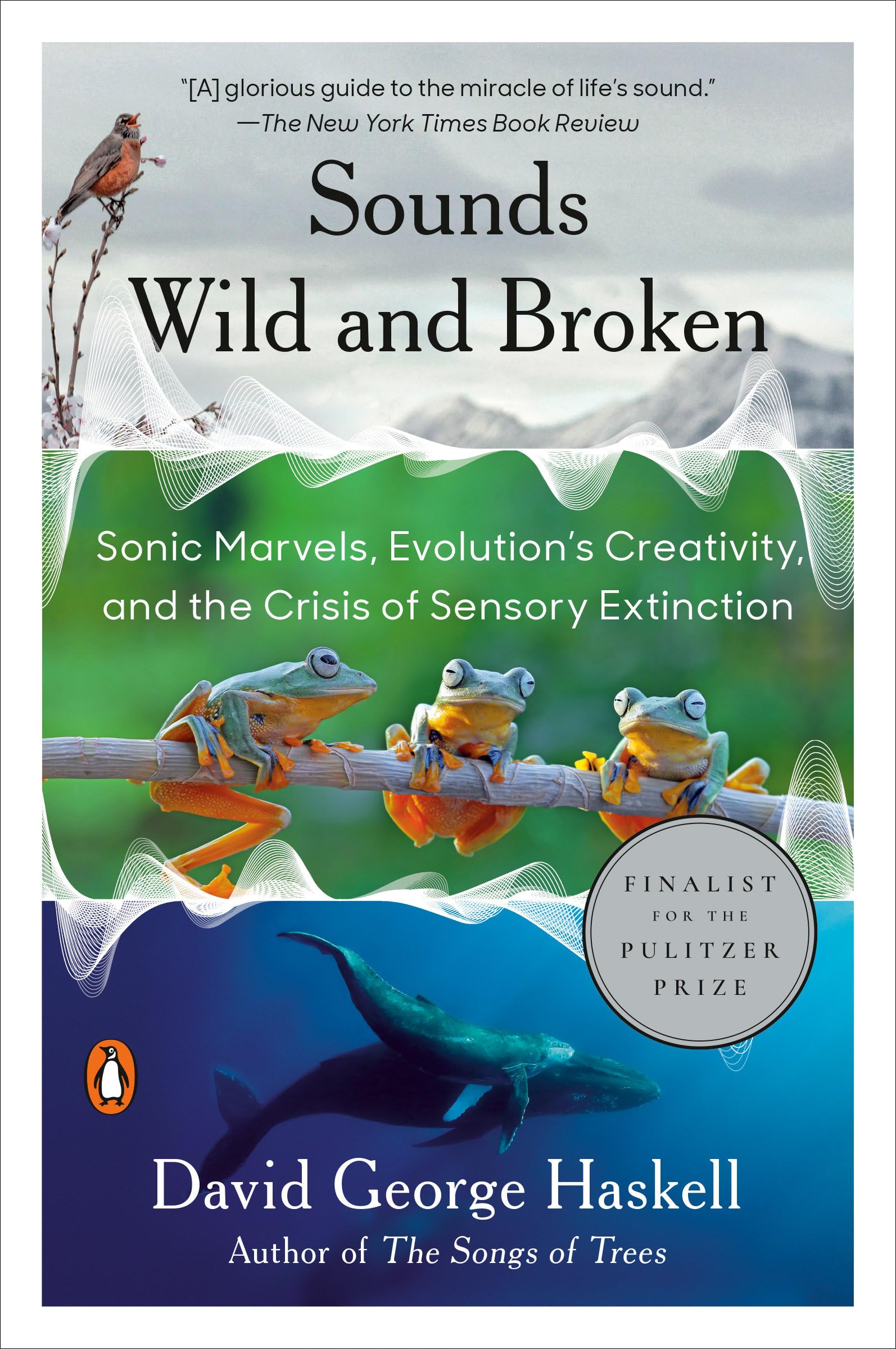
Sounds Wild and Broken: Sonic Marvels, Evolution's Creativity, and the Crisis of Sensory Extinction
$12.09
by David George Haskell



Finalist for the 2023 Pulitzer Prize in General Nonfiction and the 2023 PEN/E.O. Wilson Literary Science Writing Award Winner of the Acoustical Society of America's 2023 Science Communication Award “[ A] glorious guide to the miracle of life’s sound. ” — The New York Times Book Review A lyrical exploration of the diverse sounds of our planet, the creative processes that produced these marvels, and the perils that sonic diversity now faces We live on a planet alive with song, music, and speech. David Haskell explores how these wonders came to be. In rain forests shimmering with insect sound and swamps pulsing with frog calls we learn about evolution’s creative powers. From birds in the Rocky Mountains and on the streets of Paris, we discover how animals learn their songs and adapt to new environments. Below the waves, we hear our kinship to beings as different as snapping shrimp, toadfish, and whales. In the startlingly divergent sonic vibes of the animals of different continents, we experience the legacies of plate tectonics, the deep history of animal groups and their movements around the world, and the quirks of aesthetic evolution. Starting with the origins of animal song and traversing the whole arc of Earth history, Haskell illuminates and celebrates the emergence of the varied sounds of our world. In mammoth ivory flutes from Paleolithic caves, violins in modern concert halls, and electronic music in earbuds, we learn that human music and language belong within this story of ecology and evolution. Yet we are also destroyers, now silencing or smothering many of the sounds of the living Earth. Haskell takes us to threatened forests, noise-filled oceans, and loud city streets, and shows that sonic crises are not mere losses of sensory ornament. Sound is a generative force, and so the erasure of sonic diversity makes the world less creative, just, and beautiful. The appreciation of the beauty and brokenness of sound is therefore an important guide in today’s convulsions and crises of change and inequity. Sounds Wild and Broken is an invitation to listen, wonder, belong, and act. “Haskell’s own joy of discovery makes it irresistible to tune in . . . [he] is spot on that sensory connection can inspire people to care in ways that dry statistics never will . . . Haskell’s previous books [...] suggested the emergence of a great poet-scientist. [ Sounds Wild and Broken ] affirms [him] as a laureate for the earth, his finely tuned scientific observations made more potent by his deep love for the wild he hopes to save.” — New York Times Book Review “Earth sings and rings and warbles: a musical planet, maybe the only one in the universe. As David George Haskell tells it in his captivating new book, Sounds Wild and Broken, it is astonishing good fortune—and a fearsome responsibility—to be given this music and the ears to hear it with . . . Sounds Wild and Broken offer[s] one delight after another.” —Kathleen Dean Moore, Scientific American “[Haskell] is something of an idiosynchratic genius . . . [his] previous works leveraged two tools that established him as one of America’s premier nature writers: his Zen-like ability to pay granular attention to what most people ignore and a lyrical writing style few scientists can muster . . . As he did in The Songs of Trees , Haskell enlivens the science by taking us on a journey, hopping from continent to continent. He wanders the mountains of southern France, treks Ecuador’s Amazon jungle, and noses about eucalyptus forests in New South Wales, all to illustrate the connection between sound and place.” — Outside “A moving paean to Earth’s fraying soundtrack . . . [Haskell] traces, beautifully and brilliantly […] all the infinite serial interactions between communication and reception . . . [ Sounds Wild and Broken is] a reminder that the narrow aural spectrum on which most of us operate, and the ways in which human life is led, blocks out the planet’s great, orchestral richness.” — The Guardian "A soaring panegyric not just to the human ear but also to the auditory equipment of every living being . . . It’s beautiful, Haskell’s devotion to his ears . . . Haskell wants us, above all, to listen, to use our glorious ciliary hairs for good. Those twitching hairs delivered us from pond scum, after all. Maybe, if properly attuned, they can deliver us from catastrophe." — Los Angeles Review of Books “Haskell’s voice is unique in contemporary nature writing . . . [he] creates a pleasing poetry of nature, his carefully crafted sentences luring readers in for the long haul . . . glorious.” —Chapter16.org “Unsurprisingly, Haskell is attuned to the music of written language; his sonic descriptions ring with the truth of poetry. . . Thanks to Haskell’s profound prose, readers of Sounds Wild and Broken get to eavesdrop on cloistered conversations: rainforest mice trilling, croc offspring chirping, spiny lobsters yelping in self-defense.