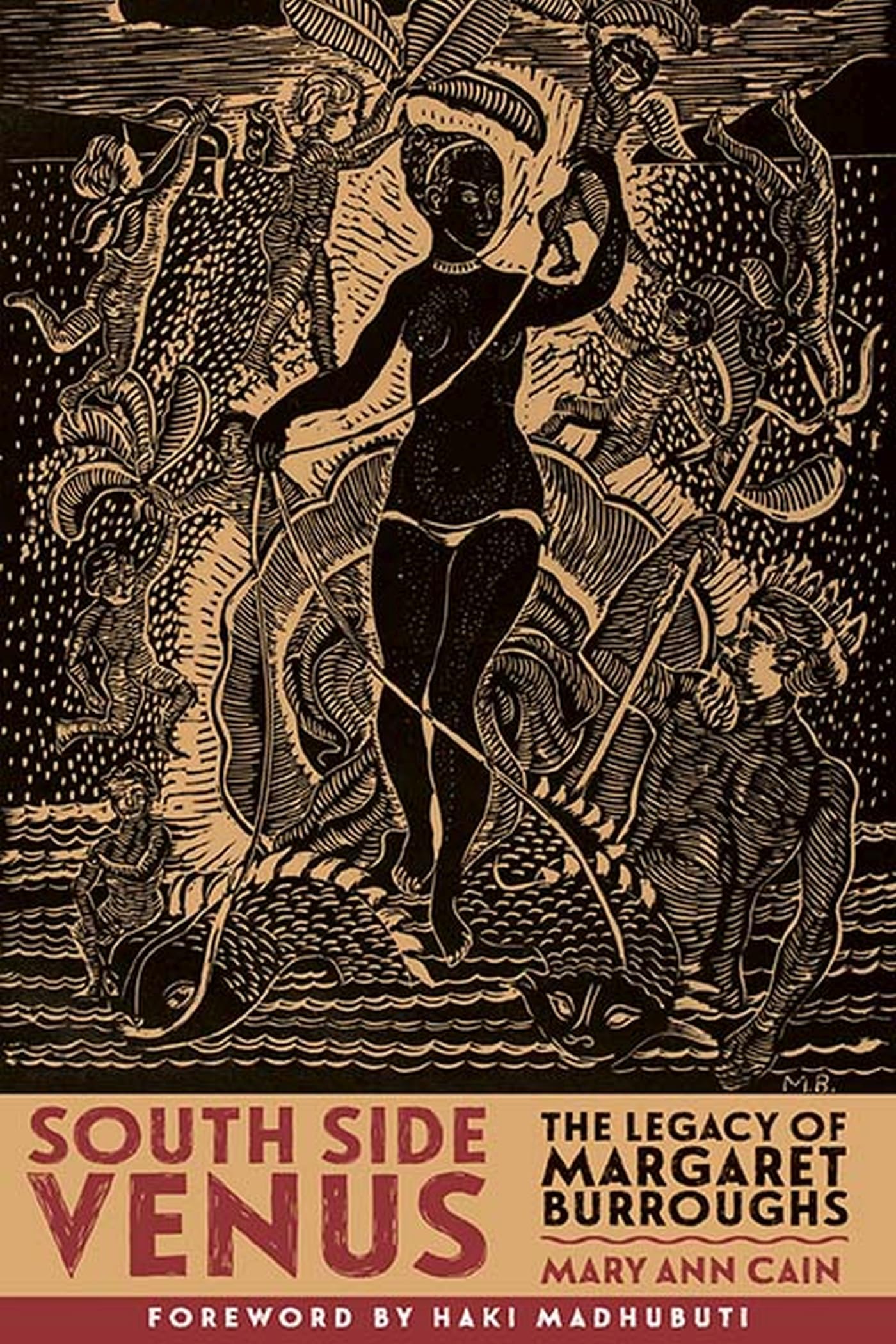



The extraordinarily productive life of curator, artist, and activist Margaret Burroughs was largely rooted in her work to establish and sustain two significant institutions in Chicago: the South Side Community Art Center (SSCAC), founded in 1940, and the DuSable Museum of African American History, founded in her living room in 1961. As Mary Ann Cain's South Side Venus: The Legacy of Margaret Burroughs reveals, the primary motivations for these efforts were love and hope. Burroughs was spurred by her love for Chicago's African American community—largely ill served by mainstream arts organizations—and by her hope that these new, black-run cultural centers would welcome many generations of aspiring artists and art lovers. This first, long–awaited biography of Burroughs draws on interviews with peers, colleagues, friends, and family, and extensive archival research at the DuSable Museum, the Art Institute of Chicago, and the Chicago Public Library. Cain traces Burroughs's multifaceted career, details her work and residency on Chicago's South Side, and highlights her relationships with other artists and culture makers. Here, we see Burroughs as teacher and mentor as well as institution builder. Anchored by the author's talks with Burroughs as they stroll through her beloved Bronzeville, and featuring portraits of Burroughs with family and friends, South Side Venus will enlighten anyone interested in Chicago, African American history, social justice, and the arts. "Cain ( Down from Moonshine ) delivers on the promise of this profound biography’s subtitle by lauding the intentionally crafted legacy of Margaret Burroughs... [an] inspiring account of a force of nature." — Publishers Weekly "...Cain offers invaluable insights into Chicago’s cultures and politics as well as Burroughs’ brilliance, progressive vision, generosity of spirit, sterling work ethic, resilience, and friendships with artists and writers, including Gwendolyn Brooks and Haki Madhubuti." — Booklist "Without question, this is the most serious, scholarly biography of Margaret Burroughs to date; successfully narrating the prescient details of her long life. It will appeal not only to scholars interested in particular cultural and intellectual moments in Black Chicago history, but to general readers interested in African American history, the city of Chicago, and its cultural institutions." —Bill V. Mullen, author of Popular Fronts: Chicago and African-American Cultural Politics, 1935–46 "Cain ( Down from Moonshine ) delivers on the promise of this profound biography’s subtitle by lauding the intentionally crafted legacy of Margaret Burroughs... [an] inspiring account of a force of nature." — Publishers Weekly MARY ANN CAIN 's critical work on writing theory and praxis includes a collaborative book (with Michelle Comstock and Lil Brannon), Composing Public Space: Teaching Writing in the Face of Private Interests . Her fiction, nonfiction essays, and poems have appeared in numerous literary journals, including the Denver Quarterly , The Sun: A Magazine of Ideas , the Bitter Oleander , and the North American Review . She is currently a professor of English at Purdue University Fort Wayne where she teaches fiction, creative nonfiction, rhetoric, and women's studies. South Side Venus The Legacy Of Margaret Burroughs By Mary Ann Cain Northwestern University Press Copyright © 2018 Mary Ann Cain All rights reserved. ISBN: 978-0-8101-3795-0 Contents Foreword by Haki Madhubuti, ix, Acknowledgments, xv, Prologue, 3, ONE Early Crossings, 9, TWO A Mile of Dimes: Crossing into Institutions, 35, THREE Crossing into War, 55, FOUR Border Crossings, 85, FIVE Art as a Passport to Crossing, 111, SIX Ancestral Crossings, 143, Notes, 175, Bibliography, 189, Index, 193, CHAPTER 1 EARLY CROSSINGS Had I not seen it with my own eyes, I might not have believed it. Everywhere she went that day, Margaret Burroughs, or Dr. B, as she was known, was stopped on the street, greeted, and thanked profusely. People, her people, "the little people" as she affectionately called those with whom she identified, those who lingered on the streets of Bronzeville that hot, humid, quintessential Chicago August afternoon, knew this eighty-eight-year-old elder by sight. We could scarcely walk a block or two without someone rushing up to say hello, someone whose life she had touched. For all its purported problems, the South Side clearly cherished its homegrown treasure. We had begun our afternoon walk at 3806 S. Michigan Avenue. Once the home of Margaret and Charles Burroughs and their children, Gayle and Paul, this historic building represents decades of Bronzeville art, artists, and sociability. It was also a haven for those who suffered from bigotry and hatred, a place to repair, rejoice, and relax. The first home of the DuSable Museum of African American History, Burroughs called it her home for decades, but it was a home t