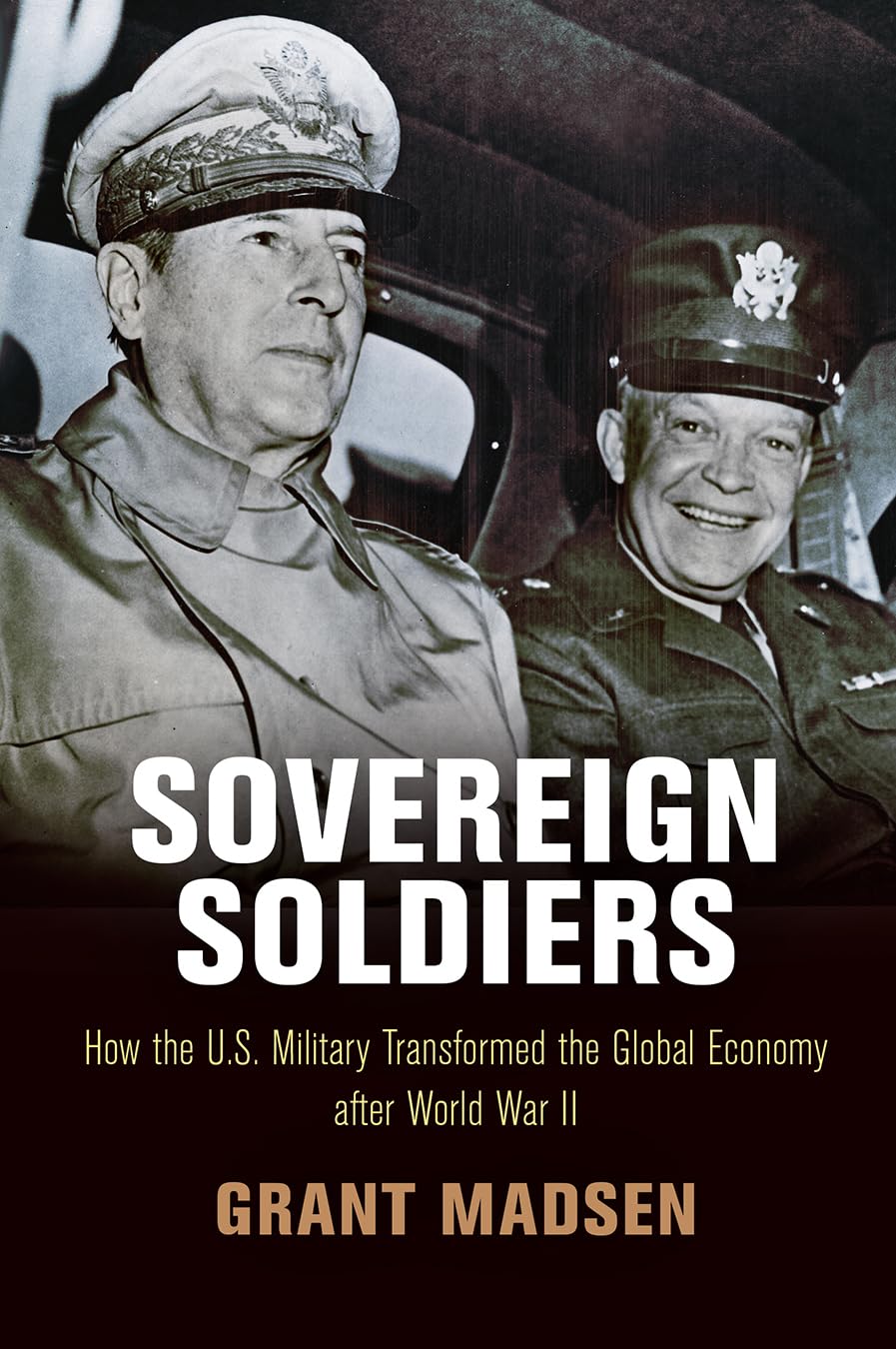
Sovereign Soldiers: How the U.S. Military Transformed the Global Economy After World War II (American Business, Politics, and Society)
$49.86
by Grant Madsen



They helped conquer the greatest armies ever assembled. Yet no sooner had they tasted victory after World War II than American generals suddenly found themselves governing their former enemies, devising domestic policy and making critical economic decisions for people they had just defeated in battle. In postwar Germany and Japan, this authority fell into the hands of Dwight D. Eisenhower and Douglas MacArthur, along with a cadre of military officials like Lucius Clay and the Detroit banker Joseph Dodge. In Sovereign Soldiers , Grant Madsen tells the story of how this cast of characters assumed an unfamiliar and often untold policymaking role. Seeking to avoid the harsh punishments meted out after World War I, military leaders believed they had to rebuild and rehabilitate their former enemies; if they failed they might cause an even deadlier World War III. Although they knew economic recovery would be critical in their effort, none was schooled in economics. Beyond their hopes, they managed to rebuild not only their former enemies but the entire western economy during the early Cold War. Madsen shows how army leaders learned from the people they governed, drawing expertise that they ultimately brought back to the United States during the Eisenhower Administration in 1953. Sovereign Soldiers thus traces the circulation of economic ideas around the globe and back to the United States, with the American military at the helm. "President Eisenhower's warning of a 'military-industrial complex' looms large in contemporary American politics. This book offers the crucial historical background to explain what Eisenhower meant. Grant Madsen shows how U.S. Army leaders after the Second World War worked to build a global economy hinged on low inflation, inexpensive capital, and free trade. He explains how this model seeded postwar prosperity at home as well as in Europe and Asia, and also how it unraveled in the 1960s and 1970s-a victim of its own successes. This book is essential reading for anyone interested in the historical roots of our current global economy and its discontents." ― Jeremi Suri, author of The Impossible Presidency: The Rise and Fall of America's Highest Office " Sovereign Soldiers offers a lively account of economic policymaking in post-World War II Germany, Japan, and the United States. Drawing on original research, Grant Madsen describes the activities of top American occupation officials, including Dwight Eisenhower and Douglas MacArthur as well as General Lucius D. Clay and Detroit banker Joseph Dodge. Charged with overseeing the reconstruction of postwar Germany and Japan, these overseas American officials developed a distinctive approach to political economy, which, as Madsen shows, had lasting influence-not only in Europe and Asia but also back in the United States." ― Mark R. Wilson, author of Destructive Creation: American Business and the Winning of World War II Grant Madsen teaches history at Brigham Young University. Introduction On a July afternoon in 1945, in the spa town of Bad Homburg, at the same time that President Harry S. Truman, Marshal Joseph Stalin, and Prime Minister Winston Churchill negotiated the borders of postwar Europe—and right after delivering the news that the United States had successfully tested the world's first atomic bomb—Secretary of War Henry Stimson found a quiet moment to lunch with two of his top generals, Dwight D. Eisenhower and Lucius Clay. The lunch gave Eisenhower a break, a chance to finally relax after Germany's surrender (which made him military governor for the American zone of conquered Germany). By the end of the year, he would return to the States to become army chief of staff, one in a series of appointments that ultimately led to the presidency. Clay, his good friend, joined the lunch as Eisenhower's heir apparent to govern Germany once Eisenhower returned to the States. An engineer by training, Clay had helped mastermind American production during the war. Many in Washington considered him the most able administrator within the army. Stimson, by contrast, was near the end of his public service. He had first entered government as a U.S. Attorney in 1906 and had achieved a long and storied career that included two stints as secretary of war and one as secretary of state, serving such different presidents as William Howard Taft, Herbert Hoover, and finally Franklin Roosevelt. Yet that afternoon Stimson wanted to talk about his term as the governor-general of the Philippines in the late 1920s (then an American territory). He reminisced about governing a foreign people under the American flag. The afternoon was pleasant—mild temperatures and sunshine. In contrast to the unremitting strain of war, it provided a longed-for respite. The villa in Bad Homburg did not betray the horrendous destruction meted out upon the Germans just about everywhere else. Stimson compared his experience in the Philippines with the orders Washington had ju