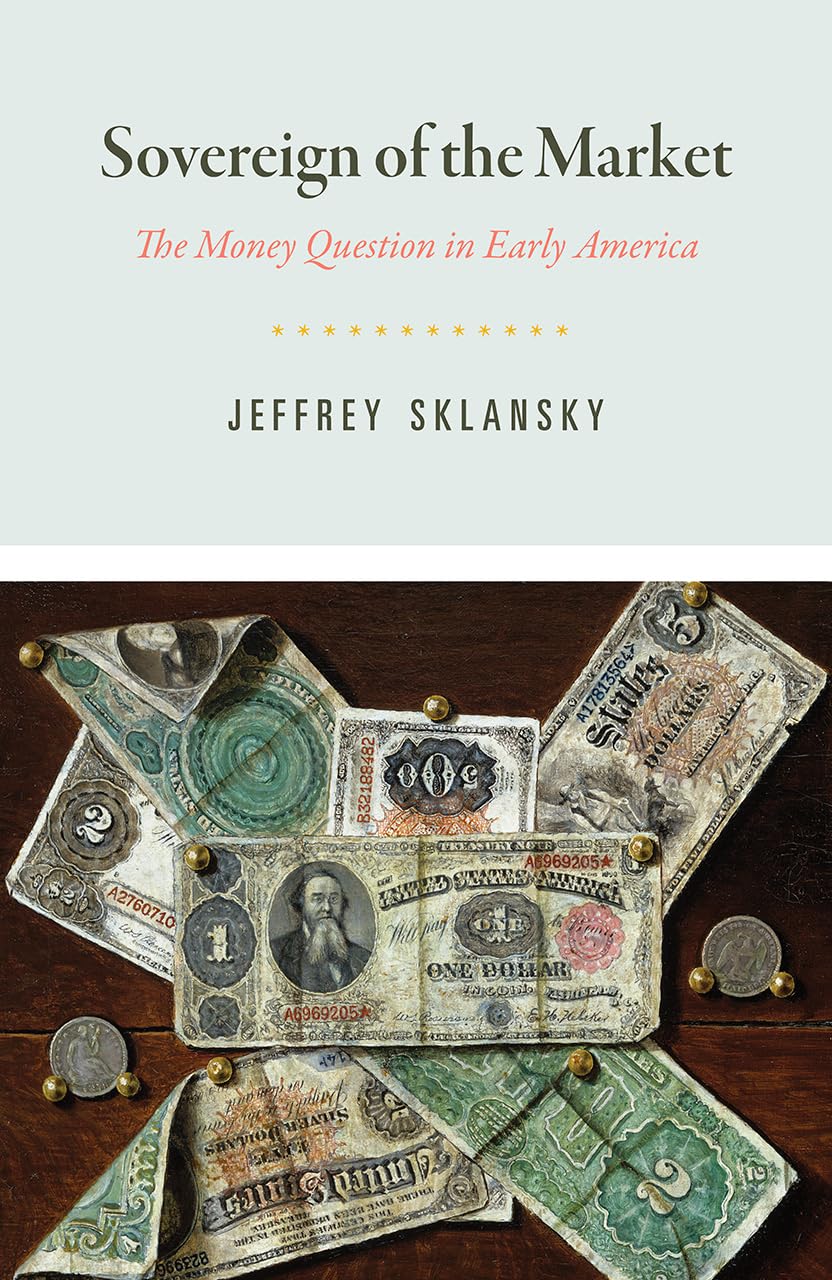
Sovereign of the Market: The Money Question in Early America (American Beginnings, 1500-1900)
$31.52
by Jeffrey Sklansky



What should serve as money, who should control its creation and circulation, and according to what rules? For more than two hundred years, the “money question” shaped American social thought, becoming a central subject of political debate and class conflict. Sovereign of the Market reveals how and why this happened. Jeffrey Sklansky’s wide-ranging study comprises three chronological parts devoted to major episodes in the career of the money question. First, the fight over the innovation of paper money in colonial New England. Second, the battle over the development of commercial banking in the new United States. And third, the struggle over the national banking system and the international gold standard in the late nineteenth century. Each section explores a broader problem of power that framed each conflict in successive phases of capitalist development: circulation, representation, and association. The three parts also encompass intellectual biographies of opposing reformers for each period, shedding new light on the connections between economic thought and other aspects of early American culture. The result is a fascinating, insightful, and deeply considered contribution to the history of capitalism. “Sklansky weaves a compelling narrative. Highly recommended.” ― Choice “ Sovereign of the Market is an exemplary work of intellectual history in its deepening engagement with new histories of capitalism. Sklansky has written a book that effectively draws upon methodological turns—social, cultural, and financial—in a way that challenges us to rethink the periodization and politics of the money-question in America. It is more than a timely and persuasive intervention in the current debates over the history of capitalism and financialization; it is a masterful and memorable work of history in itself.” ― Jean-Christophe Agnew, Yale University “Elegantly conceived and composed, Sklansky’s Sovereign of the Market brilliantly renders two centuries of early American currency debates into dramatic encounters between antagonists who struggled over the question, ‘who rules?’ These were matters not merely economic but profoundly political and social—indeed, when all is said and done, a medium of class struggle. No one can read this clear, penetrating account without recognizing, painfully, how much a century’s neglect of the money question has disabled us in understanding the rise of today’s financialized capitalism.” ― Howard Brick, Louis Evans Professor of History, University of Michigan Jeffrey Sklansky is associate professor of history at the University of Illinois at Chicago. He is the author of The Soul’s Economy: Market Society and Selfhood in American Thought, 1820–1920 .