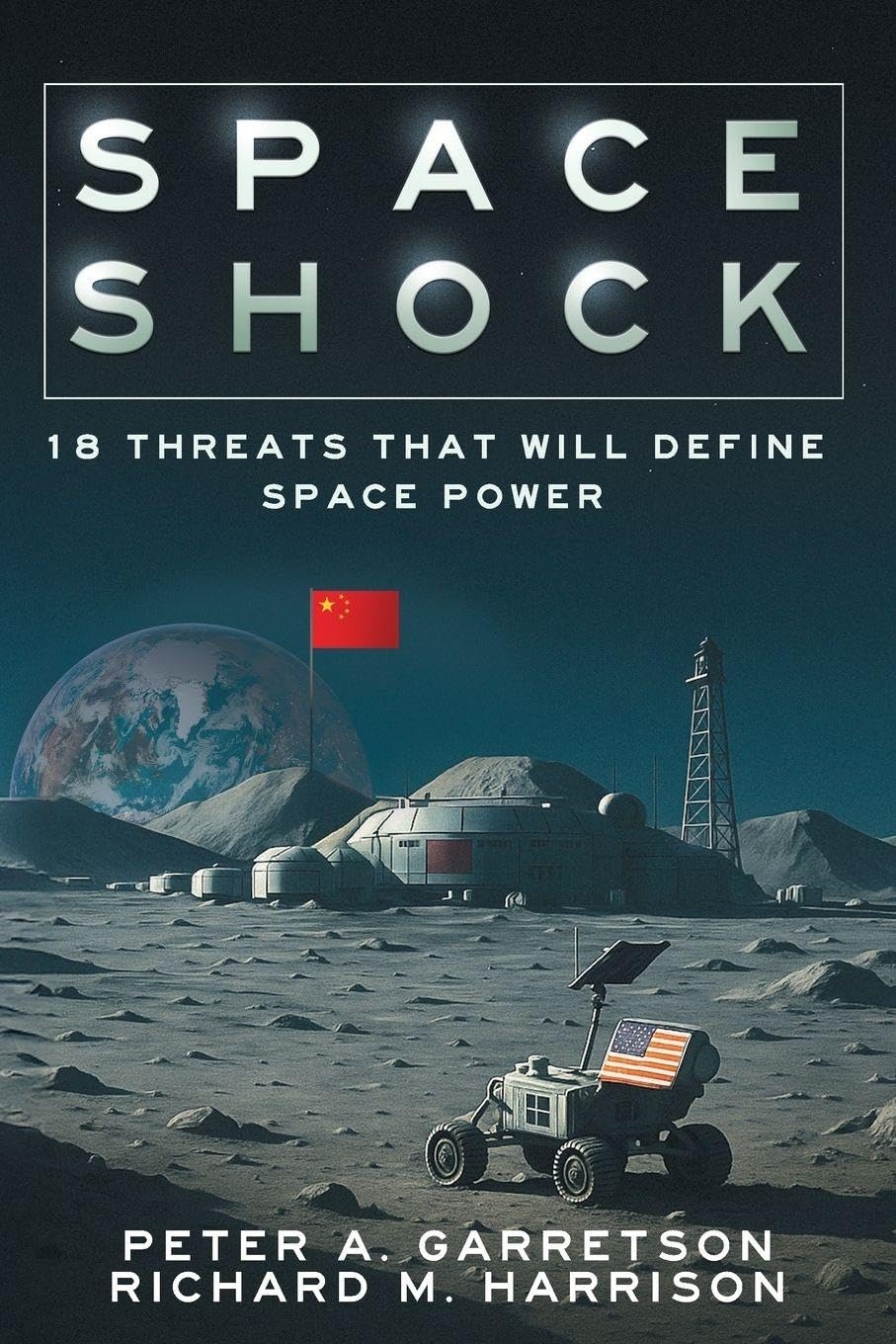



China isn't aiming for the Moon-it is planning for control of space itself. By 2045, Beijing plans to dominate a $10 trillion Cislunar economy, beam power to Earth from orbit, and mine asteroids worth quintillions. Space Shock presents eighteen realistic "Sputnik moment" scenarios-created by the authors and stress-tested through wargames with senior space, defense, and policy experts-to reveal how America might respond. From satellite shootdowns to Lunar land grabs, it exposes critical vulnerabilities and offers the strategic roadmap to ensure the United States, not China, leads humanity's expansion into the final frontier. A chilling glimpse into the futures we're not ready for. Every national security leader needs to read this-now. - John Shaw, Lieutenant General (Ret) and former Deputy Commander, U.S. Space Command This plain-language assertion of urgency regarding space policy and investment puts readers squarely in the crosshairs of what could result from failure to act. - Lee Steinke, Chief Operating Officer, CisLunar Industries Space Shock is a must read for all segments of society, from citizens to politicians...Bold action is required now! - Steve Kwast, Lieutenant General (Ret) and Co-Founder of SpaceBilt Inc., a Space logistics company These scenarios don't just make you think-they make you uneasy...what would we do if this happened tomorrow? - Joel B. Mozer, PhD, U.S. Space Force Chief Science Officer (retired) This urgent critique is a wake-up call for policymakers to act decisively to improve America's space strategy-or risk surrendering the future of space to China. - Dr. Mir Sadat, former National Security Council Policy Director (2019-2020). We ignore these insights at our peril. - John Paul "JP" Parker, Former Special Advisor for Space, Cyber, Intelligence, Weapons of Mass Destruction, and Science and Technology to the Vice President of the United States Mr. Richard M. Harrison is the Vice President of Operations and Director of the Defense Technology Program at American Foreign Policy Council (AFPC) where he co-directs the AFPC Space Policy Initiative (SPI). He currently serves as managing editor of AFPC's Defense Dossier e-journal and as editor of the Defense Technology Monitor e-bulletin. He is co-author of The Next Space Race: A Blueprint for American Primacy . Lt. Col. Peter A. Garretson, USAF (Ret.) is a Senior Fellow in Defense Studies at AFPC and a co-director of the SPI. He is a prolific writer and is co-author of The Next Space Race: A Blueprint for American Primacy and Scramble for the Skies: The Great Power Competition to Control the Resources of Outer Space . A well-reasoned and chilling glimpse into the potential futures we must prepare for. Every national security leader needs to read this-now. - Lt Gen John Shaw, U.S Space Force (Ret), Former Deputy Commander, U.S. Space Command and Author of Whither Space Power? These scenarios don't just make you think-they make you uneasy. And that's exactly what good foresight should do. Read it, then ask yourself: what would we do if this happened tomorrow? - Joel B. Mozer, PhD, U.S. Space Force Chief Science Officer (retired) If America wants to survive and protect its values and world leadership, it must think strategically about the ultimate high ground of Space. Space Shock is a must read for all segments of society, from citizens to politicians. It asks the right questions, and uses compelling scenarios to help America think and compete in the brave new world that Space represents. The timing of this book is critical, and its recommendations are key to our success as a civilization. Bold action is required now! - Steve Kwast, Lieutenant General (Ret) and Co-Founder of SpaceBilt Inc., a Space logistics company Simulations and wargaming can unlock insights that analysis alone cannot. We ignore these insights at our peril. - JP Parker, CEO, Escape Velocity and Former Special Advisor to the Vice President for Space In Space Shock, Garretson and Harrison issue a no-nonsense alert to U.S. decision-makers: when crises arrive, soaring rhetoric undermined by deep cuts to budgets and misplaced priorities will leave us underprepared. The scenarios they highlight contrast China's all-in strategy, powered by sustained, coherent investments in security, science, and exploration, against America's splintered, underfunded commitments. The authors don't just diagnose the problem, they prescribe bold action to cement U.S. leadership of the future of humanity. My takeaway from the book is: enough with the rhetoric, it is time to be strategic and invest. - Dr. Bhavya Lal, Former Acting Chief Technologist and Associate Administrator for Technology, Policy, and Strategy, NASA This plain-language assertion of urgency regarding space policy and investment puts readers squarely in the crosshairs of what could result from failure to act. Incremental advancements in space policy have become so much a part of the current US