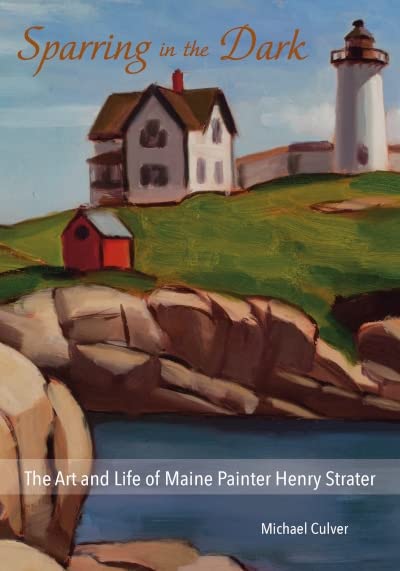



The painter Henry Strater (1896–1987) led an existence that inspired novels such as Fitzgerald’s This Side of Paradise and Hemingway’s The Old Man and the Sea . A life of over nine decades brought him into direct contact with many of the most significant artists, writers, and momentous events of the twentieth century. During the 1920s–40s, Strater’s art received the widespread critical recognition he desired, and he became an integral part of Maine’s renowned Ogunquit art colony. In 1953, he realized his dream of founding the Ogunquit Museum of American Art and establishing an impressive twentieth-century permanent collection. Despite his achievements, Strater was beset by feelings of inferiority and self-doubt, resulting in imaginary opponents conspiring to diminish his standing in American art. In truth, Strater was “sparring in the dark” with nonexistent adversaries. And so this is a narrative not only of Strater’s successes, but of the consequential uncertainties that adversely shaped his life and his art. In his incisive biography of Maine painter Henry Strater, art historian Michael Culver offers an honest and compelling portrait of a troubled artist who "loved his art above all else." Culver presents a lively tale with walk-ons by a who's who of twentieth century cultural icons, among them Ernest Hemingway, James Joyce, and F. Scott Fitzgerald. Of revelation to this reader: Strater's inspired paintings of the Southwest in which he sought to represent "the spirit of the land." Kudos to Culver for rescuing this memorable member of the "Lost Generation." Carl Little, author of Edward Hopper's New England Michael Culver's engaging and exquisitely researched biography chronicles the life of Henry Strater and his ongoing legacy as an artist and founder of the Ogunquit Museum of American Art. Strater's story—sometimes infuriating, always fascinating—spans continents and decades, from his early life in Louisville, Kentucky, to his experiences as an expatriate in Europe to his later days on the American art scene. Culver's elucidating narrative, intertwined with Strater's friendships with numerous literary and artistic luminaries of the twentieth century makes for compelling reading. Bridget Moore, president, DC Moore Gallery, New York City