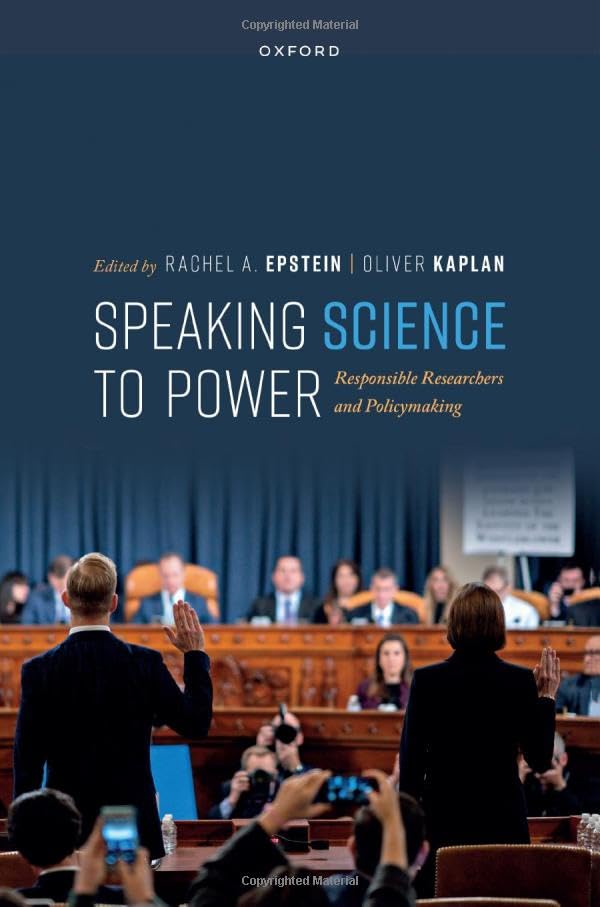
Speaking Science to Power: Responsible Researchers and Policymaking
$40.00
by Rachel A. Epstein



Science has the potential to do much good. But it can also be misused and cause harm. How can researchers become aware of the risks and share their insights responsibly? This volume gathers a premier group of scholars and practitioners to address cutting-edge dilemmas of “responsible policy engagement.” The authors reflect on their own experiences and provide guidance on how to constructively communicate with policymakers - while also being transparent about the uncertainty and subtleties of the research process. The case studies cover tricky policy engagements on topics ranging from postconflict power-sharing, atrocities prevention, NATO enlargement, economic crises, and business and human rights to counterinsurgency and state-building, census data and polling, and intelligence analysis. To avoid pitfalls, the analyses offer a mix of ethical principles and practical advice, including setting cautionary ethical redlines, reflecting on one's position and values, and describing areas of consensus and degrees of uncertainty. Speaking Science to Power uncovers the temptations scholars may face to share particular results, overgeneralize findings, conceal uncertainty, or curry favor with policymakers, and then urges them to act responsibly. "This is a book that should become core reading for all PhD students and early career researchers… And yet to define this collection as being solely focused on professional skills and the practicalities of policy engagement would represent a gross misreading of its content and relevance. Speaking Science to Power makes several intellectual contributions in relation to deepening our understanding of the "science-of-science," "metascience," and the emerging field of "impact evaluation studies"." -- Matthew Flinders, Perspectives on Politics "It will serve as a refreshing addition to graduate-level research and professional ethics courses." -- Z. Albertson, Choice "A unique and useful edited volume that has the potential to start a wider trend of reflective dialogue on methodologies beyond the standard research methods." -- Marion Messmer, International Affairs "This book is a worthwhile read for researchers wanting to ensurethat their work is impactful. It would be an excellent introduction for someone who is new to influencing policy, but an experienced researcher would undoubtedly find it useful too. The contributors' challenges and experiences may sound familiar, and they provide a useful starting-point to reflect on one's own praxis. This is a unique and useful edited volume that has the potential to start a wider trend of reflective dialogue on methodologies beyond the standard research methods." -- Marion Messmer, International Affairs "Examine[s] the opportunity for researchers to improve public policies by contributing to the quality of democracy, aiding in conflict resolution, or advancing more equitable economic policy, considering their responsibility to guard against misunderstandings, misuse, misconduct, and other potential harms." -- Journal of Economic Literature Rachel A. Epstein, Professor, Josef Korbel School of International Studies, University of Denver ,Oliver Kaplan, Associate Professor, Josef Korbel School of International Studies, University of Denver Rachel A. Epstein is a Professor at the Josef Korbel School of International Studies at the University of Denver. Her research focuses on international political economy, financial crises and reform, international security, and the role of international organizations in eliciting compliance from target states and states-in-transition. She has held several postdoctoral fellowships at the European University Institute in Florence, Italy and was also an Advanced Postdoctoral Fellow at the Freie Universität in Berlin in 2016. Oliver Kaplan is an Associate Professor at the Josef Korbel School of International Studies at the University of Denver. He is the author of the book, Resisting War: How Communities Protect Themselves (Cambridge University Press, 2017). Kaplan has also published articles on the conflict-related effects of land reforms, ex-combatant reintegration and recidivism, and research ethics. Kaplan was a Jennings Randolph Senior Fellow at the US Institute of Peace and a postdoctoral Research Associate at Princeton University and at Stanford University.