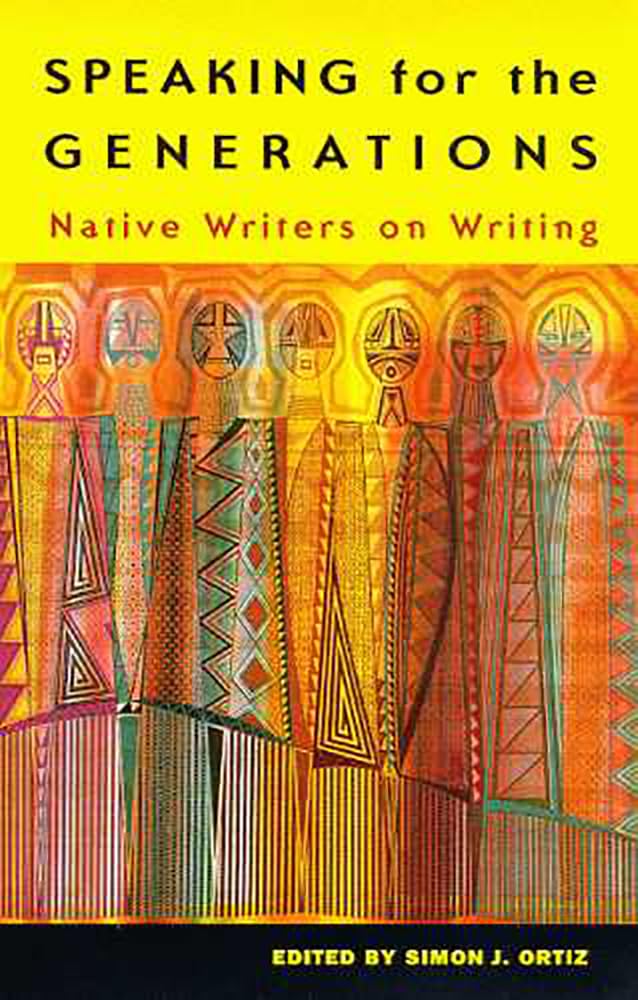
Speaking for the Generations: Native Writers on Writing (Volume 35) (Sun Tracks)
$21.95
by Simon J. Ortiz



Now it is my turn to stand. At Acoma Pueblo meetings, members rise and announce their intention to speak. In that moment they are recognized and heard. In Speaking for the Generations , Acoma Pueblo poet Simon Ortiz brings together contemporary Native American writers to take their turn. Each offers an evocation of herself or himself, describing the personal, social, and cultural influences on her or his development as a writer. Although each writer's viewpoint is personal and unique, together they reflect the rich tapestry of today's Native literature. Of varied backgrounds, the writers represent Indian heritages and cultures from the Pacific Northwest to the northern plains, from Canada to Guatemala. They are poets, novelists, and playwrights. And although their backgrounds are different and their statements intensely personal, they share common themes of their relationship to the land, to their ancestors, and to future generations of their people. From Gloria Bird's powerful recounting of personal and family history to Esther Belin's vibrant tale of her urban Native homeland in Los Angeles, these writers reveal the importance of place and politics in their lives. Leslie Marmon Silko calls upon the ancient tradition of Native American storytelling and its role in connecting the people to the land. Roberta J. Hill and Elizabeth Woody ponder some of the absurdities of contemporary Native life, while Guatemalan Victor Montejo takes readers to the Mayan world, where a native culture had writing and books long before Europeans came. Together these pieces offer an inspiring portrait of what it means to be a Native writer in the twentieth century. With passion and urgency, these writers are speaking for themselves, for their land, and for the generations. Whether reared in Amarillo, Texas, or on the Six Nations Reserve in southern Ontario, the nine Native writers anthologized here cite amazingly similar influences. Each claims a deep connection to the land. The urge to tell stories, they say, stems from being raised in a culture that is rich in storytelling--that has relied, in fact, on storytelling. "The ancient Pueblo people," writes Leslie Marmon Silko in the book's opening essay, "depended upon collective memory through successive generations to maintain and transmit an entire culture." Now, though, they find themselves writing in a language that is not culturally their own. In fact, it is the language of the colonialist. Unlike Okanagan, says Jeannette C. Armstrong, which, having never been written down, is "devised solely for use by the human voice and the human body," English "is deaf to music and only chances on it through the diligent work of writers." Many of these writers feel an obligation both to protect and promote their Native culture, and to educate the outside world about that culture. "I consider it a moral responsibility of the Native writer," says Victor D. Montejo, a Mayan from Guatemala, "to be a voice for the people and to let the world know about not only the achievements of his or her people but also the crimes committed against them." And finally there is the conflict of audience (is one writing for Natives, or for other readers?) and the feeling sometimes that one is less a member of one's community than a spokesperson for or interpreter of it. "Once," says Elizabeth Woody, a Yakama-Warm Springs- Wasco-Navajo Indian, "a friend tried to coax me into going to a distant powwow with her by saying, 'Why read and write about Indians when you could just be one for a while?'" --Jane Steinberg "This tight, well-selected anthology makes its point clearly—namely, that it isn't possible to discuss Native American art without also discussing Native American sovereignty." — Booklist "[ Speaking for the Generations ] gives voice to the need to observe the interdependence between land and people, as well as the need to listen to our ancestors." — Library Journal "Now it is my turn to stand." At Acoma Pueblo meetings, members rise and announce their intention to speak. In that moment they are recognized and heard. In "Speaking for the Generations," Acoma Pueblo poet Simon Ortiz brings together contemporary Native American writers to take their turn. Each offers an evocation of herself or himself, describing the personal, social, and cultural influences on her or his development as a writer. Although each writer's viewpoint is personal and unique, together they reflect the rich tapestry of today's Native literature. Of varied backgrounds, the writers represent Indian heritages and cultures from the Pacific Northwest to the northern plains, from Canada to Guatemala. They are poets, novelists, and playwrights. And although their backgrounds are different and their statements intensely personal, they share common themes of their relationship to the land, to their ancestors, and to future generations of their people. From Gloria Bird's powerful recounting of personal and family history to Esther