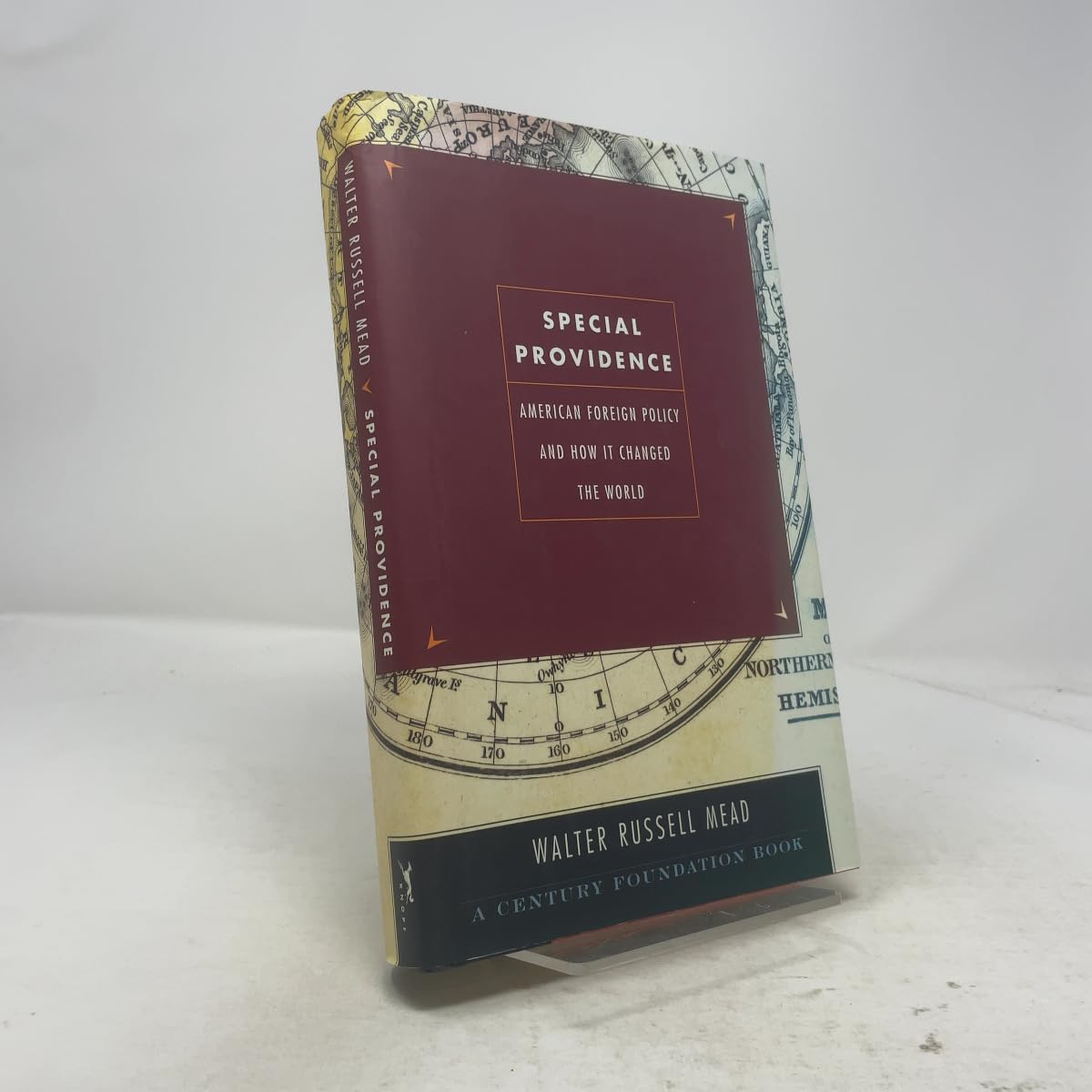
Special Providence: American Foreign Policy and How It Changed the World
$53.17
by Walter Russell Mead



From one of our leading experts on foreign policy, a full-scale reinterpretation of America’s dealings—from its earliest days—with the rest of the world. It is Walter Russell Mead’s thesis that the United States, by any standard, has had a more successful foreign policy than any of the other great powers that we have faced—and faced down. Beginning as an isolated string of settlements at the edge of the known world, this country—in two centuries—drove the French and the Spanish out of North America; forced Britain, then the world’s greatest empire, to respect American interests; dominated coalitions that defeated German and Japanese bids for world power; replaced the tottering British Empire with a more flexible and dynamic global system built on American power; triumphed in the Cold War; and exported its language, culture, currency, and political values throughout the world. Yet despite, and often because of, this success, both Americans and foreigners over the decades have routinely considered American foreign policy to be amateurish and blundering, a political backwater and an intellectual wasteland. Now, in this provocative study, Mead revisits our history to counter these appraisals. He attributes this unprecedented success (as well as recurring problems) to the interplay of four schools of thought, each with deep roots in domestic politics and each characterized by a central focus or concern, that have shaped our foreign policy debates since the American Revolution—the Hamiltonian: the protection of commerce; the Jef- fersonian: the maintenance of our democratic system; the Jacksonian: populist values and military might; and the Wilsonian: moral principle. And he delineates the ways in which they have continually, and for the most part beneficially, informed the intellectual and political bases of our success as a world power. These four schools, says Mead, are as vital today as they were two hundred years ago, and they can and should guide the nation through the challenges ahead. Special Providence is a brilliant analysis, certain to influence the way America thinks about its national past, its future, and the rest of the world. A senior fellow for foreign policy at the Council on Foreign Relations, Mead (Mortal Splendor: The American Empire in Transition) follows in the footsteps of Walter McDougall in Promised Land, Crusader State (Houghton, 1997). Like McDougall, he points out that the United States contrary to the received wisdom was awash in diplomacy from its birth throughout the supposedly isolationist 19th century. But Mead sets himself a broader task. Why, he asks, does the United States still suffer from a reputation for na?vet? despite its meteoric ascent to world power? The author traces European puzzlement at Americans' stubborn independence, aversion to state power, and obsession with commerce. Like other historians, Mead discerns several schools of thought that vie for supremacy within the American diplomatic tradition: Hamilton's preoccupation with commerce, Jefferson's watchfulness over the Republic's founding principles, Jackson's obsession with military strength, and Wilson's pursuit of a just world order. The beneficial interplay of these principles, says Mead, has yielded the most successful foreign policy in history. Largely celebratory and sure to be controversial, this work belongs in all library collections. James R. Holmes, Ph.D. Candidate, Fletcher Sch. of Law & Diplomacy, Tufts Univ., Medford, MA Copyright 2001 Reed Business Information, Inc. Since September 11, foreign policy has been front-page news. Mead, a Council on Foreign Relations senior fellow, argues that foreign policy has consistently played a more important role in U.S. politics than most studies recognize and that "American thinking about foreign policy has been relatively stable." But this stability does not reflect simplicity: Mead sees U.S. foreign policy as determined by the interaction of four approaches he labels Hamiltonian, Wilsonian, Jeffersonian, and Jacksonian. Hamiltonians are globalists who urge a business-government alliance. Wilsonians accept global responsibility to build a peaceful, law-abiding community of democratic nations as a matter of moral duty as well as national interest. Jeffersonians are skeptical; they want to preserve democracy at home but aren't anxious to spread it. Populist Jacksonians see foreign policy's goal as protecting the American people economically and militarily. Mead traces these tendencies through history, demonstrating how they have been balanced through the political process and suggesting how they could be balanced in the future. Mary Carroll Copyright © American Library Association. All rights reserved "Mead is a clear and original thinker and an engaging writer, and these pages are filled with striking insights and pithy formulations. His analysis is richer, more interesting, more accurate than so many others." --Aaron L. Friedberg, New York Times