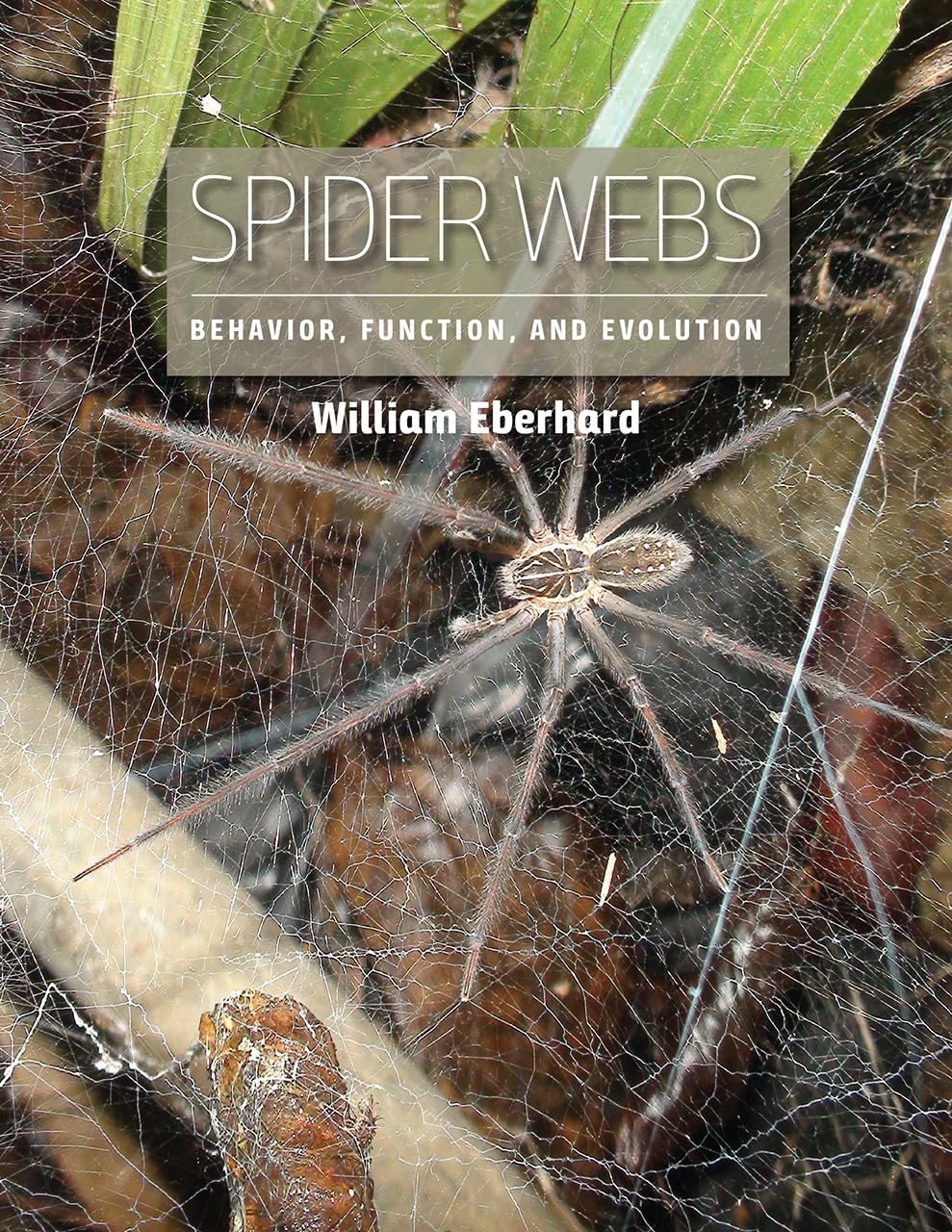



In this lavishly illustrated, first-ever book on how spider webs are built, function, and evolved, William Eberhard provides a comprehensive overview of spider functional morphology and behavior related to web building, and of the surprising physical agility and mental abilities of orb weavers. For instance, one spider spins more than three precisely spaced, morphologically complex spiral attachments per second for up to fifteen minutes at a time. Spiders even adjust the mechanical properties of their famously strong silken lines to different parts of their webs and different environments, and make dramatic modifications in orb designs to adapt to available spaces. This extensive adaptive flexibility, involving decisions influenced by up to sixteen different cues, is unexpected in such small, supposedly simple animals. As Eberhard reveals, the extraordinary diversity of webs includes ingenious solutions to gain access to prey in esoteric habitats, from blazing hot and shifting sand dunes (to capture ants) to the surfaces of tropical lakes (to capture water striders). Some webs are nets that are cast onto prey, while others form baskets into which the spider flicks prey. Some aerial webs are tramways used by spiders searching for chemical cues from their prey below, while others feature landing sites for flying insects and spiders where the spider then stalks its prey. In some webs, long trip lines are delicately sustained just above the ground by tiny rigid silk poles. Stemming from the author’s more than five decades observing spider webs, this book will be the definitive reference for years to come. "The big book on this exciting subject, lavishly illustrated and based on over five decades of research. Eberhard answers any query about the origins, morphology and utilization of spicier webs, as well as their weavers' surprising mental and physical capabilities." ― Bookseller "You would think that after centuries of studying spider webs we have a pretty good grasp of them. Yet a thorough, book-length review of their construction, function, and evolution has been missing. Eberhard has taken on that colossal task, based on his nearly fifty years of observing spiders and their webs. Some works go on to define their discipline. Spider Webs has all the trappings of becoming the arachnological benchmark. . . . It is one of those rare books that sets a discipline’s research agenda for decades to come and cannot be ignored. This book has set the bar and has set it high. For professional arachnologists this is a vital and invaluable reference work. For serious spider enthusiasts it is an absolute treasure trove. Beyond the spider community, however, there is much here of interest to ethologists and evolutionary biologists." -- Leon Vlieger ― Inquisitive Biologist “In summary, what does one get by buying the book? Spider silk is often compared to steel, weight by weight and materially speaking this book is excellent value for money at just under 2 kg weight and just under 10 cents per A4 page. Intellectually speaking, Eberhard’s book not only provides the reader with an exceptionally comprehensive, generous, and intuitive text supported by well explained illustrations that lighten the text, and overall aided by an outstanding index that allows for flitting between subjects and chapters. As importantly, there is plenty of intellectual stimulation for both spider and non-spider experts. And the honest discussion of the many open questions will provide generations of students interested in behavioral ecology with topics for research. . . . The editor and team [at the University of Chicago Press] must be congratulated not only for publishing this true labor of love but also for the superb production nowadays so rare for an academic book of this topic and scope.” -- Fritz Vollrath ― ISBE Newsletter “Based on half a century of study, Spider Webs is an unprecedented and very large book on [spiders’] biology, evolution, and diversity.” ― Natural History Book Service “This is a wonderful book. In it Eberhard explores the mechanical and evolutionary aspects of spider webs from all sides. The book is lavishly illustrated with photographs of webs appearing throughout. Each chapter has a down-to-earth summary that repeats the main points of the chapter. Eberhard is not afraid to rail against the many errors that infect previous work on spiders and webs, including adultophilia (the tendency to ignore the webs of juvenile spiders), typology (the eagerness to describe ‘the’ spider and its web when in reality there are many variations in the webs of any one species), and many more shortcomings. But by far the strength of the book is Eberhard’s ability to tell his readers what is needed on topics A to Z if we are to test hypotheses further. This willingness to lay out predictions that are derived from particular hypotheses on puzzling behaviors that have not been checked makes the book a gold mine for students of