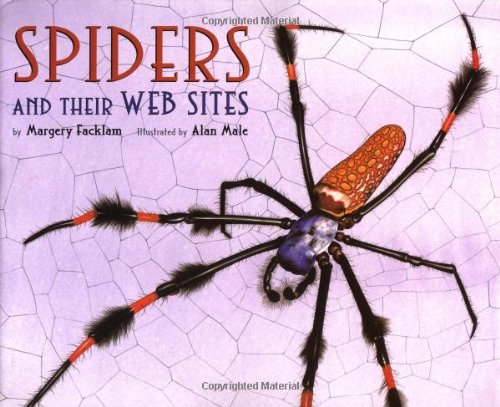



Eye-catching illustrations and informative text provide a close-up look at the physical characteristics and habits of twelve different spiders and daddy-longlegs. By the author of Creepy, Crawly Caterpillars. Gr 3-5-This title boasts a clearly written, well-organized text, as well as an eye-catching, colorful format. A baker's dozen of arachnids-12 spiders and a spider look-alike-the daddy longlegs-are profiled in two-page sections. The lucid text briefly describes each creature's major physical and behavioral characteristics, focusing on the ways in which it employs spider silk. Featured creatures include the tarantula, black widow, purse web, bolas, and spitting spider. Alternating with the text is a full-color, close-up painting of the featured arachnid in action, usually with freshly captured prey. Smaller, labeled illustrations appear in a wide margin at the bottom of each page. Some show a particular process, such as the different stages of web construction or the stalking and capturing of prey; others diagram various body parts, such as fangs, poison ducts, etc., or depict related species. There's one minor omission-the book fails to list any arachnid Web sites. As the title itself plays on the word, their absence is puzzling. Jennifer Owings Dewey's Spiders Near and Far (Dutton, 1993; o.p.) and Sandra Markle's Outside and Inside Spiders (Atheneum, 1994) both provide more information on spider anatomy, general physical and behavioral characteristics, and reproduction. Although Facklam's title lacks the depth of these titles, it has definite browser appeal and will make a useful addition to natural-history sections. Karey Wehner, San Francisco Public Library Copyright 2001 Cahners Business Information, Inc. Gr. 3-5. This entertaining book revolves around the idea that contemporary Web-site designers do something spiders perfected millions of years ago: they lure visitors to complex communication centers. Facklam, a veteran writer of children's science books, takes a look at 12 different spiders and the daddy long legs (a cousin to the spider), the eggs they hatch, and the webs they weave. She briskly introduces a wealth of information on the architectronics and psychology of web design and the physical characteristics of spiders, never losing sight of her target audience. Along the way, she fills the text with arresting facts--among them, spider silk, stronger than any other natural fiber, was used in bomb sights in World War II fighter planes. She also includes the kind of satisfyingly gross stuff some kids love: spiders don't eat their food, they envelop it in their vomit, wait for it to become liquid, and then drink it. Male's full-color illustrations add lavish, sometimes chilling details. A glossary and suggestions for further reading round out a fine book for students and interested children alike. Connie Fletcher Copyright © American Library Association. All rights reserved "...will fascinate readers with enough specific detail, drama, humor, and yuck factor to appeal to a wide audience..." -- Kirkus, 2/15/01 Margery Facklam is the author of many award-winning nonfiction books for children, including Creepy, Crawly Caterpillars and The Big Bug Book. She lives in Clarence Center, New York. Alan Male has worked as a professional illustrator for over twenty years and has illustrated more than twenty complete books. He specializes in scientific, natural history, prehistoric life, and human figure work. He lives in Cornwall, England.