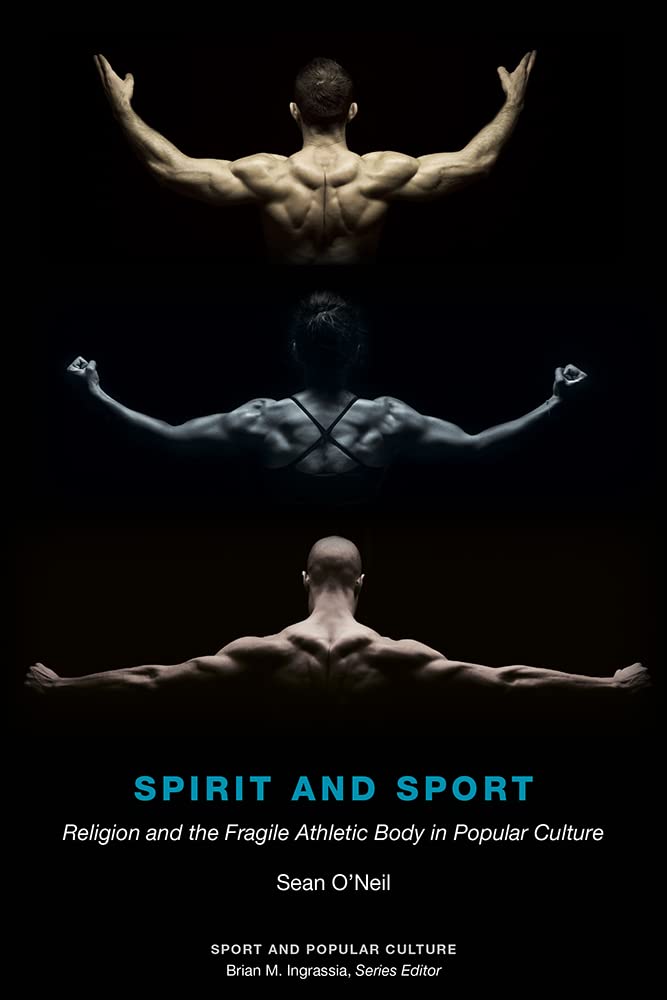
Spirit and Sport: Religion and the Fragile Athletic Body in Popular Culture (Sport & Popular Culture)
$50.00
by Sean Samuel O'Neil



In Spirit and Sport: Religion and the Fragile Athletic Body in Popular Culture , Sean O’Neil studies the intersectionality of religion and disability as it exists within contemporary sports. To do so, he calls to the forefront various contemporary stories about trauma and disability—some fictional, others biographical—and examines how we tell and interpret these stories within the frameworks of athletic activity, competition, failure, and success. O’Neil studies a wide range of perspectives, from John Irving’s A Prayer for Owen Meany and the big-screen’s Signs to the experiences of real-life athletes like Tim Tebow, Muhammad Ali, and Bethany Hamilton. Woven throughout his examination of each is a consideration of religious belief and practice, especially within Christianity, as it relates to athletic ability—the lighthearted stories of victory and overcoming, the inspiring triumph over fragility and limitation so often couched in religious terms. O’Neil’s study draws upon his experiences as a hospital chaplain and his own battle with skin cancer. By blending personal experience with sociological observation, O’Neil argues that the intersection of religion, sports, and disability in popular culture is a revealing site of cultural struggle over competing myths, identities, and values related to the body—both the physical bodies we inhabit as well as the broader social bodies to which we subscribe. Spirit and Sport is a study with broad appeal: from O’Neil’s autoethnographic storytelling to the wide range of narrative media he examines, religious scholars, sports historians, and general audiences alike are sure to find it a thought-provoking and engaging read. "I applaud O’Neil for showing us something that is hiding in plain sight, namely, the many and complicated ways in which religion, sports, and disability intersect. As he shows repeatedly and convincingly, disability is frequently braided into the stories told about athletic bodies moving, competing, succeeding, and failing. The impressive range of source material offers varied perspectives, insofar as we hear stories from different sports, and from a diverse range of athletes and commentators who engage in, observe, and interpret these activities."—Arthur Remillard, Professor of Religious Studies and Director of the Wolf-Kuhn Ethics Institute, Saint Francis University Spirit and Sport is an insightful, heartfelt work that stimulates fresh thinking on the experience of being human and our vulnerable bodies. While the field of disability theology has been exploring these intersections for a while, Sean Samuel O'Neil's approach through the lens of sports and experiences of athletes creates an innovative framework with fruitful, new vantage points. This book is not only for people whose lives are connected to sports through observation or participation but also offers encouragement for those of us working to create communities where the broad diversity of bodies is welcomed and valued, and where through the seasons of life we learn to honor our own bodies as well. —Rev. Dr. Bethany McKinney Fox, author of Disability and the Way of Jesus: Holistic Healing in the Gospels and the Church SEAN O’NEIL is an affiliated scholar with the Sport and Religion Research Alliance at the University of Tennessee, Knoxville. He lives in Fort Worth, Texas, where he is also a bishop, pastor, and hospital chaplain. He has written for Religion Dispatches and his articles have appeared in the Encyclopedia of Religion and Film and Identity and Myth in Sports Documentaries: Critical Essays. From the Foreword by Brian M. Ingrassia Human bodies are inherently frail, even if sport gives us the illusion they are not, and a level playing field almost never exists, even if sport gives us the illusion that it does. Sean Samuel O’Neil’s Spirit and Sport: Religion and the Fragile Athletic Body offers an innovative and powerful extended musing on the intersections between disability, sport, and religion. This book is a veritable Venn diagram, the center of overlapping circles wherein football celebrity Tim Tebow kneels in the end zone before meeting with disabled children, and Bethany Hamilton, the champion “soul surfer” who succumbed to a shark attack at age thirteen, models swimwear that some evangelicals consider too revealing. We learn that advice to “swing away,” depending upon context, could mean the difference between life and death—and even the difference between a disavowal or an affirmation of faith. This volume is unique in that it challenges us to think beyond the nineteenth-century maxim of mens sana in corpore sano, or a “sound mind in a sound body.” The unstated assumption of Muscular Christianity was that by building a strong body one could go forth and do God’s work. Such were the ideas that drove Luther Halsey Gulick, James Naismith, and an entire generation of Young Men’s Christian Association (YMCA) missionaries and gymnastics instructors. But