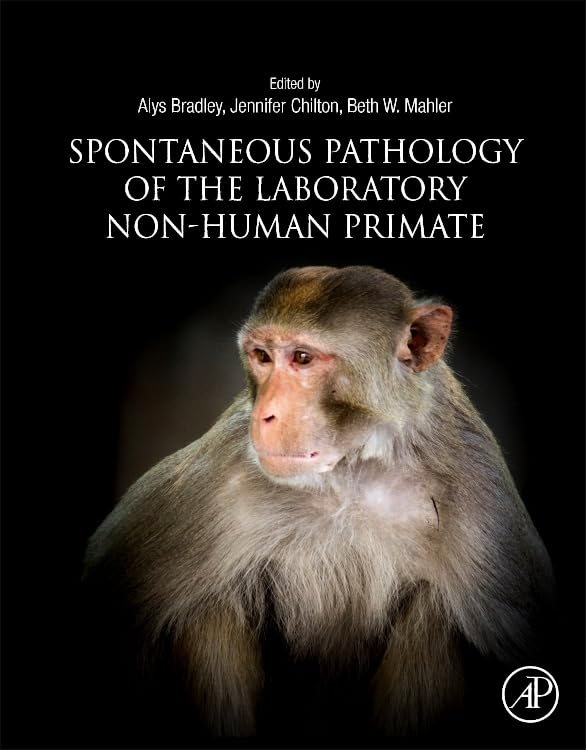



Spontaneous Pathology of the Laboratory Non-human Primate serves as a "go to" resource for all pathologists working on primates in safety assessment studies. In addition, it helps diagnostic veterinary pathologists rule out spontaneous non-clinical disease pathologies when assigning cause of death to species in zoological collections. Primate species included are rhesus, cynomolgus macaques and marmosets. Multi-authored chapters are arranged by organ system, thus providing the necessary information for continued research. Pathologists often face a lack of suitable reference materials or historical data to determine if pathologic changes they are observing in monkeys are spontaneous or a consequence of other treatments or factors. Contains color illustrations that depict the most common lesions to augment descriptions - Covers descriptions that are compliant with the International Harmonization of Nomenclature and Diagnostic Criteria (INHAND) guidelines set forth by the Society of Toxicologic Pathology (STP) - Provides pathologists with common terms that are compliant with the FDA’s Standard for Exchange of Nonclinical Data (SEND) guidelines “[A] reliable resource of consolidated references for pathologic processes in non-human primates,... a worthy objective as there are few dedicated pathology books in this arena.... This book is for pathologists working on primates in safety assessment studies and diagnostic veterinary pathologists working on non-human primates…. [and] would also be an asset for pathology residents and veterinary students seeking careers in laboratory animal medicine or laboratory animal pathology…. The systems chapters are the best aspect of the book. They provide good detail on pathologic processes based on organ system…. Overall, this is a useful book that consolidates knowledge from scattered resources on non-human primate pathology. Pathologists, residents, and students can use this book as a good starting point for disease investigation. --©Doody’s Review Service, 2024, Jonathan Samuelson, DVM MS (University of Illinois College of Veterinary Medicine) Comprehensive text that describes the spontaneous pathology seen in common laboratory primates, including rhesus, cynomolgus macaques and marmosets Spontaneous Pathology of the Laboratory Non-human Primate serves as a "go to" resource for all pathologists working on primates in safety assessment studies. In addition, it helps diagnostic veterinary pathologists rule out spontaneous non-clinical disease pathologies when assigning cause of death to species in zoological collections. Primate species included are rhesus, cynomolgus macaques and marmosets. Multi-authored chapters are arranged by organ system, thus providing the necessary information for continued research. Pathologists often face a lack of suitable reference materials or historical data to determine if pathologic changes they are observing in monkeys are spontaneous or a consequence of other treatments or factors. Dr. Bradley has been with Charles River since 1998 where she is the senior director of pathology. In this capacity she leads a team of veterinary pathologists and pathology analysts. She has specialist interest and provides consultancy services in neuropathology, non-human primate pathology, medical devices, and cellular therapy products (human and animal stem cells). She is an experienced study pathologist for acute, long term reproductive toxicology, tumorigenicity, oncogenicity, microautoradiography, target animal safety and carcinogenicity studies. She has authored over 700 GLP or GMP compliant toxicological peer reviewed pathology and photomicroscopy reports. She is the GLP and GMP Study Director as well as the Quality Control Manager for GMP pathology services. Dr. Chilton has been with Charles River since 2007 where she is the senior veterinary pathologist. She has specialist interest and provides consultancy services in neuropathology, non-human primate and comparative pathology. She has authored numerous GLP and investigative toxicological reports and is currently the neuropathology liaison to The National Chimpanzee Brain Resource (NCBR), George Washington University, Washington DC and staff pathologist for the Alamogordo Primate Facility, Alamogordo, NM. Ms. Mahler is a Pathology Associate with over 32 years of experience as a certified histologist (HT) in the areas of histology, animal necropsy, and digital photomicroscopy. Since 2006, she has served as the illustrations editor for the journal Toxicologic Pathology. Past illustrative editorship roles include associate editor of Pathology of the Mouse, edited by Dr Robert R. Maronpot.