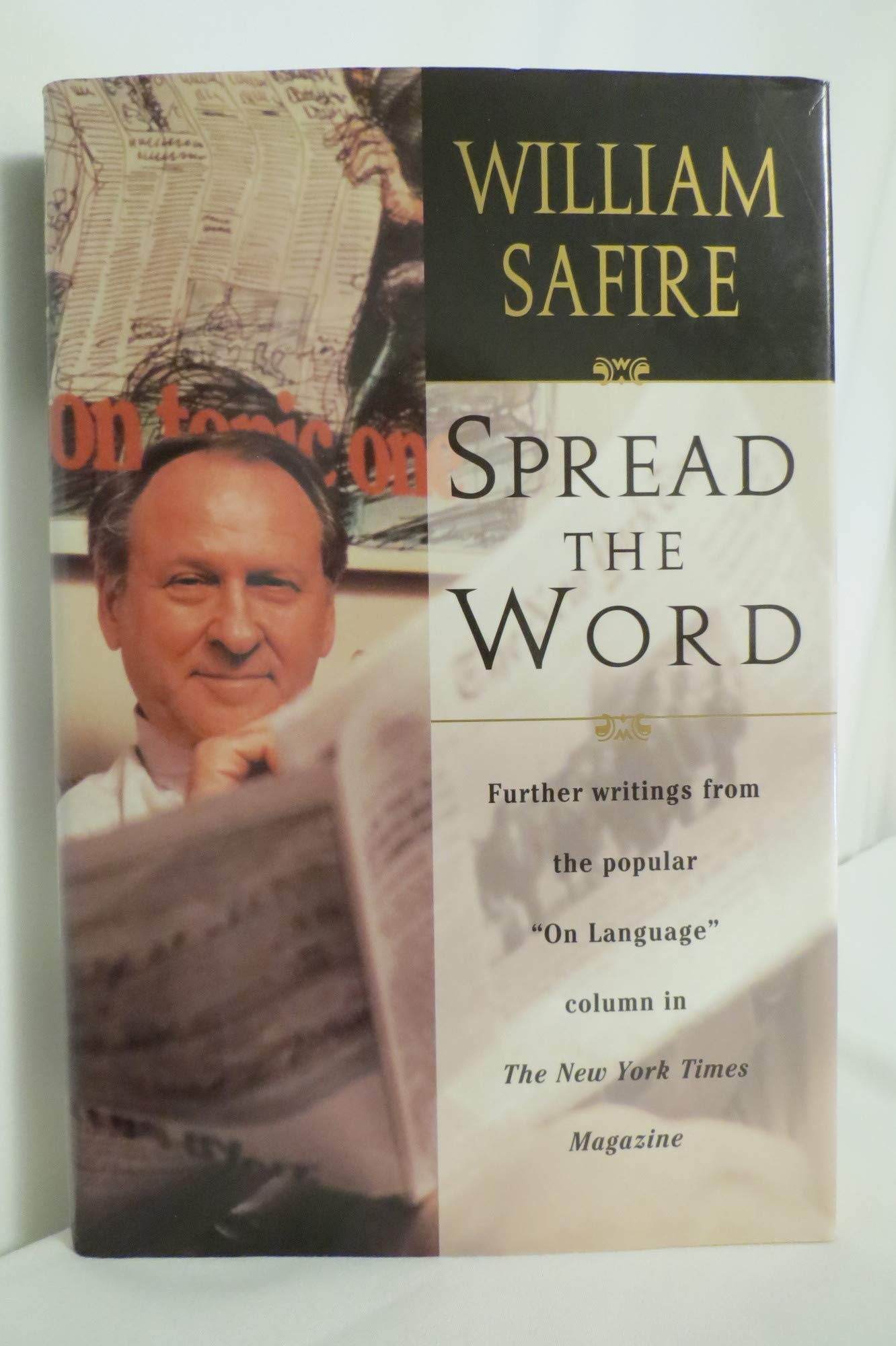



As William Safire writes in his introduction to Spread the Word , the eleventh book collecting his "On Language" columns from The New York Times Magazine , in language matters "it's a comfort to have a rule." And yet, as he makes clear throughout this entertaining collection, the question that confronts writers and public speakers daily is deciding when a rule should be applied rigorously to a linguistic dilemma, and when that rule is best sidelined by common sense. In the two decades that Safire has entertained and enlightened readers of his weekly column, he has consistently enlivened our national conversation about what's new and what's acceptable in language. In Spread the Word , he adroitly dissects the evolution of current phrases, verbal trends, and the origins of colloquialisms that often go unexamined. He tackles all topics, from the habits of newspaper editorial writers to teenagers' argot to the often tortured speech of politicians. Here, Safire examines such conundrums as the origin of There is no free lunch; the correct use of among and between; the evolution of the word babe; the subtle distinctions between diddly squat, diddle-daddle, and just plain diddle; the meaning of bad hair day, tough sell, hard love, and shoulda, coulda, woulda; the vogue status of such words as daunting, same-old-same-old, and dope; and the inherent humor of bananas. In this vigorous and erudite assemblage, which is organized alphabetically by topic, Safire shares his infectious curiosity about how we use words with an approach that is often amusing and always thought-provoking. In fact, "On Language" columns often elicit passionate comments from Safire's readers, the Lexicographic Irregulars. A lively selection of their letters on specific linguistic issues is interspersed throughout the book. From a reader in Providence, Rhode Island, "on the indispensability of the hyphen: Personals ads seem to be a goldmine of casual usage, never proofread and seldom submitted to grammarians for grading. One gem was from a man who started describing himself as a BIG FIRM ATTORNEY." And this from Fred Cassidy, chief editor of The Dictionary of American Regional English: "Your picture of the stupid dog not responding to the command 'sic 'em' reminds me of the corresponding cat story of the man who had made three holes in the bottom of his door so that his cats could come and go when the door was closed. An efficiency-minded neighbor asked him, Couldn't all your cats use a single hole? 'No!' he glared. 'When I say scat I mean scat!'" Shown by the many letters included here--and in the delight that the Gotcha! Gang takes in correcting America's foremost language maven--readers take great enjoyment in the national dialogue that William Safire fosters about words every week. William Safire's "On Language" column, 20 years old with the publication of this collection, is one of Sunday morning's great pleasures: Where else can one turn for a timely linguistic assessment of a president's inaugural speech, a corporation's annual report, or the use of terms such as stud muffin and horny ? A still greater pleasure is reading Safire's language columns in book form, where they are accompanied by letters from tireless members of the Nitpickers' League, the Gotcha! Gang, the Squad Squad, the Board of Octogenarian Mentors, and others. The columns may be Safire's, but the letters--from Jacques Barzun, Alistair Cooke, William A. Sabin, even Arthur Schlesinger Jr. and Benazir Bhutto--are allowed the final word. And imperfect wordsmiths everywhere may be relieved to know that even William Safire can make a mistake. "Sometimes," he writes in his introduction to Spread the Word , "a kindly copy editor will call to say, 'Are you deliberately trying to slip this egregious error into the paper?'" --Jane Steinberg Here are two new books by well-known columnists/language mavens. Safire is funny, thought-provoking, and, after 20 years of writing columns for the New York Times Magazine, an American institution. Gathering these columns and including many letters from readers, his book focuses on the way our language was used historically and how it is used now. The columns are clever and highly readable, and some of the letters from readers are just as much fun. Wallraff has been writing her witty column for The Atlantic Monthly for many years. Partly a style and usage manual that will be valuable for reference and on the corner of a writing desk, this book is also a written lecture by a great English teacher. Safire and Wallraff cover some of the same ground and sometimes differ, one notable example being the use of the article an before words that start with h such as historian. The best part of these books is, in most instances, that the "right" usage is not as important as reading about how the authors formed their opinions. Safire may have a slight edge owing to name recognition, but both books will put smiles on many a reader's face.A