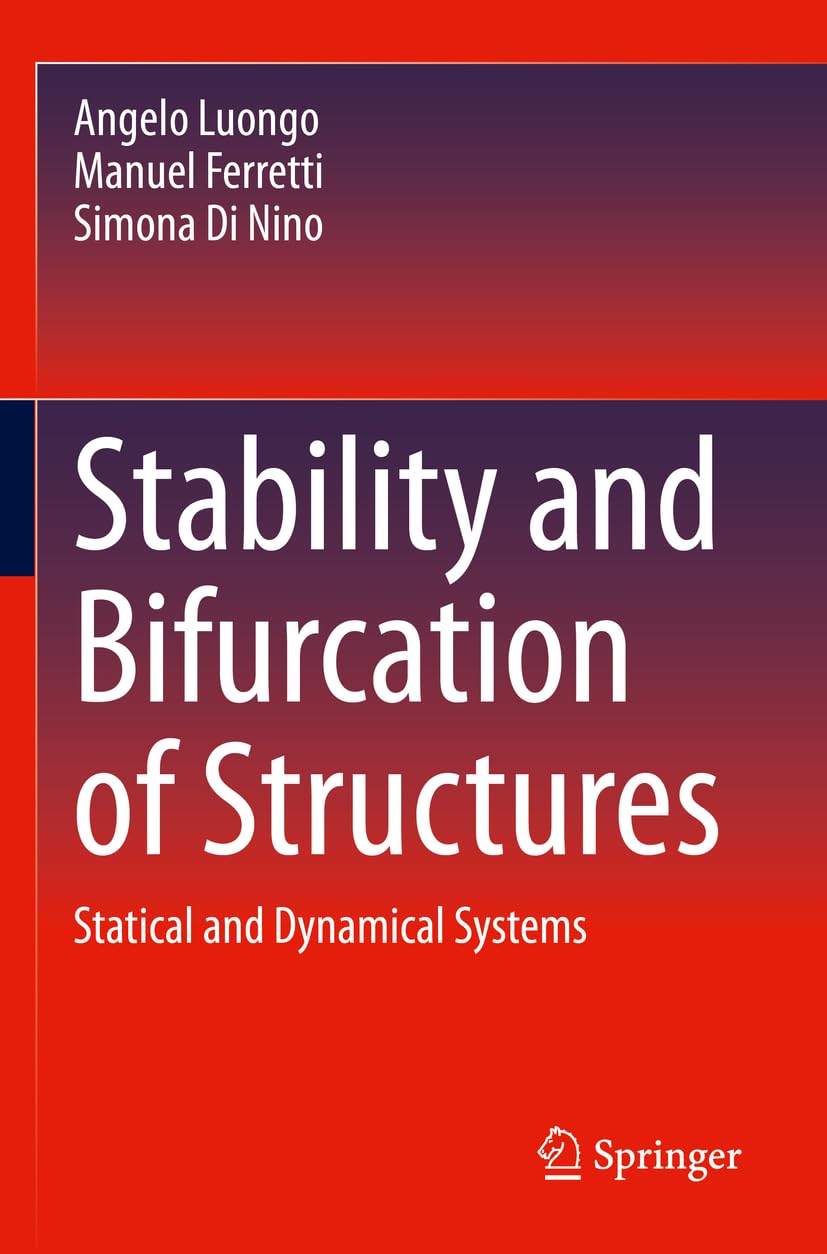
Stability and Bifurcation of Structures: Statical and Dynamical Systems
$89.99
by Angelo Luongo



This book overcomes the separation existing in literature between the static and the dynamic bifurcation worlds. It brings together buckling and post-buckling problems with nonlinear dynamics, the bridge being represented by the perturbation method, i.e., a mathematical tool that allows for solving static and dynamic problems virtually in the same way. The book is organized as follows: Chapter one gives an overview; Chapter two illustrates phenomenological aspect of static and dynamic bifurcations; Chapter three deals with linear stability analysis of dynamical systems; Chapter four and five discuss the general theory and present examples of buckling and post-buckling of elastic structures; Chapter six describes a linearized approach to buckling, usually adopted in the technical literature, in which pre-critical deformations are neglected; Chapters seven to ten, analyze elastic and elasto-plastic buckling of planar systems of beams, thin-walled beams and plate assemblies, respectively; Chapters eleven to thirteen, illustrate dynamic instability phenomena, such as flutter induced by follower forces, aeroelastic bifurcations caused by wind flow, and parametric excitation triggered by pulsating loads. Finally, Chapter fourteen discusses a large gallery of solved problems, concerning topics covered in the book. An Appendix presents the Vlasov theory of open thin-walled beams. The book is devoted to advanced undergraduate and graduate students, as well as engineers and practitioners. The methods illustrated here are immediately applicable to model real problems. The Book Introduces, in a simple way, complex concepts of bifurcation theory, by making use of elementary mathematics - Gives a comprehensive overview of bifurcation of linear and nonlinear structures, in static and dynamic fields - Contains a chapter in which many problems are solved, either analytically or numerically, and results commented “One of the book’s most commendable aspects is its balanced approach to mathematical rigor and conceptual clarity. … ‘Stability and bifurcation of structures’ is a meticulously crafted and highly valuable resource for students, researchers, and practicing engineers. … Whether approaching the topic for the first time or seeking a more unified perspective on stability problems, this book offers a rich and insightful journey through fundamental aspects of structural mechanics and their bifurcations.” (Joseph Páez Chávez, zbMATH 1566.37002, 2025) This book overcomes the separation existing in literature between the static and the dynamic bifurcation worlds. It brings together buckling and post-buckling problems with nonlinear dynamics, the bridge being represented by the perturbation method, i.e., a mathematical tool that allows for solving static and dynamic problems virtually in the same way. The book is organized as follows: Chapter one gives an overview; Chapter two illustrates phenomenological aspect of static and dynamic bifurcations; Chapter three deals with linear stability analysis of dynamical systems; Chapter four and five discuss the general theory and present examples of buckling and post-buckling of elastic structures; Chapter six describes a linearized approach to buckling, usually adopted in the technical literature, in which pre-critical deformations are neglected; Chapters seven to ten, analyze elastic and elasto-plastic buckling of planar systems of beams, thin-walled beams and plate assemblies, respectively; Chapters eleven to thirteen, illustrate dynamic instability phenomena, such as flutter induced by follower forces, aeroelastic bifurcations caused by wind flow, and parametric excitation triggered by pulsating loads. Finally, Chapter fourteen discusses a large gallery of solved problems, concerning topics covered in the book. An Appendix presents the Vlasov theory of open thin-walled beams. The book is devoted to advanced undergraduate and graduate students, as well as engineers and practitioners. The methods illustrated here are immediately applicable to model real problems. The Book Introduces, in a simple way, complex concepts of bifurcation theory, by making use of elementary mathematics - Gives a comprehensive overview of bifurcation of linear and nonlinear structures, in static and dynamic fields - Contains a chapter in which many problems are solved, either analytically or numerically, and results commented Angelo Luongo is Professor, DICEAA, University of L’Aquila, Italy. Manuel Ferretti is Associate Professor, DICEAA, University of L’Aquila, Italy. Simona Di Nino is a Research Fellow, DICEAA, University of L’Aquila, Italy.