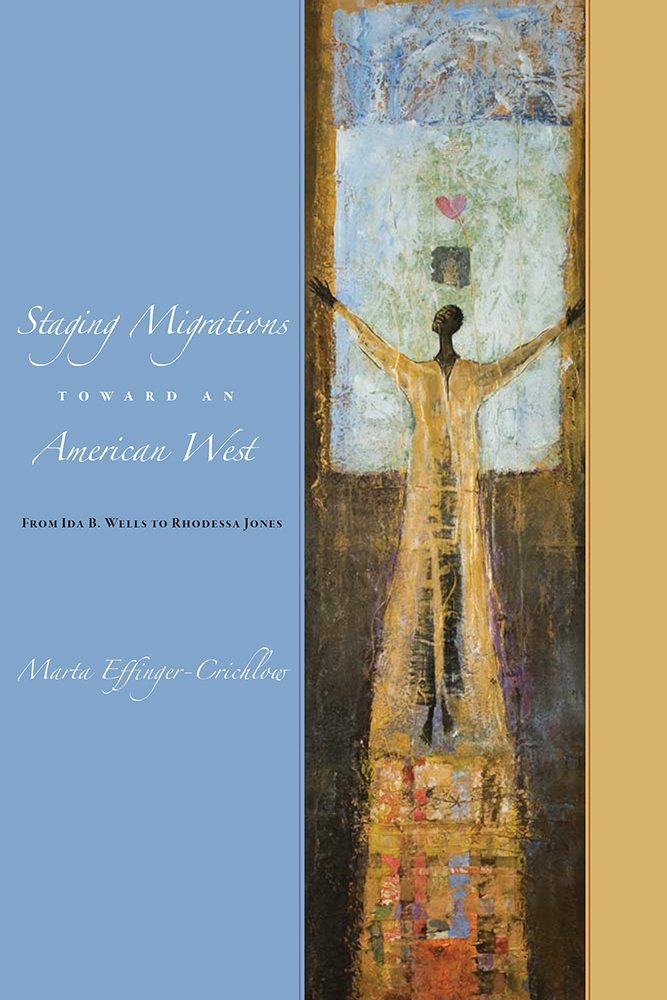
Staging Migrations toward an American West: From Ida B. Wells to Rhodessa Jones
$55.63
by Marta Effinger-Crichlow



Staging Migrations toward an American West examines how black women's theatrical and everyday performances of migration toward the American West expose the complexities of their struggles for sociopolitical emancipation. While migration is often viewed as merely a physical process, Effinger-Crichlow expands the concept to include a series of symbolic internal journeys within confined and unconfined spaces. Four case studies consider how the featured women―activist Ida B. Wells, singer Sissieretta "Black Patti” Jones, World War II black female defense-industry workers, and performance artist Rhodessa Jones―imagined and experienced the American West geographically and symbolically at different historical moments. Dissecting the varied ways they used migration to survive in the world from the viewpoint of theater and performance theory, Effinger-Crichlow reconceptualizes the migration histories of black women in nineteenth- and twentieth-century America. This interdisciplinary study expands the understanding of the African American struggle for unconstrained movement and full citizenship in the United States and will interest students and scholars of American and African American history, women and gender studies, theater, and performance theory. " Staging Migrations toward an American West fills a void in the scholarship of African American history, American history in general, women's history, feminist criticism, and performance theory. While most migration scholarship in these fields has focused on the 'Great Migration' of Black Americans moving from rural, Jim Crow south to northern industrial cities such as New York, Chicago, Pittsburgh, and Detroit, Effinger-Crichlow illuminates a westward migration that has been comparatively ignored.” —Judith Stephens-Lorenz, Pennsylvania State University "With exhaustive scholarly and archival research, site visits, personal interviews, and the establishing of an archive of narratives, Marta Effinger-Crichlow’s Staging Migrations Toward an American West examines how Black women’s on- and off-stage performances—as part of their western migrations—shape tales of personal and sociopolitical journeys toward freedom. . . . The unique theories and criticisms Effinger-Crichlow deploys will also make this book an invaluable resource for theatre and performance theorists and practitioners, feminist theorists, African American historians, and wider anthropological and ethnographic scholars." —kb saine, Continuum "[R]eaders looking for an intersectionality-influenced, history-based way of thinking about migration as a 'performance' of everyday life—especially in the lives of black women—will find this a wonderful text to incorporate into their library." —Journal of American History Marta Effinger-Crichlow is chair and associate professor in the African American Studies Department at New York City College of Technology-CUNY. Staging Migrations toward an American West From Ida B. Wells to Rhodessa Jones By Marta Effinger-Crichlow University Press of Colorado Copyright © 2014 University Press of Colorado All rights reserved. ISBN: 978-1-60732-311-2 Contents List of Figures, Acknowledgments, INTRODUCTION, ONE "Tell My People to go West": Ida B. Wells, TWO "I'd Go [Wherever] They Said 'Show'": The Black Patti Troubadours, THREE Wherever the Opportunity Was Goin' to Be I'd a Been Gone": Black Female Migrants in World War II's Defense Industry, FOUR "I Want to Go Home": Rhodessa Jones's The Medea Project: Theater for Incarcerated Women, EPILOGUE Rhodessa Jones's The Medea Project, CONCLUSION, Bibliography, Index, CHAPTER 1 "Tell My People to Go West" Ida B. Wells The city of Memphis has demonstrated that neither character nor standing avails the Negro if he dares to protect himself against the white man or become his rival. There is nothing we can do about the lynching now, as we are out-numbered and without arms. The white mob could help itself to ammunition without pay, but the order was rigidly enforced against the selling of guns to Negroes. There is therefore only one thing left that we can do; save our money and leave a town which will neither protect our lives and property, nor give us a fair trial in the courts, but takes us out and murders us in cold blood when accused by white persons. These words, written by Ida Bell Wells in an 1892 editorial about the lynching of Thomas Moss and his business partners, convey Wells's outrage over oppressive racial violence inflicted upon the black residents of Memphis. A witness claimed Moss begged "for his life for the sake of his wife and child and unborn baby." In his final moments, he cried out to his attackers, "Tell my people to go West — there is no justice for them here." Moss's words first appeared in the Memphis Commercial on March 10, 1892. At the time of the lynchings, Wells was away from Memphis spreading the word about her Free Speech and Headlight n