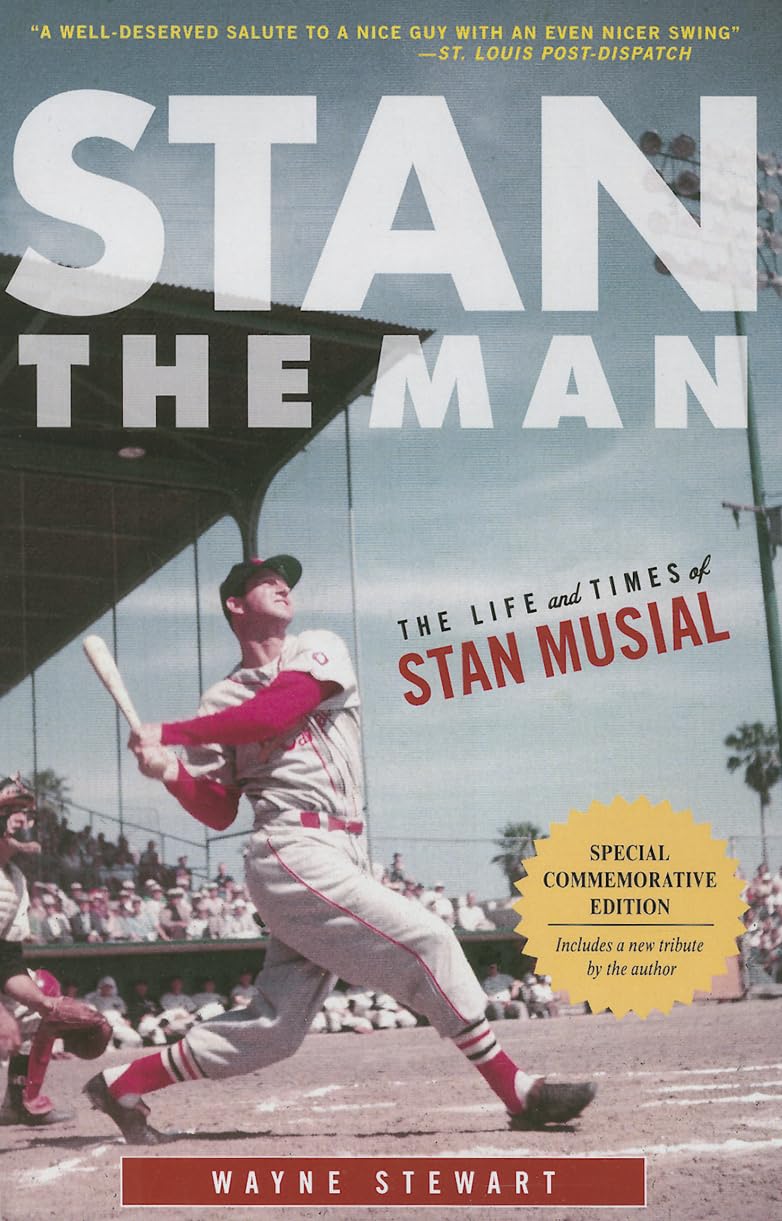



Broad in scope and deep in analysis, this biography of Stan Musial details not only the personality and the accomplishments of the man, but artfully examines his life against the backdrop of the Great Depression, which the already-impoverished Musial family endured. It looks at Stan’s support racial integration in baseball, as well as the tragedy that struck his hometown of Donora, Pennsylvania, and claimed many lives, including his father’s. The slew of never-before-published material and revealing anecdotes gained through numerous exclusive interviews with former classmates, relatives, friends, teammates, and contemporaries allow this book to shed fresh light on the legendary Musial while making the book a must-read for all baseball fans. This updated, paperback edition includes a new, commemorative section written after Musial’s passing. Wayne Stewart has written more than 500 sports articles for publications such as Baseball Digest , Boys’ Life , and USA Today Baseball Weekly , and is the author of 25 books, including Babe Ruth: A Biography and Baseball Dads . He lives in Lorain, Ohio. Stan the Man The Life and Times of Stan Musial By Wayne Stewart Triumph Books Copyright © 2014 Wayne Stewart All rights reserved. ISBN: 978-1-60078-948-9 Contents Acknowledgments, Introduction, Prologue, 1. Stan "the Boy" Musial, 2. The Making of a Man, 3. The Minors and the Million-Dollar Accident, 4. A Supernova Appears — "Nobody, but Nobody, Can Be That Good", 5. A Cornucopia of Batting Crowns, 6. More Glory, More Golden Years, 7. All Good Things Must ..., 8. Beyond the Field, 9. Kudos, 10. The Legacy of the Man — Cooperstown and Beyond, Epilogue, Appendix. Records, Stats, and Feats, Sources, About the Author, Photo Gallery, CHAPTER 1 Stan "the Boy" Musial Long before he was Stan the Man, he was Stanislaus Frank Musial, the boy. To use a steel metaphor, which is fitting since he was born in a steel town, he was a blast-furnace product composed of a mixture of three ingredients: environment, heredity, and his times. Musial's hometown of Donora, nestled in the Monongahela Valley in western Pennsylvania, is a very rugged Rust Belt town populated by equally rugged men. The town sits in Washington County, named after the man who surveyed it, George Washington. By the time Musial was born, there were 350 coal mines and more than 30 steel mills in the Pittsburgh vicinity. Donora hosted a coal mine and the thriving United States Steel's American Steel and Wire Company, which perched near the Monongahela River. The Monongahela curls around Donora on its way to rendezvous with the Allegheny River. From the river's horseshoe curve, the streets of town sloped upward, and many of the houses squatted at precipitous angles to those streets. In icy and snowy weather, cars strained and groaned up the myriad steep hills, desperately seeking a toehold. Meanwhile, children streaked down the same streets, almost sans friction, in a sled rider's paradise. Longjohns were de rigueur, sometimes for sleepwear, and even women and children became adept at banking their coal furnaces at night. Nicknamed "the Home of Champions," the town has always loved sports and been a veritable hotbed of athleticism. Donora has also been home to a variety of nationalities. In the past, each ethnic group was steadfastly proud of its accolades — its Polish toughness or its Italian grit or its Slovenian strength. Stan's Polish heritage was indeed a point of pride. "Very much so," agreed Donora native Ted Musial (unrelated to Stan). "He liked to be called 'Stash.' In Polish, that's Stanley. " Donoran Wallace Zielinski said, "All of the ethnic groups that came at the turn of the century more or less stuck with themselves — they went to their own churches, they went to their own clubs. They went there and they spoke their language. The churches had their priests that came from the same country and would speak their sermons in their language. When I was an altar boy, the priests would speak the sermon in Polish and in English — we would be there forever." John Benyo Jr. of Donora said his grandfather, John Danek, whose native tongue was Polish, worked in the mill, where he gained the nickname "Manzanas," (meaning apples ) from his Spanish coworkers because he always packed an apple in his lunch pail. "I can remember walking uptown with him and hearing, 'Hey, Manzanas, como esta?' My grandfather could actually speak better Spanish than he could English. Those guys worked together in the mill — they spoke Polish, they spoke Spanish, they spoke a little bit of Italian. Enough just to get by, so you could understand each other. And what got me was black people speaking Polish." Joe Barbao Jr., whose father once coached Musial, stated, "You had so many different dialects in Donora and you got to understand different languages just listening to [fellow natives]. The first thing you know, you start talking like them, e