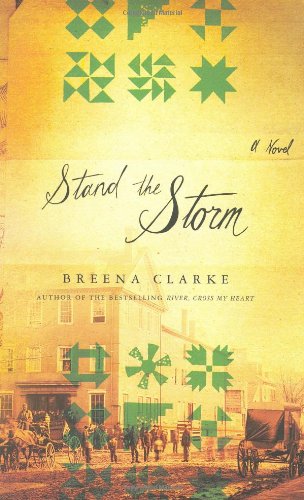



Even though Sewing Annie Coats and her son, Gabriel, have managed to buy their freedom, their lives are still marked by constant struggle and sacrifice. Washington's Georgetown neighborhood, where the Coatses operate a tailor's shop and laundry, is supposed to be a "promised land" for former slaves but is effectively a frontier town, gritty and dangerous, with no laws protecting black people. The remarkable emotional energy with which the Coatses wage their daily battles-as they negotiate with their former owner, as they assist escaped slaves en route to freedom, as they prepare for the encroaching war, and as they strive to love each other enough-is what propels STAND THE STORM and makes the novel's tragic denouement so devastating. Like her first work of historical fiction, Stand the Storm weaves together the tale of an African American family struggling to cope in a white world. Although this novel takes place a few generations before River, Cross My Heart , it packs an equally powerful punch. Despite its horrors and violence, Stand the Storm is a surprisingly uplifting love story about men and women attempting to free themselves from bondage. Critics praised the emotional depth of Clarke’s characterizations and her compelling portrayal of life in a city that discriminates against its African American inhabitants. They diverged slightly on the quality of the writing, but the memorable cast of characters—primary and secondary—as well as the humane story more than made up for any flaws. Copyright 2008 Bookmarks Publishing LLC In this story of a slave family buying its freedom, Clarke illuminates and personalizes a dreadful part of our nation’s past. Skilled needleworker Sewing Annie at Ridley Plantation in St. Mary’s County, Maryland, trains her son, Gabriel, so well that at the age of 10, he’s hired out to a tailor in Georgetown (also the site of Clarke’s best-selling debut River, Cross My Heart, 1999). Gabriel is successful enough to buy manumission in 1854 for himself and his family, a bargain abrogated by crafty Jonathan Ridley in 1862 when District of Columbia slaves are decreed free with their owners eligible for compensation. Although the family, taking the surname Coats, no longer suffers the cruelty commonly meted out to persons considered the property of others, abject humiliation and threats to their liberty continue. Clarke laces the novel with details, including accounts of syndicates of African American laundry women and U.S. black troops, to the extent that plot becomes secondary. Although some incidents seem extraneous, and even primary characters are dispatched with unseemly haste, this is a vivid view of slavery. --Michele Leber "[Clarke's] knowledge of the period and the novel's dense, deliberate narrative create a poignant story about the intricacies of human bondage and its dissolution, built around a family's unshakable faith in one another." (starred review) ( Publishers Weekly ) "...illuminates and personalizes a dreadful part of our nation's past...a vivid view of slavery." ( Booklist Michele Leber ) "Clarke's sensitivity and her lyrical, earthy narration bring a freshness to the somber subject matter." ( Kirkus Reviews ) Breena Clarke grew up in Washington, DC, and was educated at Webster College and Howard University. Her one previous novel, RIVER, CROSS MY HEART, was a selection of Oprah's Book Club and became an international bestseller. Reviewed by Gail Buckley I loved this book. I loved these people: The Coats family of Stand the Storm are quasi-free Negroes living in Georgetown just before, during and after the Civil War. Breena Clarke has written another stirring work of historical fiction that weaves the passionate, dramatic and uplifting story of the African American aspiration for true freedom into the great American tapestry. Sewing Annie, whose husband had been sold away by her owner, Jonathan Ridley, knew that slaves with special skills were last to be sold. So she determined to teach her two children, Gabriel and Ellen, everything she knew about sewing, weaving, knitting, dyeing and the magical lore of quilts. "A woman whose every day was applied to the task of survival," Sewing Annie not only taught Gabriel about scissors and cloth; she taught him how to study whites without their knowing it, and how to disarm them. "Don't let them read your eyeballs," she says. "Keep them low and quiet." At the age of 10, while still a slave, Gabriel is hired out to Georgetown tailor Abraham Pearl. Privately disapproving of slavery, Pearl treats Gabriel as an apprentice and assistant. Eight years later, Pearl decides to sell his shop to Ridley and move west -- leaving Gabriel a chest full of regulation military buttons. Keeping all profits for himself, Ridley puts Gabriel in charge of the business but makes his treacherous nephew the overseer. Annie handles the overseer by providing the perfect cup of hot black coffee for his daily hangovers: "Annie thus charmed him