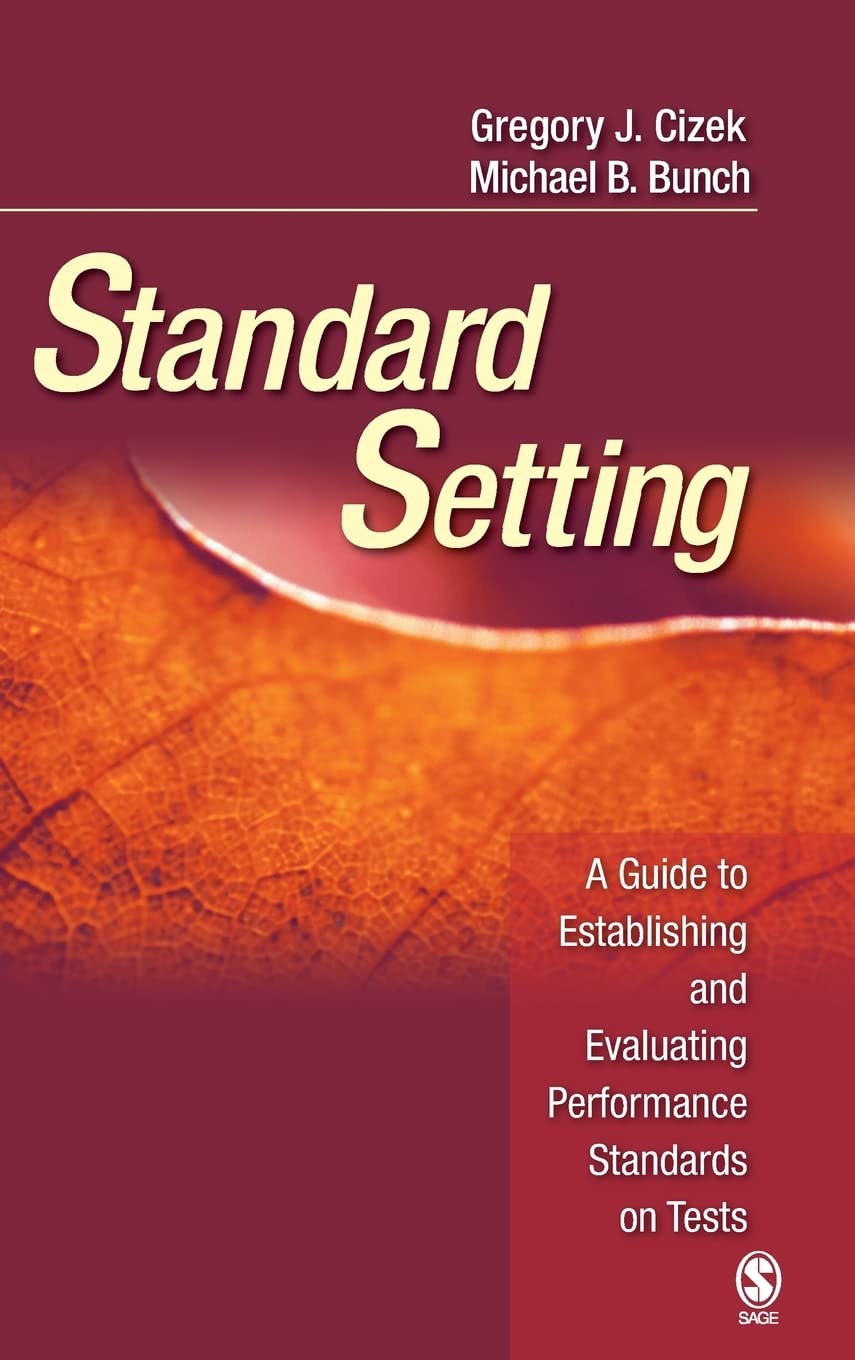
Standard Setting: A Guide to Establishing and Evaluating Performance Standards on Tests
$178.97
by Gregory J. Cizek



" Standard Setting: A Guide to Establishing and Evaluating Performance Standards on Tests is a well-timed text, given the legislated requirement of performance standards in our K-12 educational system, as well as the continued need in the process of credentialing professionals. This book would be useful to individuals retained to produce or coordinate standard-setting activites." ― PSYCCRITIQUES In Standard Setting: A Guide to Establishing and Evaluating Performance Standards on Tests , authors Gregory J. Cizek and Michael B. Bunch provide the only "go-to" reference on how to set standards on tests in education, licensure, and certification. This book is comprehensive in scope, practical in nature, and definitive in terms of cataloguing the essential conceptual and procedural fundamentals of setting performance standards. Key Features: Offers a detailed description of procedures: In a practical, straightforward, and virtually jargon-free style, this book begins with important foundational and conceptual information about standard setting followed by step-by-step procedures for all currently used methods, including Angoff, Item Mapping, Analystic Judgment, etc. In addition, a full chapter is devoted to future issues and research in standard setting. - Enables readers to design, implement, and evaluate a standard setting study: Using this book, readers will be able to: select an appropriate standard setting method; schedule and plan implementation; identify and train qualified standard-setting participants; conduct the standard setting meeting; calculate one or more cut scores; and evaluate the success of the procedure they have implemented. - Allows readers to adapt written materials to their situation: Examples are provided in widely available formats such as Excel, SPSS, .pdf and Word files so readers do not have to purchase specialized software or learn to use unfamiliar packages. The book includes downloadable forms, sample correspondence, checklists, data sets, and analytical software for performing calculations required for various standard setting procedures. Intended Audience: This is an excellent supplementary textbook for graduate courses such as Applied Measurement in Education; Psychometric Theory; Advanced Educational Measurement; Special Topics in Measurement and Evaluation; Seminar in Educational and Psychological Measurement in the departments of Educational Psychology, Measurement and Evaluation, Psychology, and others. A well-timed text, given the legislated requirement of performance standards in our K-12 educational system, as well as the continued need in the process of credentialing professionals. This book would be useful to individuals retained to produce or coordinate standard-setting activites. -- PsycCritiques Published On: 2007-12-14 It is abundantly apparent that the authors know standard setting and themselves have implemented numerous standard-setting procedures using different methods for different types of assessment programs.... Although the book is very practical, someone who has a fair amount of knowledge in standard setting will not feel shortchanged. There is a richness in the discussions of the methods that engages the reader, such as the different modifications of a method and the situational challenge that warranted each modification. Also, when a specific implementation of a method is discussed in detail, the authors are very conscientious in discussing the impetus for the adaptations. The historical perspective presented for some of the methods is quite intriguing. -- Journal of Educational Measurement Published On: 2011-01-19 Gregory J. Cizek is Professor of Educational Measurement at the University of North Carolina, Chapel Hill. His background in the field of educational assessment includes five years as a manager of licensure and certification testing programs for American College Testing (ACT) in Iowa City, Iowa, and 15 years of teaching experience at the college level, where his teaching assignments have consisted primarily of graduate courses in educational testing, research methods, and statistics. He is the author of over 200 books, chapters, articles, conference papers, and reports. His books include Handbook of Educational Policy (Academic Press, 1998); Cheating on Tests: How to Do It, Detect It, and Prevent It (Lawrence Erlbaum, 1999); Setting Performance Standards: Concepts, Methods, and Perspectives (Lawrence Erlbaum, 2001); and Detecting and Preventing Classroom Cheating (Corwin Press, 2003). Dr. Cizek has served as an elected member and vice president of a local school board in Ohio, and he currently works with several states, organizations, and the U.S. Department of Education on technical and policy issues related to large-scale standards-based testing programs for students in grades K–12. He began his career as an elementary school teacher in Michigan, where he taught second and fourth grades. Michael B. Bunch is Vic