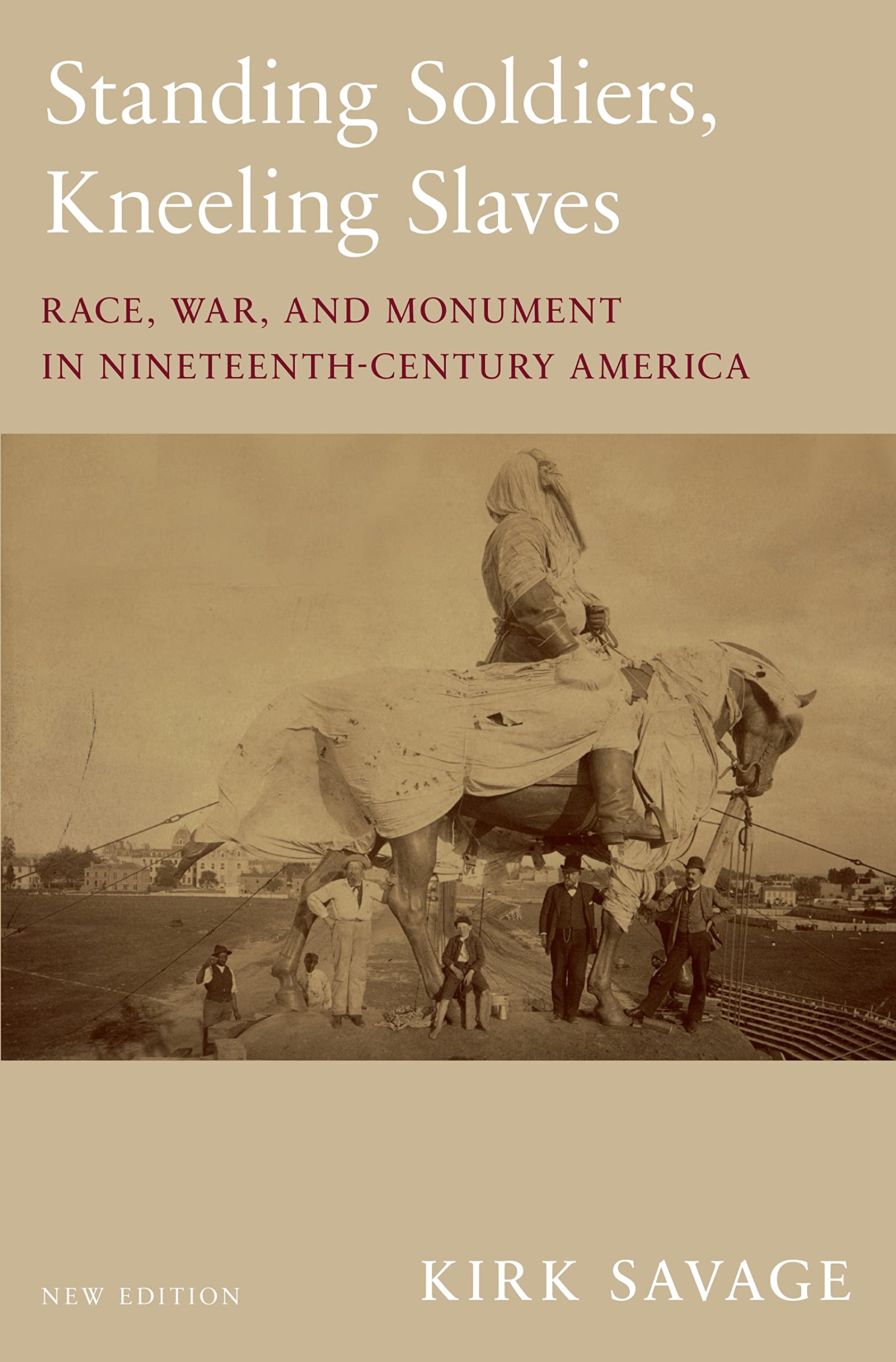
Standing Soldiers, Kneeling Slaves: Race, War, and Monument in Nineteenth-Century America, New Edition
$14.81
by Kirk Savage



A history of U.S. Civil War monuments that shows how they distort history and perpetuate white supremacy The United States began as a slave society, holding millions of Africans and their descendants in bondage, and remained so until a civil war took the lives of a half million soldiers, some once slaves themselves. Standing Soldiers, Kneeling Slaves explores how the history of slavery and its violent end was told in public spaces―specifically in the sculptural monuments that came to dominate streets, parks, and town squares in nineteenth-century America. Looking at monuments built and unbuilt, Kirk Savage shows how the greatest era of monument building in American history took place amid struggles over race, gender, and collective memory. Standing Soldiers, Kneeling Slaves probes a host of fascinating questions and remains the only sustained investigation of post-Civil War monument building as a process of national and racial definition. Featuring a new preface by the author that reflects on recent events surrounding the meaning of these monuments, and new photography and illustrations throughout, this new and expanded edition reveals how monuments exposed the myth of a "united" people, and have only become more controversial with the passage of time. "[A] tour de force." -- Library Journal "A richly detailed and engagingly written study." -- Boston Globe "An important and innovative work that will surely gain a wide scholarly audience . . . My hope is that it will also gain the wider readership its message deserves among the civic leaders who shape public policy and the general citizenry who both inherit and build the public monuments that guide public memory. Though the story Savage traces is often a discouraging one, his message is ultimately hopeful. By understanding how we have defined our past and our present through the lasting medium of public sculpture, we can imagine how we can shape, and perhaps redeem our future." --Catherine W. Bishir, Journal of the Society of Architectural Historians "In a fascinating study of public space and the less-than-public contradictions of nineteenth-century culture, Kirk Savage sheds light not only on memory and monument but also on the invention of the 'popular' itself." --Henry Louis Gates, Jr. "Kirk Savage shows ingenuity in his analysis and interpretation of post-war commemorative sculpture." -- Times Literary Supplement "In a fascinating study of public space and the less-than-public contradictions of nineteenth-century culture, Kirk Savage sheds light not only on memory and monument but also on the invention of the 'popular' itself." ―Henry Louis Gates, Jr. "A richly detailed and engagingly written study." ― Boston Globe "Kirk Savage shows ingenuity in his analysis and interpretation of post-war commemorative sculpture." ― Times Literary Supplement "An important and innovative work that will surely gain a wide scholarly audience. . . . My hope is that it will also gain the wider readership its message deserves among the civic leaders who shape public policy and the general citizenry who both inherit and build the public monuments that guide public memory. Though the story Savage traces is often a discouraging one, his message is ultimately hopeful. By understanding how we have defined our past and our present through the lasting medium of public sculpture, we can imagine how we can shape, and perhaps redeem our future." ―Catherine W. Bishir, Journal of the Society of Architectural Historians "[A] tour de force." ― Library Journal Kirk Savage is the William S. Dietrich II Professor of History of Art and Architecture at the University of Pittsburgh. He is the author of Monument Wars: Washington D.C., the National Mall, and the Transformation of the Memorial Landscape (Princeton) and the editor of The Civil War in Art and Memory . Standing Soldiers, Kneeling Slaves Race, War, and Monument in Nineteenth-Century America By Kirk Savage PRINCETON UNIVERSITY PRESS Copyright © 2018 Princeton University Press All rights reserved. ISBN: 978-0-691-18315-2 Contents Preface to the New Edition, ix, Acknowledgments, xv, Chapter One Introduction, 3, Chapter Two Exposing Slavery, 21, Chapter Three Imagining Emancipation, 52, Chapter Four Freedom's Memorial, 89, Chapter Five Slavery's Memorial, 129, Chapter Six Common Soldiers, 162, Chapter Seven Epilogue, 209, Notes, 215, Index, 259, Illustration Credits, 271, CHAPTER 1 INTRODUCTION The United States of America originated as a slave society, holding millions of Africans and their descendants in bondage, and remained so until a civil war took the lives of a half million soldiers, some once slaves themselves. This book explores how that history of slavery and its violent end was told in public space — specifically in the sculptural monuments that increasingly came to dominate public space in nineteenth-century America. The shift from slaver