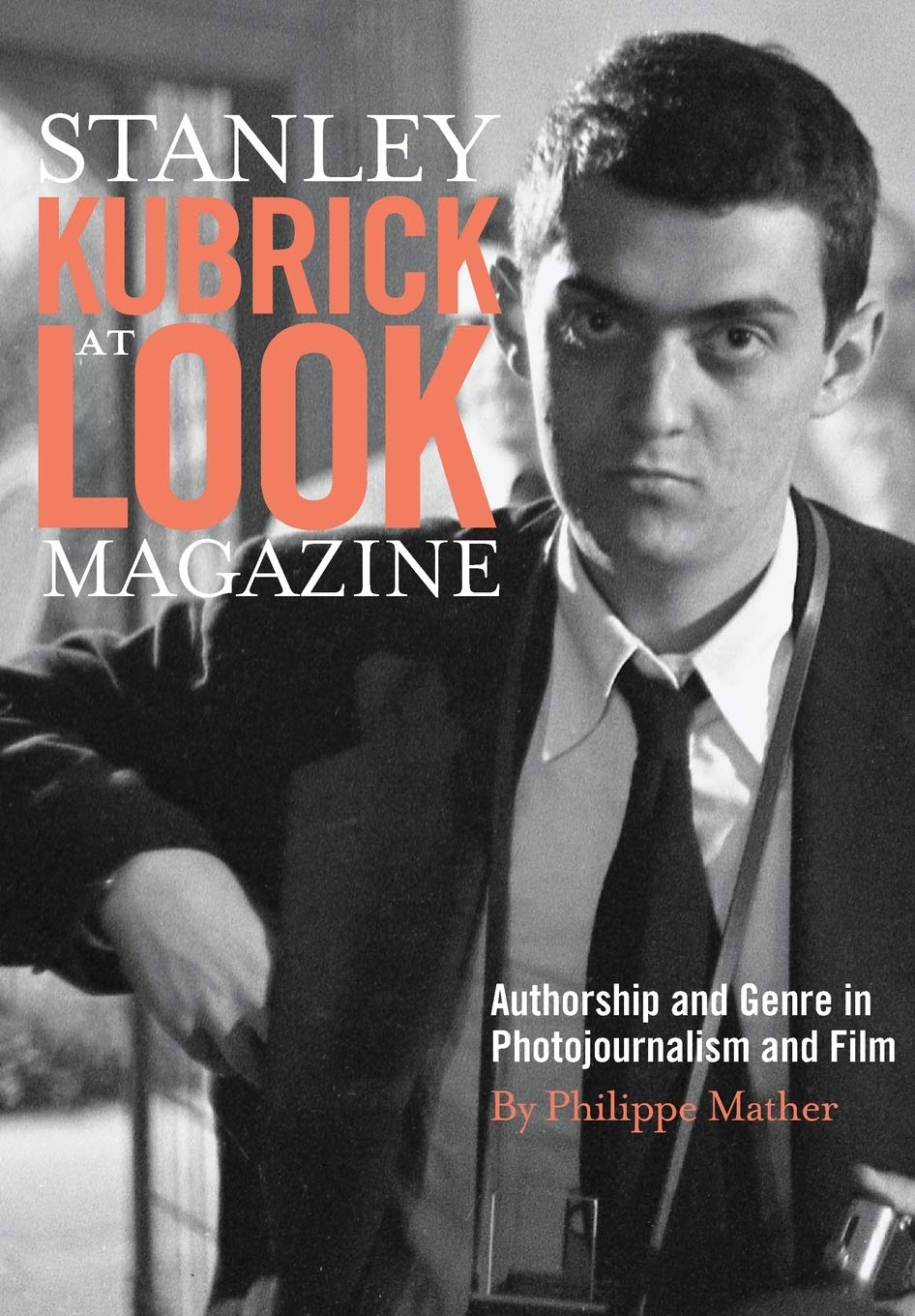
Stanley Kubrick at Look Magazine: Authorship and Genre in Photojournalism and Film
$21.50
by Philippe D. Mather



From 1945 to 1950, during the formative years of his career, Stanley Kubrick worked as a photojournalist for Look magazine. Offering a comprehensive examination of the work he produced during this period—before going on to become one of America’s most celebrated filmmakers— Stanley Kubrick a t "Look " Magazine sheds new light on the aesthetic and ideological factors that shaped his artistic voice. Tracing the links between his photojournalism and films, Philippe Mather shows how working at Look fostered Kubrick’s emerging genius for combining images and words to tell a story. Mather then demonstrates how exploring these links enhances our understanding of Kubrick’s approach to narrative structure—as well as his distinctive combinations of such genres as fiction and documentary, and fantasy and realism. Beautifully written and exhaustively researched, Stanley Kubrick a t "Look " Magazine features never-before-published photographs from the Look archives and complete scans of Kubrick’s photo essays from hard-to-obtain back issues of the magazine. It will be an indispensable addition to the libraries of Kubrick scholars and fans. “A fascinating book.” -- Mark Moran ― PictureVille “By exploring the images captured by the teenager standing behind the still photography lens, Stanley Kubrick at “Look” Magazine brings more into focus the creative decisions made by the filmmaker as an adult.” -- Trevor Hogg ― Flickering Myth “Detailed and at times broad, it is fervently written and researched, and uncovers the sources of the 'Kubrickian worldview' whose origins have seldom been studied, nor particularly established.” -- Edward Frost ― CineVue Philippe Mather is associate professor of media studies at Campion College at the University of Regina, Saskatchewan. Stanley Kubrick at Look magazine Authorship and Genre in Photojournalism and Film By Philippe Mather Intellect Ltd Copyright © 2013 Intellect Ltd All rights reserved. ISBN: 978-1-84150-611-1 Contents Acknowledgements, Introduction, Part I: Authorship: A Sociology of Production, Chapter 1: Psychosocial Context: A Formative Period. Stanley Kubrick at Look Magazine in the Lifespan, Chapter 2: Macro-objective Analysis: Look Magazine's Organizational Structure, Chapter 3: Micro-objectivity: The Work Culture at Look Magazine, Chapter 4: Macro-subjectivity: Look Magazine's Conception of Photojournalism, Chapter 5: Micro-subjectivity: Stanley Kubrick's Conception of Photojournalism and Film, Part II: Genre: Contexts of Reception, Chapter 6: Photojournalism Genres: A Semantic/Syntactic/Pragmatic Approach, Chapter 7: Photography and Film: History, Ontology and Pragmatics, Chapter 8: From Photojournalism to Film: Transmedial Correspondences in the Formal and Stylistic Systems, Chapter 9: Photography in Film: Photographic and Documentary Aspects of Kubrick's Films, Conclusion, Appendix, Bibliography, Index, Photographic Credits, CHAPTER 1 Psychosocial Context: A Formative Period. Stanley Kubrick at Look Magazine in the Lifespan A fundamental premise for this study is the banal yet crucial notion that a young person's formative years usually have a lasting impact on his or her professional development, yet most auteurist accounts of Kubrick's career either downplay or ignore this early period in his life. I therefore turn to basic concepts in developmental psychology that offer the advantage of focusing on commonalities between people rather than unique individual qualities (Bocknek, 16). In the case of an artist such as Stanley Kubrick, there can indeed be a temptation to eschew social-psychological concerns and assume, based on the perceived quality of his later films, that he was an exceptional individual who was mostly self-directed, primarily influenced by internal goals. The popular expression "no man is an island" suggests a different emphasis, and one may reasonably argue that it is more informative to consider the extent to which Kubrick conformed to a profile of the typical middle-class teenager. This approach will make it easier to properly assess the impact of Kubrick's years at Look magazine, and highlight the formative dimension of that life period. His tenure at Look coincides with the college years, specifically the period 17 to 22 years of age, identified by Daniel Levinson as the early transition to adulthood in terms of psychosocial development (Berk, 447). This period is also described as "more influential than any other period of adulthood," largely due to its transitional function in the lifespan (Berk, 435). The young adult's development is the result of a complex interaction between personal talents and several factors included in the social-historical environment, such as cultural mores and family experiences (Bocknek, 23). Glen Evans and Millicent Poole describe two major kinds of "developmental frames," namely demographic variables (age, gender, parents' soc