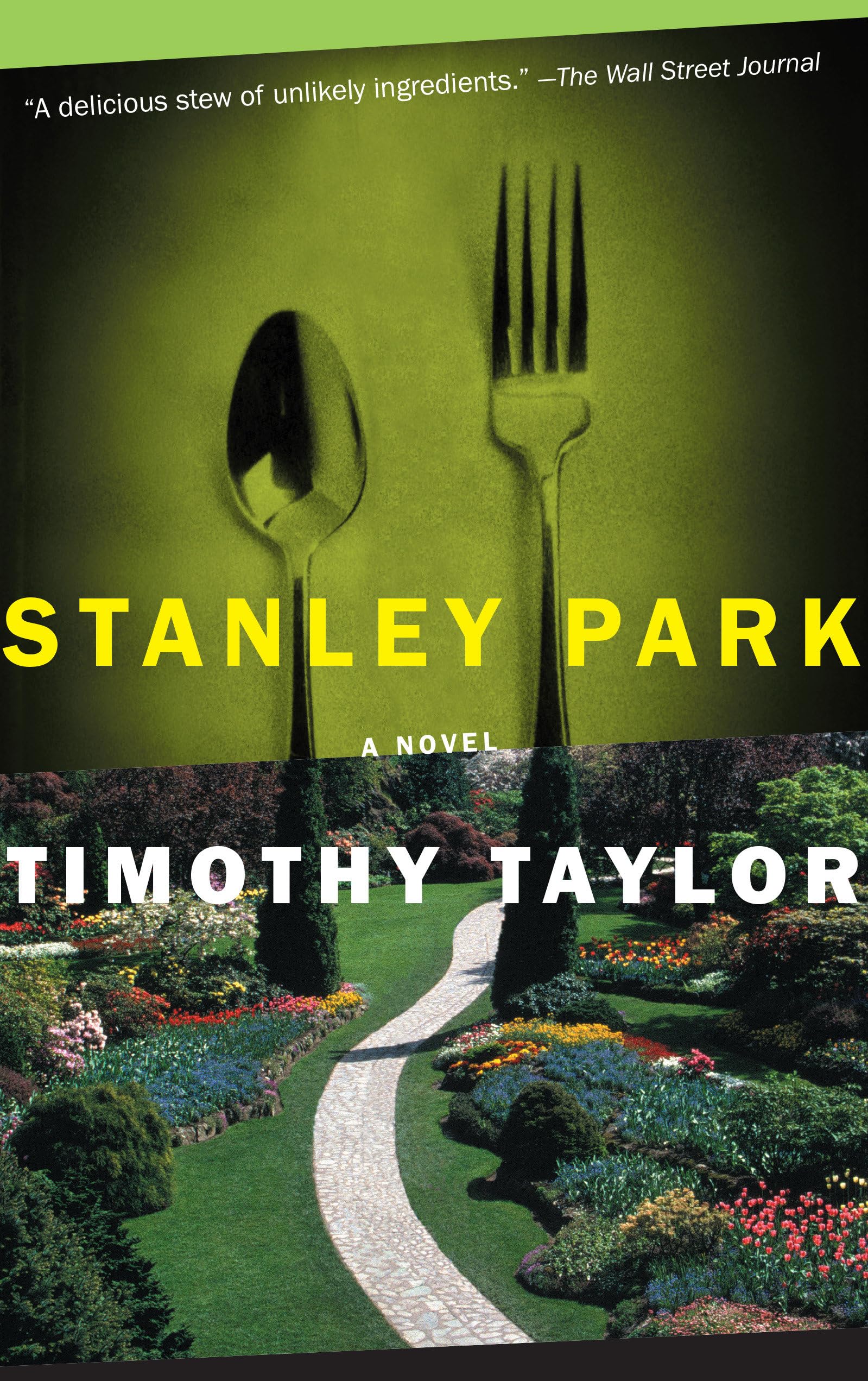



Overwhelmed by debts despite the success of his Pacific Northwest restaurant, Jeremy Papier agonizes over turning control over to a family friend who would bail him out of his troubles despite the firm objections of his chef, a situation that is further complicated when his eccentric father involves him in an urban murder mystery. Timothy Taylor is a Canadian novelist, short story writer, journalist, and professor of creative writing. Stanley Park By Timothy Taylor Counterpoint Press Copyright © 2003 Timothy Taylor All right reserved. ISBN: 9781582432908 the canvasback They arranged to meet at Lost Lagoon. It was an in-between place, the city on one side, Stanley Park on the other. Ten years of rare contact, and they had sought each other out. Surprised each other, created expectations. Now the Professor was late. Jeremy Papier found a bench up the hill from the lagoon and opened a section of newspaper across the wet boards. The bench was between two cherry trees, the pink blossoms of which met high over his head forming an arch, a doorway. It wasn’t precisely the spot they’d discussed–the Professor had suggested the boathouse–but it was within eyesight, within shouting distance. It was close enough. If he had to wait, Jeremy thought, settling onto the paper and blowing out a long breath, he was going to sit. He crossed one long, aching leg over the other. He fingered the tooling on a favourite pair of cowboy boots, ran long fingers through tangled black hair. He sat because he was tired, certainly. Jeremy accepted that being a chef, even a young chef, meant being exhausted most of the time. But there had also been a family portrait taken here, on this bench, years before. Also early spring, he remembered; the three of them had sat here under the cherry blossoms. Jeremy on the one side, seven years old. His mother, Hélène, on the other. The Professor had his arms around them both, feet flat on the grass. He looked extremely pleased. Jeremy’s mother was less obviously so, her expression typically guarded, although she made dozens of copies of the photo and sent these off to relatives spread across Europe from Ireland to Spain, from the Czech Republic to as far east as Bulgaria. Documenting settlement. He wondered if his father, who had no relations other than those in the photo, would remember this detail. Now Jeremy lit a cigarette and watched an erratic stream of homeless people making their way into the forest for the night. When he arrived there had been seawall walkers and hotdog eaters, birdwatchers, rollerbladers, chess players returning from the picnic tables over by bowling greens. Then lagoon traffic changed direction like a freak tide. The flow of those heading back to their warm apartments in the West End tapered to nothing, and the paths were filled with the delusional, the alcoholic, the paranoid, the bipolar. The Professor’s subjects, his obsession. The inbound. Four hundred hectares of Stanley Park offering its bleak, anonymous shelter to those without other options. Of course, Jeremy didn’t have to remind himself, the Professor had other options. They had discussed meeting on the phone earlier in the week. When Jeremy picked up–expecting a late reservation, maybe his black-cod supplier, who was due into Vancouver the next morning–he heard wind and trees rustling at the other end of the line. Normally reticent, the Professor was animated about his most recent research. “… following on from everything that I have done,” he said, “culminating with this work.” From his end, standing at a pay phone on the far side of the lagoon, the Professor could hear the dishwasher hammering away in the background behind his son’s tired response. “Participatory anthropology. Is that what you call it now?” Jeremy was saying. “I thought it was immersive.” “Like everything,” the Professor answered, “my work has evolved.” He needed help with something, the Professor said. He wanted to meet. “How unusual,” Jeremy said. “And what advice can I give on running a restaurant?” the Professor shot back. “None,” Jeremy answered. “I just said there was something I wanted to talk to you about. Something that had to do with the restaurant.” “Strange times,” the Professor said, looking into the darkness around the pay phone. Checking instinctively. Very strange. The stream of those inbound had slowed to a trickle. A trio of men passed, bent behind shopping carts that were draped and hung with plastic, heaped to the height of pack horses, bags full of other bags. Jeremy could only wonder at the purpose of them all, although the Professor could have told him that the bag itself captured the imagination. It held emblematic power. For its ability to hold, certainly. To secure contents, to carry belongings from place to place. But even the smell of the plastic, its oily permanence, suggested the resilience of things discarded. Jeremy watched the three men make their way around the lagoon and d