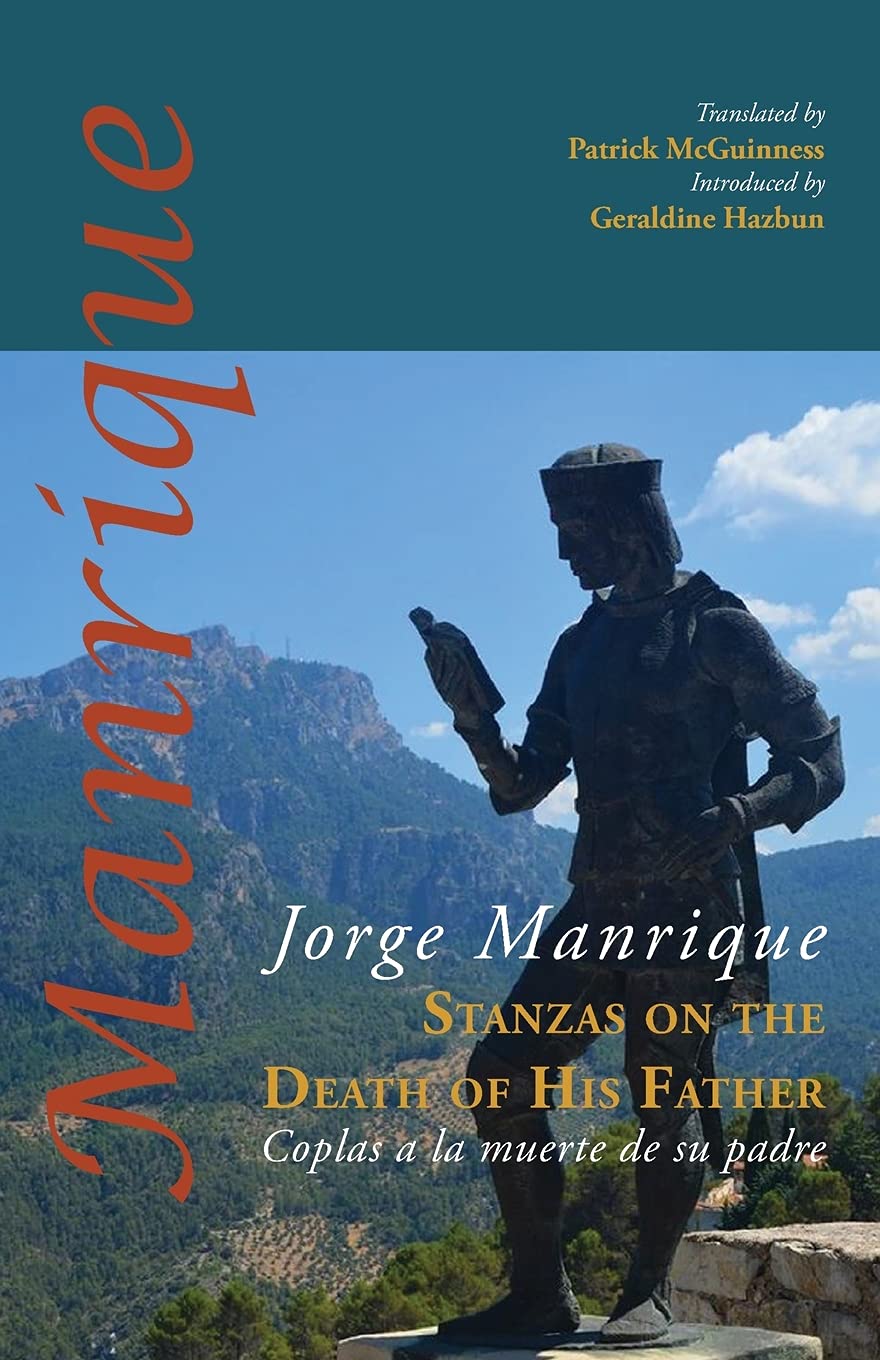
Stanzas on the Death of His Father: Coplas a la muerte de su padre (Shearsman Classics)
$18.00
by Jorge Manrique



Coplas por la muerte de su padre by Jorge Manrique (c.1440-79) is one of the most celebrated poems in the Spanish language. Written shortly before the poet's death, it is a dignified elegy that speaks not just of a personal loss, that of the poet's father Rodrigo Manrique (d.1476), but of the evanescence of all things sub specie aeternitatis . Its popularity is aided by memorable lines, not least the two opening metaphors: man's life is a river meandering unto the sea of death (st. 3), and this world is the road to the next, the lasting dwelling place (st. 5). The poem replicates these reflections in its wending form. Its forty stanzas each comprise four tercets; each tercet is made up of two longer octosyllabic verses combined with one four-syllable half line known as pie quebrado . These regular broken lines, like beats of a heart, invest the poem with a resonant quality befitting the injunction at the opening of the poem to awaken one's slumbering soul to the passage of time: 'Recuerde el alma dormida, avive el seso e despierte' (st. 1). Jorge Manrique (c.1440-79) came from an exemplary aristocratic background. His grand-father Pedro Manrique was governor of León and married Leonor of Castile, granddaughter of King Enrique II. Jorge's father Rodrigo was a towering figure of the fifteenth-century reconquest, a reputation founded on his military campaigns at the frontier. Rodrigo was honoured by King Juan II as Count of Paredes and elected Master of the Order of Santiago. Jorge's uncle, Gómez Manrique, was also a distinguished figure. A highly respected court poet and dramatist, he was corregidor of Toledo for fourteen years, an appointment possibly connected to his support for Isabel and Fernando, the Catholic Monarchs. As for Jorge himself, he too was actively involved in the political affairs of his time, often acting alongside his father for the cause of Isabel and Fernando. He became a captain of the Holy Brotherhood of Toledo in the later stages of his life and, as a result of military action at the castle of Garcimuñoz, died from his injuries in April 1479. Patrick McGuinness is Professor of French and Comparative Literature at Oxford, and Sir Win and Lady Bishoff Fellow in French at St Anne's College. He works on modern literature in French, as well as British and American poetry. His books include two volumes of poetry, two novels, and translations from a number of writers, including Mallarmé, Hélène Dorion and Gilles Ortlieb. His most recent books are a novel, Throw Me to the Wolves (2019), and Real Oxford (2021), an exploration of the city behind the dreaming spires. Geraldine Hazbun is Professor of Medieval Spanish Literature at Oxford and Ferreras Willetts Fellow in Spanish at St Anne's College. She works on literature from the medieval and early modern periods with particular focus on epic poetry, ballads, chronicles, and travel writing. Recent publications include Reading Illegitimacy in Early Iberian Literature (2020), Narratives of the Islamic Conquest from Medieval Spain (2015) and Treacherous Foundations: Betrayal and Collective Identity in Early Spanish Epic, Chronicle, and Drama (2009).