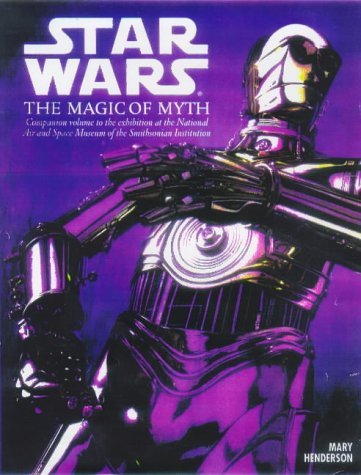



Star Wars(r) has captured the hearts and imaginations of millions and millions of people like no other story of our time. This official companion volume to the landmark exhibit at the Smithsonian Institution's National Air and Space Museum explores the mythological roots of the Star Wars saga, a story that will continue to unfold into the next millenium. Written by the exhibit's curator and illustrated with hundreds of photographs, drawings and images, Star Wars(r): The Magic of Myth illuminates this modern tale of the ageless and mythic battle of good versus evil. ars(r) has captured the hearts and imaginations of millions and millions of people like no other story of our time. This official companion volume to the landmark exhibit at the Smithsonian Institution's National Air and Space Museum explores the mythological roots of the Star Wars saga, a story that will continue to unfold into the next millenium. Written by the exhibit's curator and illustrated with hundreds of photographs, drawings and images, Star Wars(r): The Magic of Myth illuminates this modern tale of the ageless and mythic battle of good versus evil. As Joseph Campbell and other scholars have noted, there is a certain typical hero sequence of actions that can be found in most myths. First, the hero must separate from the ordinary world of his or her life up to the point at which the story begins; then, in the new world through which the journey takes place, the hero must undergo a series of trials and must overcome many obstacles in order to achieve an initiation into ways of being hitherto unknown; finally, the hero returns to share what he or she has learned with others. This story pattern can be found throughout classical mythology. Campbell himself cites the examples of Jason--who left the cave in which he was brought up in order to search for the Golden Fleece and then returned with his prize to recapture his homeland--and Prometheus, who traveled to Mount Olympus, stole fire from the gods, and brought it back to earth. The knights of King Arthur's Round Table set off to seek the Holy Grail, and the great figures of every major religion have each gone on a "vision quest," from Moses' journey to the mountain, to Jesus' time in the desert, Muhammad's meditations in the mountain cave, and Buddha's search for enlightenment that ended under the bodhi tree. As these last examples show, the journey is often not just a physical adventure that takes the hero from one place to another but it is also a spiritual one, as the hero moves from ignorance and innocence to experience and enlightenment. This is one reason why the middle leg of the journey is called "initiation"; as in the initiation rites of primitive cultures, the hero must give up the "childhood" that innocence and dependence represent and "come back as a responsible adult." In a psychological sense, then, this is a voyage of self-discovery, an expedition whose true destination is the realm within each of us, where we must find our own unique center with all its strengths and weaknesses. Joseph Campbell puts it this way: "All the life-potentialities that we never managed to bring to adult realization, those other portions of ourself are there [in the internal world]; for such golden seeds do not die. If only a portion of that lost totality could be dredged up into the light of day, we should experience a marvelous expansion of our powers, a vivid renewal of life. We should tower in stature. Moreover, if we could dredge up something forgotten not only by ourselves hut by our whole generation or our entire civilization, we should become indeed the boon-bringer, the culture hero of the day- a personage of not only local but world historical moment." If we look at Luke Skywalker's story in this light, its meaning begins to glow. Luke's journey through the three films transforms him from a rebellious and impatient teenager, itching for adventure, into a grown-up hero who has confronted his strengths and weaknesses and found the power to help save the world. Along the way, he encounters ogres and wizards, mazes and traps-the archetypal symbols of the hero's journey. In cracking his voyage, we will identify all the classical elements that help to make a myth of Star Wars. But Luke's is not the only journey, the only transformation, that the Star Wars trilogy describes. Part of the joy and fascination of this particular myth is that it is full of heroes, sometimes found in the most unlikely places. Several of the main characters set off on a journey, encounter trials, and return profoundly changed. We will also see how Han Solo, the princess Leia Organa, and even Darth Vader and See-Threepio go through their own transformations and discover their deeper natures. In myth, heroes are almost always drawn from the extremes of life; they are often either princes or paupers. Sometimes the hero is the child of distinguished parents--the fathe