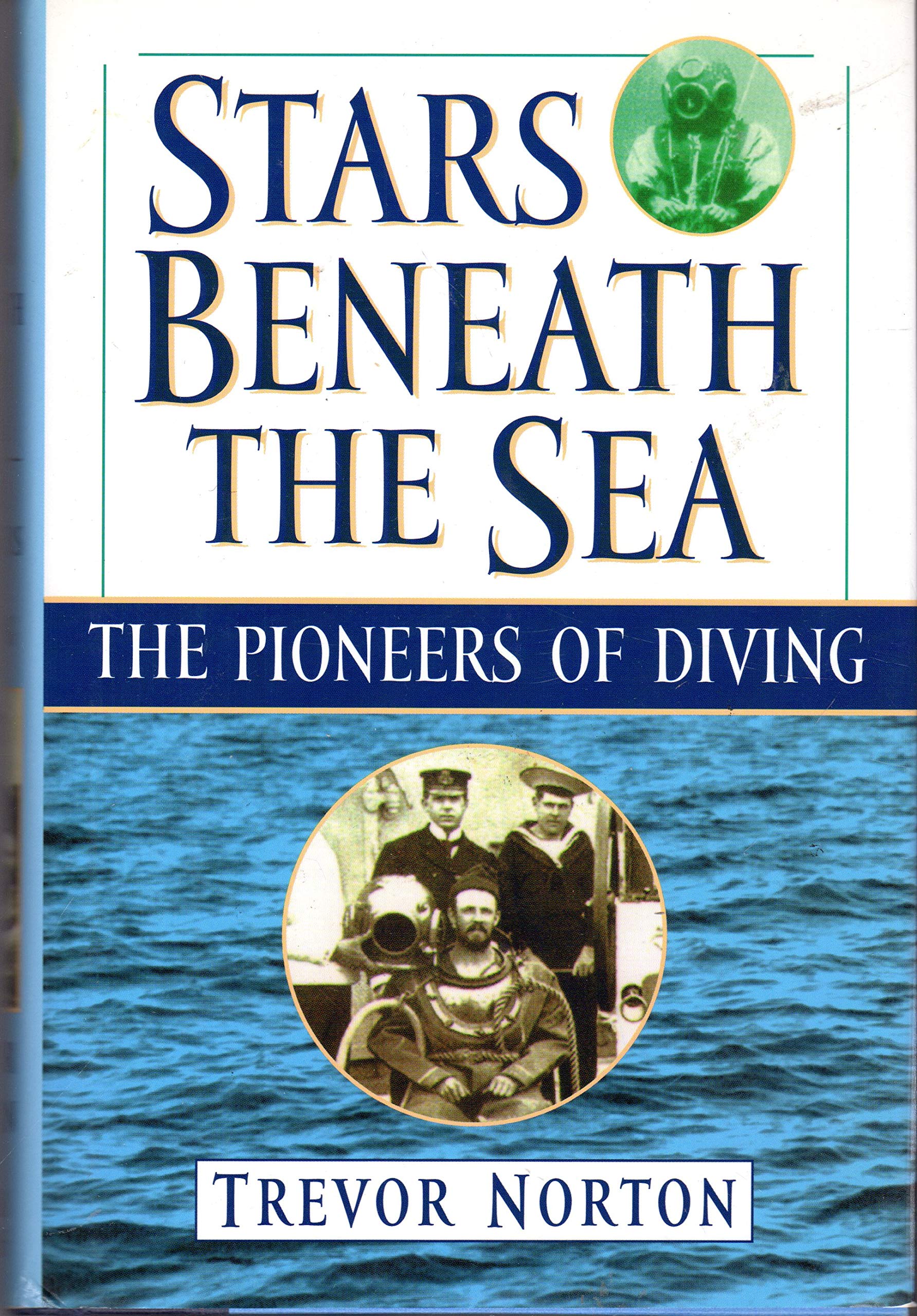



A series of detailed portraits, this history of the art of diving recounts the eccentric exploits and sense-defying feats of the men who turned underwater adventure into modern science. As a serious scuba diver interested in diving's history, this reviewer enjoyed Stars Beneath the Sea. The biographical sketches of some of the lesser-known diving pioneers--including the first scientific diver, Henri Milne Edwards; father-and-son physiologists John and J.B.S. Haldane; Frederic Dumas, the colleague of Jacques Cousteau; and underwater archaeologist Peter Throckmorton--added to her knowledge of deep-sea diving. However, the very informal, anecdotal, and superficial style of the profiles and the many British terms unfamiliar to American readers (Norton is English, and the book was originally published in the U.K. in 1999) limit the book's value in U.S academic libraries. Also, the somewhat off-color nature of some of the nondiving anecdotes included about the subjects is sure to make collection developers cringe. With these caveats, this book is recommended for personal collections and for public, academic, and special libraries with collections on diving and underwater science--Margaret Rioux MBL/WHOI Lib., Woods Hole, MA Copyright 2000 Reed Business Information, Inc. Marine biologist Norton moonlights as a historian of diving in this admirably concise and witty collection of character portraits, in pictures as well as words, of 13 depth-plumbing heroes. The gallery extends in time from Henri Milne Edwards (1800^-85), the first scientist to turn underwater observer, to Peter Throckmorton (1928^-90), the founder of underwater archaeology. In between come such relatively well known figures as William Beebe of bathysphere fame; John Haldane, who invented the time tables crucial to preventing the bends; and his son J. B. S. Haldane, a great eccentric as well as one of the greatest biologists, who perfected the mixing of oxygen and helium that makes very deep diving possible. Then there are Guy Gilpatric, who invented spearfishing on the French Riviera; Hans Hass, pioneer of underwater movies; and Frederic Dumas, codeveloper of the aqualung (with Jacques Cousteau, conspicuous in absentia). This entertaining and informative book, tricked out with a good, big bibliography directing the inquisitive further, is a fine maritime selection for virtually any library. Roland Green Copyright © American Library Association. All rights reserved Lively, encapsulated histories of a dozen or so adventurers, scientists, and eccentrics who experimented to discover ways to plumb the depths of the ocean, written by British scientist Trevor (Marine Biology/Univ. of Liverpool).Nobody had ever gone skindiving before John Guy Gilpatric created the first diving mask out of an old pair of flying goggles. That was in the South of France late in the 1920s, but people had been upending bell jars to capture the air inside in order to dive--and breathe--since Aristotle. Later in the 20th century, the efforts to discover the secrets of the deep became more scientific. J.B.S. Haldane, who follows his distinguished father in Trevor's study, began as a demolitions expert, progressed to the serious study of blood chemistry in the water and in the sky, and finished by laying the foundations for human and population genetics. He probably deserves his own book. Each of these adventuresome, sometimes foolhardy men arrived at the bottom of the ocean by a different route--from a love of the sea, from a love of the air, from pure curiosity, or from the love of photography. Jules Verne's Twenty Thousand Leagues Under the Sea was seminal for most of them. Many tended to hurl themselves into the center of their experiments, some squashing themselves into leaky diving bells, others percolating their own blood for scientific ends. But what all Norton's subjects have in common is a battle against the pressure of deep water as they fought against the dark and the huge weight of an undersea atmosphere that tended to make eardrums perforate, bleed, and worse: "If the air supply was cut off," says Norton of some early divers who were over 150 feet down in primitive "hard hat" diving suits, "his entire body could be rammed up into the helmet, except for the soft bits which would shoot up the air hose." A seaworthy effort. (b&w photos, illustrations) -- Copyright © 2000 Kirkus Associates, LP. All rights reserved. Used Book in Good Condition