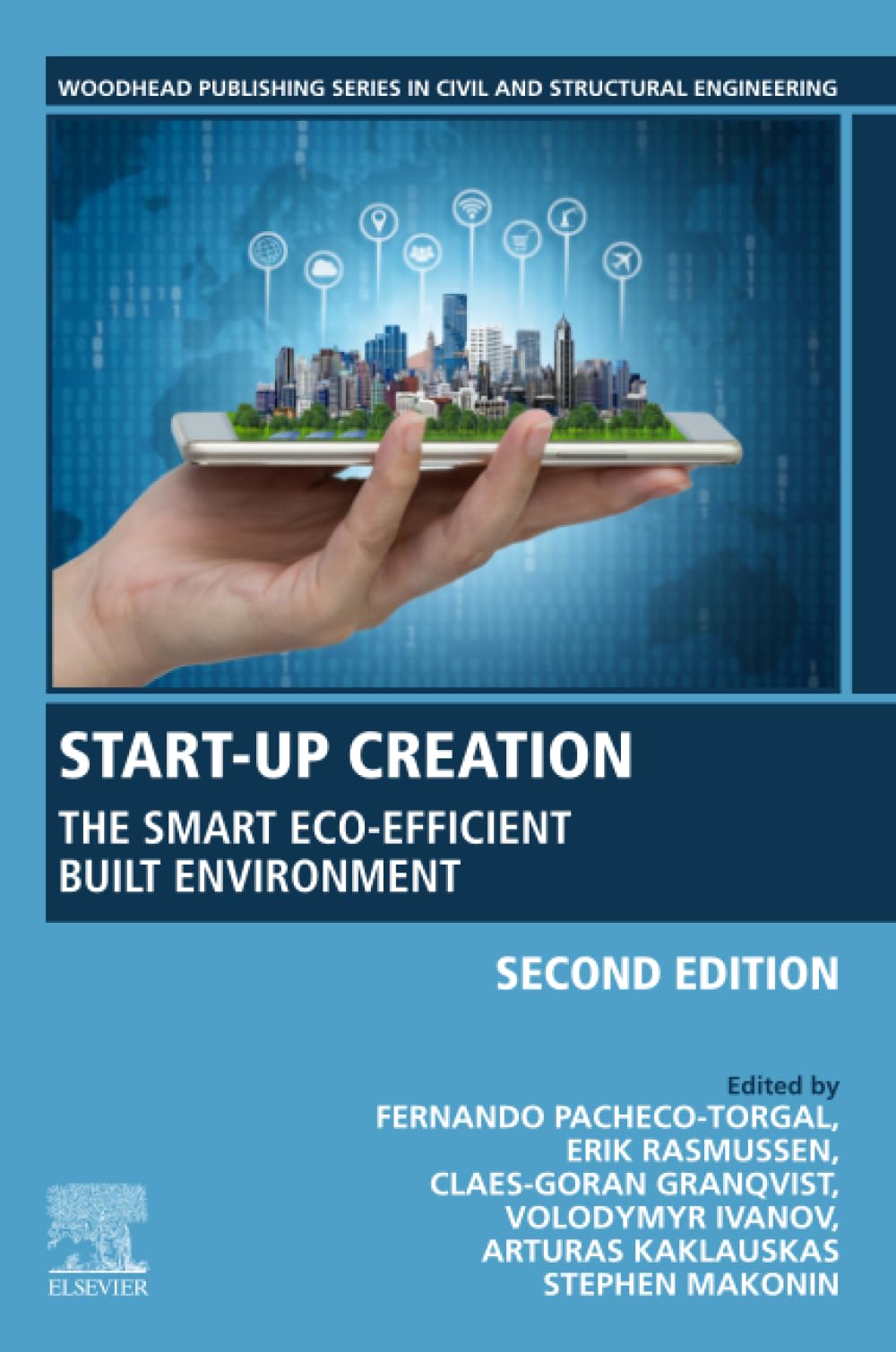
Start-Up Creation: The Smart Eco-efficient Built Environment (Woodhead Publishing Series in Civil and Structural Engineering)
$172.25
by F. Pacheco-Torgal



Start-up creation is the most distinctive feature of the entrepreneurial knowledge-based economy. It is also essential for economic growth and especially important in the current context of young graduate’s high unemployment rates that are expected to increase in the next few decades. There are other books on the creation of start-up companies, designed to be of value to academics wishing to exploit the commercial value of a new technology or business solution, but none of these existing titles focus on start-up creation in the construction industry. In the second edition of this extremely successful title the editors present a state-of-the-art review on advanced technologies, and their application in several areas of the built environment covering energy efficiency, structural performance, air and water quality to inspire the creation of start-up companies from university research. Part One begins with the key factors behind successful start-up companies from university research, including the development of a business plan, start-up financing, and the importance of intellectual property. Part Two focuses on the use of Big Data, Intelligent decision support systems, the Internet of Things and their use in the energy efficiency of the built environment. Finally, Part three is an entire new section that focuses on several smartphone applications for the smart built environment. While in the first edition the section concerning apps for smart buildings had just two chapters, one for app programming basics and a second a case study on building security in this second edition the core of the book is about app development that constitutes 50% of the book. Entire new section that was not available in the first edition on smart-phone applications and virtual assistance for infrastructure monitoring - Chapters on business plans, start-up financing and intellectual property have been brought fully up to date as well as algorithms, big data and the Internet of Things for eco-efficient smart buildings - Comprehensive guide to start-ups that arise from college and university research and how the application of advanced technology can be applied to the built environment Comprehensive guide to start-ups that arise from college and university research and how the application of advanced technology can be applied to the built environment Dr. F. Pacheco Torgal is a Principal Investigator at the University of Minho in Portugal. He holds the title of Counsellor at the Portuguese Engineers Association. He is a member of the editorial boards for nine international journals. Over the last 10 years he has participated in the research decision for more than 460 papers and has also acted as a Foreign Expert on the evaluation of 22 PhD thesis. Over the last 10 years he has also been a Member of the Scientific Committees for more than 60 conferences, most of them held in Asian countries. He is also a grant assessor for several scientific institutions in 15 countries, including the UK, US, Netherlands, China, France, Australia, Kazakhstan, Belgium, Spain, Czech Republic, Chile, Saudi Arabia, UA. Emirates, Croatia, Poland, and the EU Commission. In the last 10 years, he reviewed more than 70 research projects. Erik Stavnsager Rasmussen is an Associate Professor in the Department of Marketing and Management, International Business and Entrepreneurship, University of Southern Denmark, Denmark. His research areas include international new ventures and born global firms. Claes G. Granqvist is Professor of Solid-State Physics at the Ångström Laboratory, Uppsala University, Sweden. His research is focused on optical and electrical properties of materials, especially thin films for energy efficiency and solar energy utilization. He has written numerous scientific publications, books and proceedings volumes and is a member of several academies and societies. Dr. Volodymyr Ivanov has more than 40 years of teaching and research experience on Environmental, Industrial, and Construction Microbiology and Biotechnology in the universities of Europe, Asia, and USA. He has authored 200 papers, patents, book chapters and 8 monographs. His textbook “Environmental Microbiology for Engineers, Francis & Taylor, 1st (2010) and 2nd (2015) editions, has been adopted for graduate and post-graduate courses in many universities. His research experience includes the supervision and participation in numerous projects on biotechnologies with biofilms and biogranules, microbial transformations of iron, biocementation, bioclogging, bioremediation of soil, and microbiological monitoring of water quality. A. Kaklauskas is a professor at Vilnius Gediminas Technical University, in Lithuania; Member of the Research Council of Lithuania; Member of the Science Europe working group on Data Sharing and Supporting Infrastructures; Head of the Department of Construction Management and Property; member of the Lithuanian Academy of Sciences; editor-in-chief of Journal of Civ