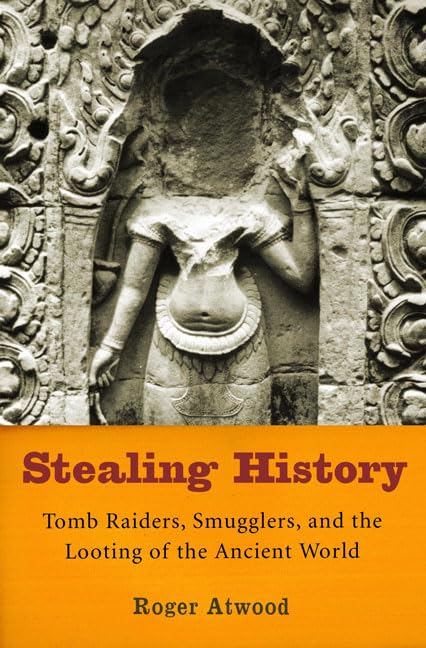
Stealing History: Tomb Raiders, Smugglers, and the Looting of the Ancient World
$23.51
by Roger Atwood



Roger Atwood knows more about the market for ancient objects than almost anyone. He knows where priceless antiquities are buried, who is digging them up, and who is fencing and buying them. In this fascinating book, Atwood takes readers on a journey through Iraq, Peru, Hong Kong, and across America, showing how the worldwide antiquities trade is destroying what's left of the ancient sites before archaeologists can reach them, and thus erasing their historical significance. And it is getting worse. The discovery of the legendary Royal Tombs of Sipan in Peru started an epidemic. Grave robbers scouring the courntryside for tombs--and finding them. Atwood recounts the incredible story of the biggest piece of gold ever found in the Americas, a 2,000-year-old, three-pound masterpiece that cost one looter his life, sent two smugglers to jail, and wrecked lives from Panama to Pennsylvainia. Packed with true stories, this book not only reveals what has been found, but at what cost to both human life and history. Writing for magazines such as ARTnews , Atwood is an expert on the global traffic in stolen archaeological objects. His meticulous book tracks his investigation of one such object, a gold ornament cast by the Moche culture of pre-Columbian Peru. But in a prelude, Atwood recounts the night he accompanied, with their permission, Peruvian grave robbers at work. Although sympathetic to their destitution, Atwood is appalled at their obliteration of a site's archaeological value. Of course, the demand for these objects emanates from the acquisitive appetites of museums and wealthy collectors, who appear in the course of Atwood's account of the Moche "backflap." Plundered by grave robbers in 1987, it was smuggled into the U.S. by a corrupt Panamanian diplomat and seized in an FBI sting in 1997. Atwood's high-velocity, true-crime narrative immediately hooks readers while also informing them about the international antiquities business. A case study of the sordid trade, Atwood's stern admonition to the art world to reform, before archaeological knowledge becomes irretrievable forever, deserves a hearing. Gilbert Taylor Copyright © American Library Association. All rights reserved Roger Atwood is a regular contributor to ARTnews and Archaeology magazines, and his articles on culture and politics have appeared in The New Republic , Mother Jones , The Nation , The Miami Herald , and The Boston Globe . Atwood was a journalist for Reuters for over fifteen years, reporting from Peru, Argentina, Brazil, and Chile, and a senior editor at their Washington, D.C. bureau. He is currently a fellow at the Alicia Patterson Foundation. Recently I visited a private collection housed in a villa in Miraflores, a quiet residential district of Lima, Peru. The tour was guided by Enrico Poli, the owner of the villa, which is packed with Cusco paintings, colonial silver and old furniture. But the museum's true gem is its pre-Columbian collection, which contains some golden objects from the Moche royal tombs in Sipán, discovered in 1987. (The Moche culture dominated the northern coast of Peru from the first to the sixth centuries A.D.; Moche arts, crafts and technology were extremely advanced for the ancient world.) The eccentric collector was free with graphic explanations of erotic Moche figurines, causing his audience of Peruvian and Ecuadorian matrons to blush, but he avoided any mention of the provenance of his unique possessions. Such caution was understandable. The majority of Peruvian archaeological artifacts in the private museums are purchased from grave looters -- so-called huaqueros, who have destroyed practically every archaeological site in Peru over the last decades. Roger Atwood's new book, Stealing History, tells the sad tale of the royal tombs at Sipán in great detail. In the best-case scenario, treasures discovered by gravediggers became prey to unscrupulous Peruvian collectors; in the worst, they were smuggled out of the country, to be sold at European and American antiquity markets. Atwood's account of the joint quest of the well-known Peruvian archaeologist Walter Alva and a group of FBI agents to recover the looted treasures reads like a perfect detective story, replete with Mafia connections, diplomat-smugglers and police chases. By the end of the 1990s, the majority of Sipán objects smuggled out of the country had been returned to Peru, but the end of the story is more sad than happy. The author tries both to reconstruct the looting of one particular site and to put the tragedy of Sipán in a broader context of the history of crimes against the past, from the "purchase" of the Parthenon Marbles by Lord Elgin to the explosion of illegal archaeological excavations in Iraq after the fall of Saddam Hussein. But if grave robbers have always existed, some tendencies in archaeological looting are more recent. In 1923, the 22-year-old André Malraux (surprisingly not mentioned by Atwood) was caught using a