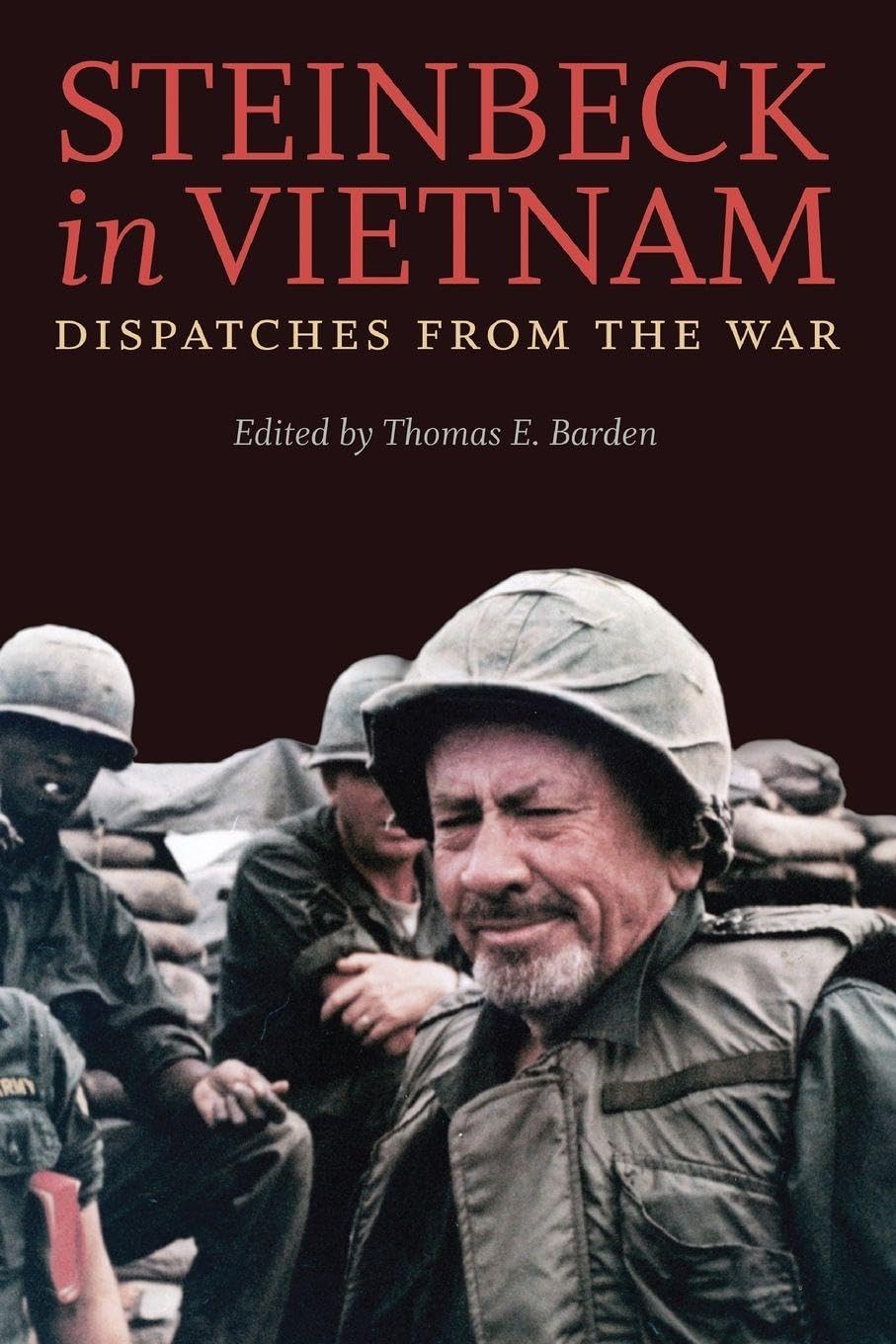



Although his career continued for almost three decades after the 1939 publication of The Grapes of Wrath, John Steinbeck is still most closely associated with his Depression-era works of social struggle. But from Pearl Harbor on, he often wrote passionate accounts of America’s wars based on his own firsthand experience. Vietnam was no exception. Thomas E. Barden’s Steinbeck in Vietnam offers for the first time a complete collection of the dispatches Steinbeck wrote as a war correspondent for Newsday. Rejected by the military because of his reputation as a subversive, and reticent to document the war officially for the Johnson administration, Steinbeck saw in Newsday a unique opportunity to put his skills to use. Between December 1966 and May 1967, the sixty-four-year-old Steinbeck toured the major combat areas of South Vietnam and traveled to the north of Thailand and into Laos, documenting his experiences in a series of columns titled Letters to Alicia, in reference to Newsday publisher Harry F. Guggenheim’s deceased wife. His columns were controversial, coming at a time when opposition to the conflict was growing and even ardent supporters were beginning to question its course. As he dared to go into the field, rode in helicopter gunships, and even fired artillery pieces, many detractors called him a warmonger and worse. Readers today might be surprised that the celebrated author would risk his literary reputation to document such a divisive war, particularly at the end of his career. Drawing on four primary-source archives―the Steinbeck collection at Princeton, the Papers of Harry F. Guggenheim at the Library of Congress, the Pierpont Morgan Library’s Steinbeck holdings, and the archives of Newsday ―Barden’s collection brings together the last published writings of this American author of enduring national and international stature. In addition to offering a definitive edition of these essays, Barden includes extensive notes as well as an introduction that provides background on the essays themselves, the military situation, the social context of the 1960s, and Steinbeck’s personal and political attitudes at the time. These dispatches are really the last work that Steinbeck published, and they are intensely interesting pieces of writing. Their vividness alone makes them worth reading. The letters are impressionistic, and they often contain excellent reportage, showing readers what the war looked like from the ground. They remind us once again that Steinbeck’s gift was essentially journalistic. ― Jay Parini, Middlebury College, author of John Steinbeck: A Biography [O]pinions that viscerally reflect the deep political chasm that the war created in America. Steinbeck’s writing is vividly descriptive, evoking place and circumstance.... [His] ability to capture the day-to-day conduct of the war and its destructive force is sometimes shockingly immediate. ― Publishers Weekly [Steinbeck's] dispatches reflect his initial excitement over the weaponry (e.g., the AC-47 gunship, known as Puff the Magic Dragon) and the heroic American soldiers standing against communism, but he gradually came to see the mismatch between the American narrative and the reality that most Vietnamese just wanted the war to end. By the time he left Asia, readers can sense disillusion and a feeling that the soldiers were in an unwinnable situation.... This personal look at a contentious moment in American history will supplement Vietnam War collections and reward any student who wishes to better understand the times. ― Library Journal Between December 1966 and May 1967, Steinbeck filed pieces that sought to support the U.S. effort in Vietnam, to lionize the soldiers whom he met (and with whom he occasionally ducked incoming rounds), to expose the dimensions of Viet Cong and North Vietnamese violence against civilians, to chide the liberal media for ingesting without question the enemy’s propaganda and to urge other writers (he names Updike, Williams, Bellow, Albee and Miller) to travel to Vietnam to see the war firsthand.... Steinbeck’s positions later softened, but not in the pages of Newsday. ― Kirkus Though John Steinbeck is best known for chronicling the woes of the Great Depression, his raw, journalistic accounts of later human tragedies are written with the same poignancy as The Grapes of Wrath and Of Mice and Men . In Steinbeck in Vietnam, we are offered glimpses of the author's last works. ― Huffington Post Reading Steinbeck in Vietnam is a fascinating, occasionally uncomfortable experience.... Written with the force that characterizes all of Steinbeck's work, his Vietnam dispatches are a mixture of vitriolic attacks on war protestors, lyrical descriptions of the countryside, paeans to the American soldier and moments of stunning insight. What makes the columns more than a historical curiosity is Steinbeck's effort to understand the war on its own terms. That internal struggle, publicly shared in the