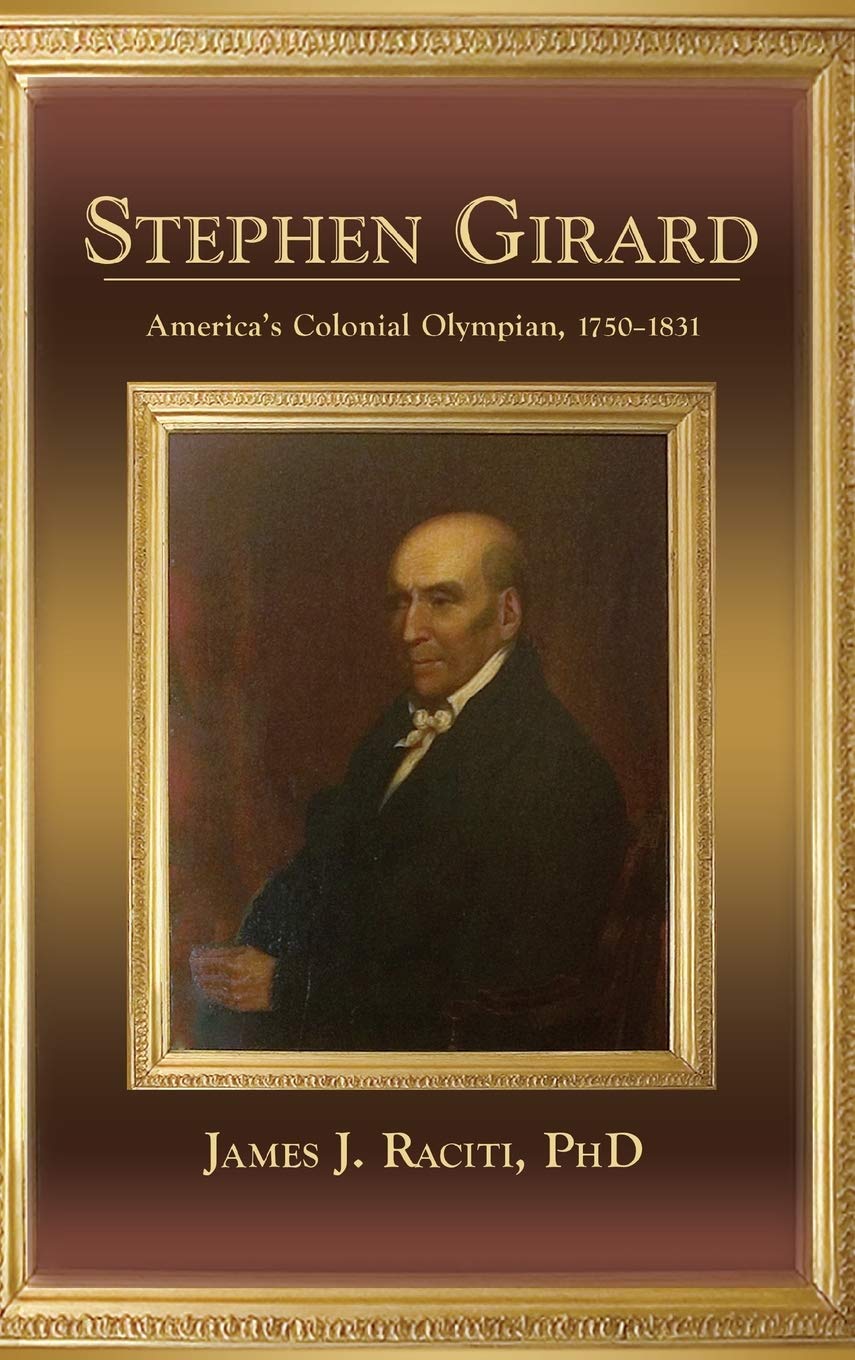



Why is Stephen Girard, a figure from late Colonial America, important today? As a teenager, he left home in Bordeaux, France with meager funds and went to sea as a merchant marine, following his family's tradition. In early summer, 1776, he landed in Philadelphia when a British blockade forced his ship into the city's Delaware River port. With his extraordinary intelligence and with an ability to foresee market trends and grasp the mysteries of international trade, he remained in Philadelphia and became an American citizen. By the early eighteen hundreds he had become the richest man in America. Is this reason enough to pay closer attention to Girard? Why don't American History textbooks mention him? As the first private banker in America, he should be counted among our Founding Fathers. He labored tirelessly and unselfishly during Philadelphia's 1793 yellow fever epidemic, risking his life caring for the sick, sometimes performing the most repulsive tasks. Most wealthy Philadelphians had left the city. In 1811, Great Britain increased its harassment of American ships. Girard put his entire fortune into the hands of the US Treasury to wage war once again with a country that refused to accept America as a sovereign nation. He proved himself a courageous philanthropist and a great patriot. The War of 1812, an American success, forever freed the country from subservience to England. When Girard died in 1831, thousands of Philadelphians showed their love and respect for him. He left most of his fortune to the City of Philadelphia and to founding an institution for poor orphans--Girard College, opening its doors to students in 1848. President Truman visited the college for its centennial in 1948 to honor this remarkable man--a man who walked the streets with Washington, Jefferson and Adams and had flags made by Betsy Ross. ''This book is a must read for all those who have any affiliation with Girard College, for it provides invaluable insight into the motivations of Stephen Girard, the first major philanthropist in the United States. James J. Raciti, a graduate of Girard College class of 1951, has produced a fascinating and informative biography of Stephen Girard. In deference to younger Girardians, who may wish to read this book, the author employs a Socratic dialogue for 75% of the text. This format is similar to the dialogues of the ancient Greek philosopher Socrates with his students. Each of 18 chapters consists of a series of specific questions and answers relevant to the life and times of Stephen Girard. The reveal new and fascinating details of all stages of Girard's life including his unhappy childhood in southern France; his financial successes as a mariner, merchant, banker and eventually a farmer; his community services during the Yellow Fever epidemic; his financing of the federal government during the War of 1812; his death in Philadelphia at age 81. ''The dialogues are most engaging, for they inform the reader of Girard's activities and motivations as he dealt with his family members, employees, business colleagues and local and federal government officials in both France and a newly established United States of America. Perhaps most salient for all those affiliated with Girard College in the past and today are the descriptions of Girard's emerging views over a three-decade period that led to the specification of the educational philosophy, the effective management strategies of a 24/7 boarding school environment, the comprehensive academic curriculum, and even the physical plant of the school enabled by his generous entitlements. ''By examining the source materials in both the extensive archives at Girard College and in southern France, Raciti is able to provide backgrounds that have not been included in the many earlier biographies of Stephen Girard. For example, he discusses in several chapters the relationship between Girard and his siblings. Many family members attempted to convince him that he should share his accumulating wealth with relatives. Girard steadfastly refused, feeling that each person should strive, as did he, to become self-sufficient and to support his/her immediate family members. However, when the children of several siblings were left destitute, Girard provided funds for their support, including their education in France and Philadelphia. Furthermore, Girard took into his residence the children of colleagues and employees and provided them both a supportive home and an appropriate education. Raciti reports that Girard enjoyed having young people in his home environment. ''Perhaps the most engaging section of this book is Appendix 1, entitled 'Stephen's Twilight Visitors: A Fictional Dramatization of Stephen Girard's Last Evening.' In a radical departure from the standard format for an academic biography, Raciti provides in this appendix a series of hypothetical interactions between Stephen Girard on his deathbed and the spirits of several of his contemporaries, including hi