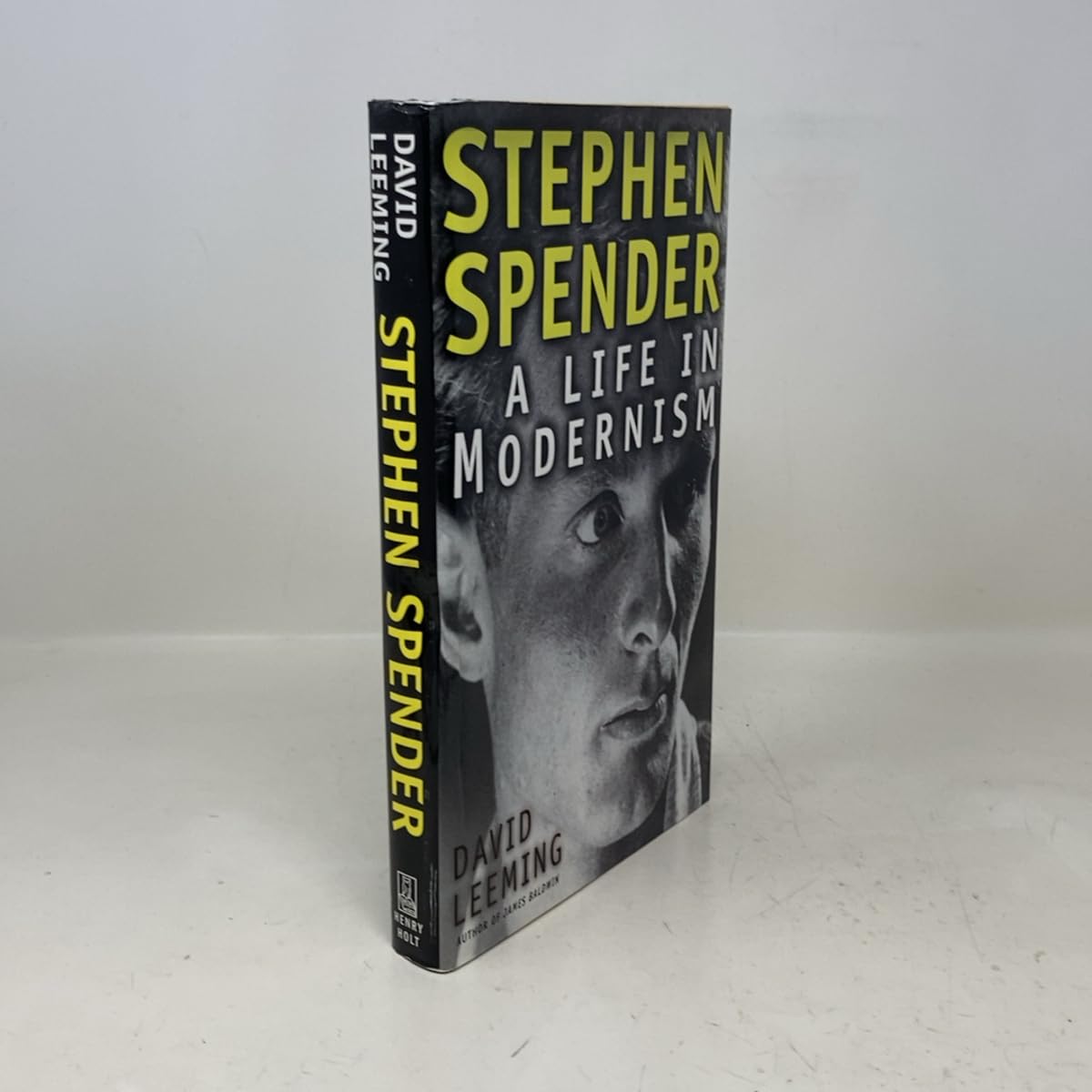



The first critical biography of one of the twentieth century's towering literary figures. Stephen Spender was a minor poet, but a major cultural influence during much of the century. Literary critic, journalist, art critic, social commentator, and friendend of the best-known cultural figures of the modernist and postmodernist periods (Yeats, Woolf, Sartre, Auden, Eliot, Isherwood, Hughes, Brodsky, Ginsberg-a "who's who" of contemporary literature). Spender's writing recorded and distilled the emotional turbulence of many of the century's defining moments: the Spanish Civil War; the rise and fall of Marxism and Nazism; World War II; the human rights struggle after the war; the Vietnam protest, the Cold War, and the 1960s sexual revolution; the rise of America as a cultural and political force. As David Leeming's fascinating biography demonstrates, Stephen Spender's life reflected the complexity and flux of the century in which he lived: his sexual ambivalence, his famous friends, the free-love days in Germany between the wars, the CIA-Encounter scandal. In David Leeming's capable hands, this comprehensive, unauthorized study of Spender is a meditation on modernity itself. Leeming, a former professor of English at the University of Connecticut at Storrs and a teaching colleague (in the 1970s) of British poet, autobiographer, literary critic, journalist, and art critic Stephen Spender, claims that his interest in Spender is "not as a Englishman particularly but as a cosmopolitan man of letters and a witness to the development of modernism, in its sociopolitic and aesthetic aspects." Still, in 11 chapters accompanied by copious footnotes, Leeming offers a revealing portrait of Spender, sparing no detail of Spender's strengths and foibles: the homosexual love affairs that continued almost until the end of Spender's life, Spender's unsuccessful first marriage to Inez Pearn, and his successful, enduring 51-year marriage to concert pianist Natasha Litvin, who bore him two children. Disappointingly, Leeming does not provide many in-depth analyses of Spender's writings, and the book lacks an index of proper names. Still, the multifaceted Spender's biography reads like fiction and will enthrall the reader from start to finish.ABob Ivey, Univ. of Memphis Copyright 1999 Reed Business Information, Inc. Leeming, a discerning biographer, is drawn to seminal artists such as James Baldwin and, now, poet Spender, a "true cosmopolitan." Leeming's friendship with his subject began in 1970 and lasted until Spender's death in 1994, a relationship that, coupled with Spender's eloquent self-disclosure in his journals, autobiography, critical writings, and poetry, makes for an exceptionally fluent narrative. Leeming sees Spender as a key witness to and participant in the rise of modernism, and, indeed, Spender's life reads like a who's who of twentieth-century letters. An orphan when he enrolled at Oxford, where he forged deep friendships with fellow students Auden and Isherwood, Spender found substitute parents in T. S. Eliot and Virginia Woolf. Aesthetically astute, politically liberal, candid about his bisexuality, expressive, and self-depreciating, Spender was always in the thick of things, and the convoluted chronicle of the evolution of his writing, extensive travels, work as editor and teacher, stint as the first non-American poet laureate, and happiness as husband and father seems to reflect the complexity and mutability of his times. Donna Seaman A ``Pylon Poet's'' progress over the century, from the official biographer of James Baldwin. If Spender always seemed somewhat overshadowed by his friends Auden in poetry and Isherwood in fiction, he made up for it by pervading the English literary scene, with American forays, through a career lasting almost seven decades. Although he wasnt averse to publishing parts of his life, notably World Within World and his Journals 1939-1983, as well as autobiographic fiction, he was dismayed by Hugh David's ``portrait'' in 1992, not to mention David Leavitt's 1993 roman ... clef, While England Slept. With this background, Leeming, who got to know Spender during one of the poet's many visiting professorships in America, has to work with both a good deal of interesting material and an inhibiting inheritance. The name-dropping aloneT.S. Eliot, Virginia Woolf, Yeats, Isaiah Berlin, Ted Hughes, Francis Bacon, David Hockney, et al.is enough to underscore Spender's famous line, ``I think continually of those who were truly great.'' Throughout his life, Spender underwent numerous contradictions that deserve closer probing than Leeming is willing to do: Spender's lyric gift, influenced by Wordsworth and Shelley, that he turned to 1930s modernism under Auden's influence (including verses on power pylons and express trains); several intense homosexual relationships both before and during a long and happy marriage; a radical political outlook, despite disillusionment with the Spanish Civil War and