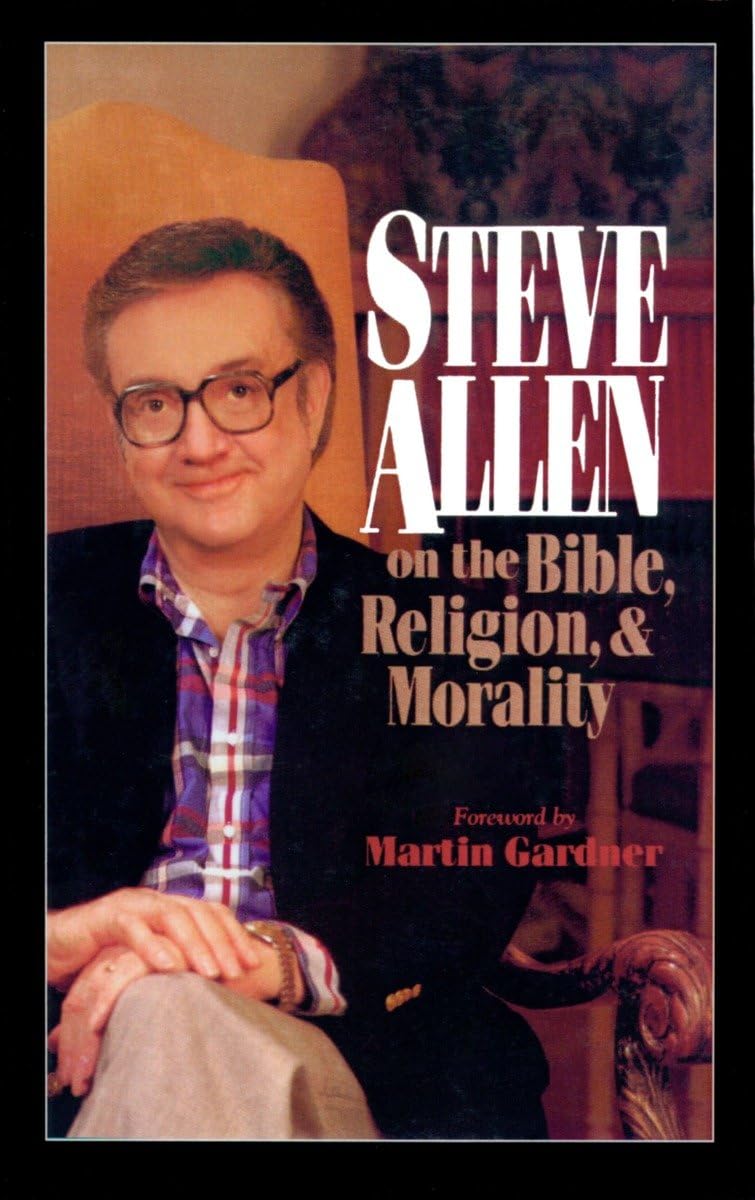



America's dean of intelligent comedy doesn't think the Bible is a laughing matter. His good look at the good book is a closely reasoned examination of Scripture, designed to encourage rational analysis of the most influential document of Western civilization. Although the Bible has been consulted for more than twenty centuries, Allen asserts that there remains an extensive degree of common ignorance about it. Noting that most people today rarely read the Bible, Allen is convinced that the millions who do read it are not able to understand certain passages at all.Steve Allen on the Bible, Religion, and Morality took form when Allen began his own exploration of the Bible, marking passages that struck him as extraordinarily beautiful, or those that were profoundly confusing. Spellbound by the very mystery of it, he perceived that much of the text leads directly to controversy. And, he urges, it is of greater importance now than ever before that all Americans be conversant with the Bible, partly because of those who would use Scriptures as a weapon to force their views on others.Allen presents his ideas as a series of alphabetically arranged essays on characters, events, and books of the Scriptures, as well as on such controversial topics as abortion, anti-Semitism, capital punishment, death, evolution, and original sin. He draws on the expertise of biblical scholars, theologians, and philosophers to demonstrate that fundamentalist assumptions about the reliability and authenticity of the Bible as the inviolable Word of God simply have no rational or factual basis.Allen highlights the errors, inconsistencies, and self-contradictions of the Bible. While not denying the value of many biblical passages, he argues that Americans can and should critique the Bible as they would any other historical document.While Allen finds much in the Bible with which one can take issue, his examination also reveals that much is meaningful. Allen's goal - to make people think reasonably about Scripture - is achieved through remarkable clear, readable, and insightful prose. The famous author/comedian/songwriter here fires off a blunderbuss at uncritical biblical literalism. Finding the Bible as a whole riddled with historical, scientific, and moral error, he attacks the Old Testament for portraying God as vengeful and bloodthirsty and the New Testament for assigning most of humanity to eternal damnation in hell. He believes neither approach provides insight into God's true nature. Allen goes on to criticize the religious establishment, especially that of fundamentalism, for ignoring or vilifying the fruits of biblical historical-critical research. Though he claims to find much of the Bible ennobling, the majority of this work is so relentlessly belligerent that one is not surprised to find that he originally planned to publish it posthumously. -Richard S. Watts, San Bernardino Cty. Lib., Cal. Copyright 1990 Reed Business Information, Inc. As one of America's most versatile and creative entertainers, Steve Allen has composed thousands of songs, written dozens of books, and created many television programs including NBC's "Tonight Show" and the PBS "Meeting of Minds" series. In this book, Allen focuses his talents and critical intelligence on the Bible. He points out that despite the significance of the Scriptures to Western culture, history, religion, and morality, the majority of Americans are almost completely ignorant of the actual contents of the Good Book. STEVE ALLEN ON THE BIBLE, RELIGION, AND MORALITY is an attempt not only to inform the public but to stimulate critical inquiry into the history of the Bible and its role in the formation of religion and morality. In a work reminiscent of Voltaire's PHILOSOPHICAL DICTIONARY, Allen presents his ideas as a series of alphabetically arranged essays on characters, events, and books of the Holy Scriptures, as well as on such controversial topics as abortion, anti-Semitism, capital punishment, death, evolution, flying saucers, and original sin. He draws on the expertise of biblical scholars, theologians, and philosophers to demonstrate that fundamentalist assumptions about the reliability and authenticity of the Bible as a historical document or as the inviolable Word of God simply have no rational or factual basis. Like Thomas Paine's THE AGE OF REASON, this book highlights the errors, inconsistencies, self-contradictions, and morally repugnant episodes and characters of the Bible. So much in Scriptures is at variance with our Western ideals of morality and common decency that an intelligent, objective reader cannot help but judge the Bible as a fascinating, important but very fallible, al! l-too-human book. While not denying the value of many biblical passages, Mr. Allen argues that Americans can and should critique the Bible as they would any other historical document. This by no means implies, however, that in so doing they must discard their faith. Steve Allen's interest in b