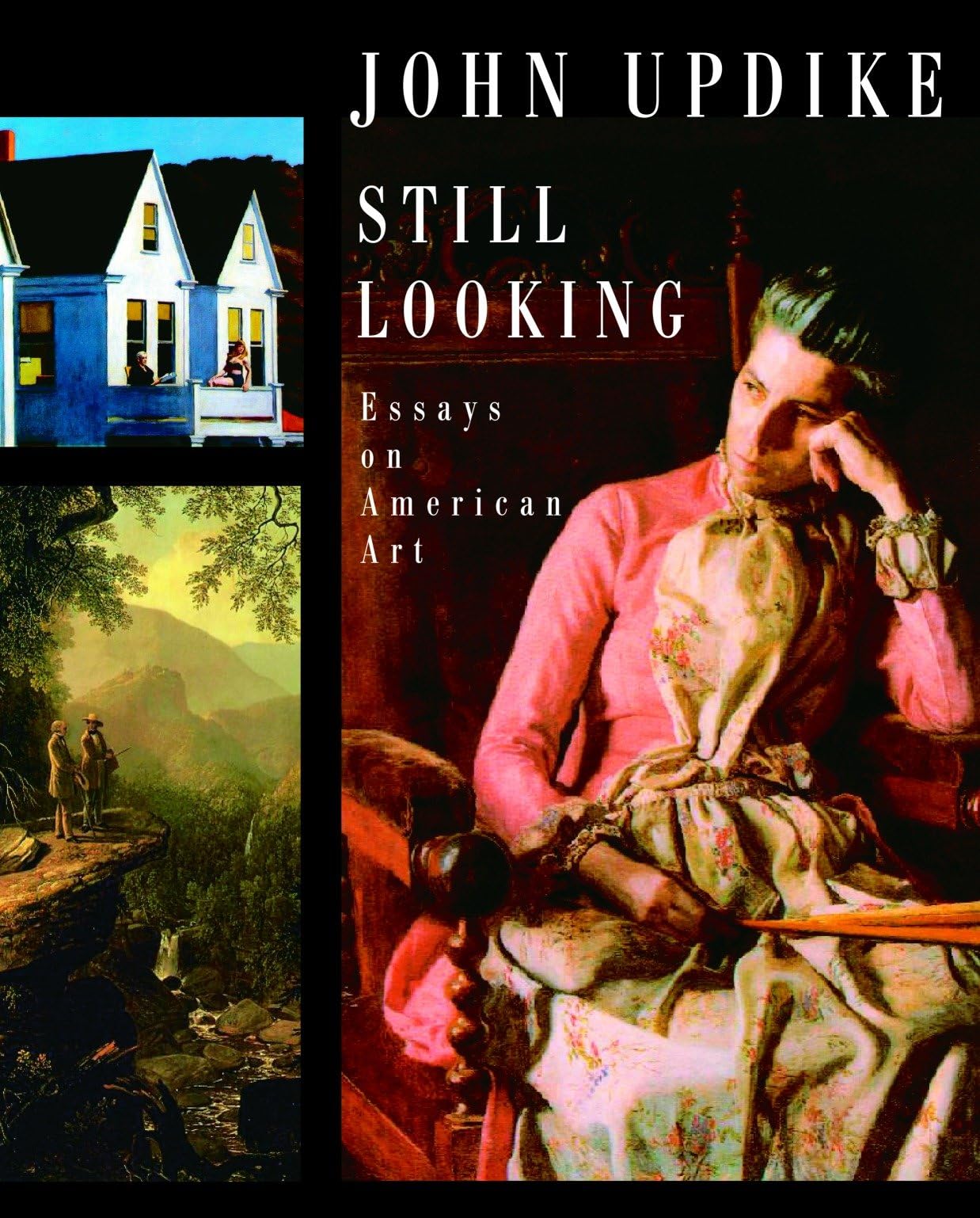



From a master of American letters and the author of the acclaimed Rabbit series comes a richly illustrated book of eighteen insightful essays about American art, written while he was the art critic at The New York Review of Books. “Remarkably elegant little essays, dense in thought and perception but offhandedly casual in style. Their brevity makes more acute the sense of regret one feels to see them end.” — Newsday When, in 1989, a collection of John Updike’s writings on art appeared under the title Just Looking, a reviewer in the San Francisco Chronicle commented, “He refreshes for us the sense of prose opportunity that makes art a sustaining subject to people who write about it.” In the sixteen years since Just Looking was published, he continued to serve as an art critic, mostly for The New York Review of Books, and from fifty or so articles has selected, for this book, eighteen that deal with American art. After beginning with early American portraits, landscapes, and the transatlantic career of John Singleton Copley, Still Looking then considers the curious case of Martin Johnson Heade and extols two late-nineteenth-century masters, Winslow Homer and Thomas Eakins. Next, it discusses the eccentric pre-moderns James McNeill Whistler and Albert Pinkham Ryder, the competing American Impressionists and Realists in the early twentieth century, and such now-historic avant-garde figures as Alfred Stieglitz, Marsden Hartley, Arthur Dove, and Elie Nadelman. Two appreciations of Edward Hopper and appraisals of Jackson Pollock and Andy Warhol round out the volume. America speaks through its artists. As Updike states in his introduction, “The dots can be connected from Copley to Pollock: the same tense engagement with materials, the same demand for a morality of representation, can be discerned in both.” Published primarily in the New York Review of Books , the collected essays in Still Looking are less art criticism than finely honed art appreciations. Reviewers note Updikes inquisitive tone and earnest interest in his subject matter. The often honored (an American Book Award, an O. Henry Prize, a National Medal for the Humanities) and prolific author once aspired for a career in cartooning and studied at the Ruskin School of Drawing and Fine Art in Oxford, England. The major complaint, if it can be registered as such, is that Updike is so effective at bringing these works to life that the book, though amply illustrated, provokes frustration that the exhibitions are no longer running. Copyright © 2004 Phillips & Nelson Media, Inc. *Starred Review* Updike's art criticism is free of abstraction and jargon and radiant in its curiosity and discernment. He can't help but bring a novelist's gift for psychological insight to his discussions of art, even as he expertly considers technique and aesthetics. American art is his passion, and within that realm, it is painting that he loves best, although he has included a judicious discussion of Alfred Stieglitz, the most painterly of photographers. Updike begins with a witty discussion of American portraiture and John Singleton Copley, then celebrates American landscape painting in his most rousing pieces, discussing with deep feeling the idea of the sublime during the oh-so-brief era in the New World when "nature reigned untamed" and offering agile responses to the paintings of Frederic Edwin Church, Martin Johnson Heade, and Winslow Homer. Forthright in his castigation of museum exhibitions burdened with dunning commentary, incisive in his interpretation of John Sloan and Arthur Dove, and brilliant in his response to Edward Hopper, Updike is receptivity personified, writing about art with ardent attention, knowledge, and profound appreciation. Updike's immersion in art assures us that there are oases, still, from the crassness of commercial images. Donna Seaman Copyright © American Library Association. All rights reserved Praise for On Looking “Some of these essays are marvelous examples of critical explanation, in which the psychological concerns of the novelist drive the eye from work to work in an exhibition until a deep understanding of the art emerges.” — The New York Times Book Review “These are remarkably elegant little essays, dense in thought and perception but offhandedly casual in style. Their brevity makes more acute the sense of regret one feels to see them end.” — Newsday JOHN UPDIKE was the author of more than sixty books, eight of them collections of poetry. His novels, including The Centaur, Rabbit Is Rich, and Rabbit at Rest, won the Pulitzer Prize, the National Book Award, the National Book Critics Circle Award, and the William Dean Howells Medal of the American Academy of Arts and Letters. He died in 2009. Used Book in Good Condition