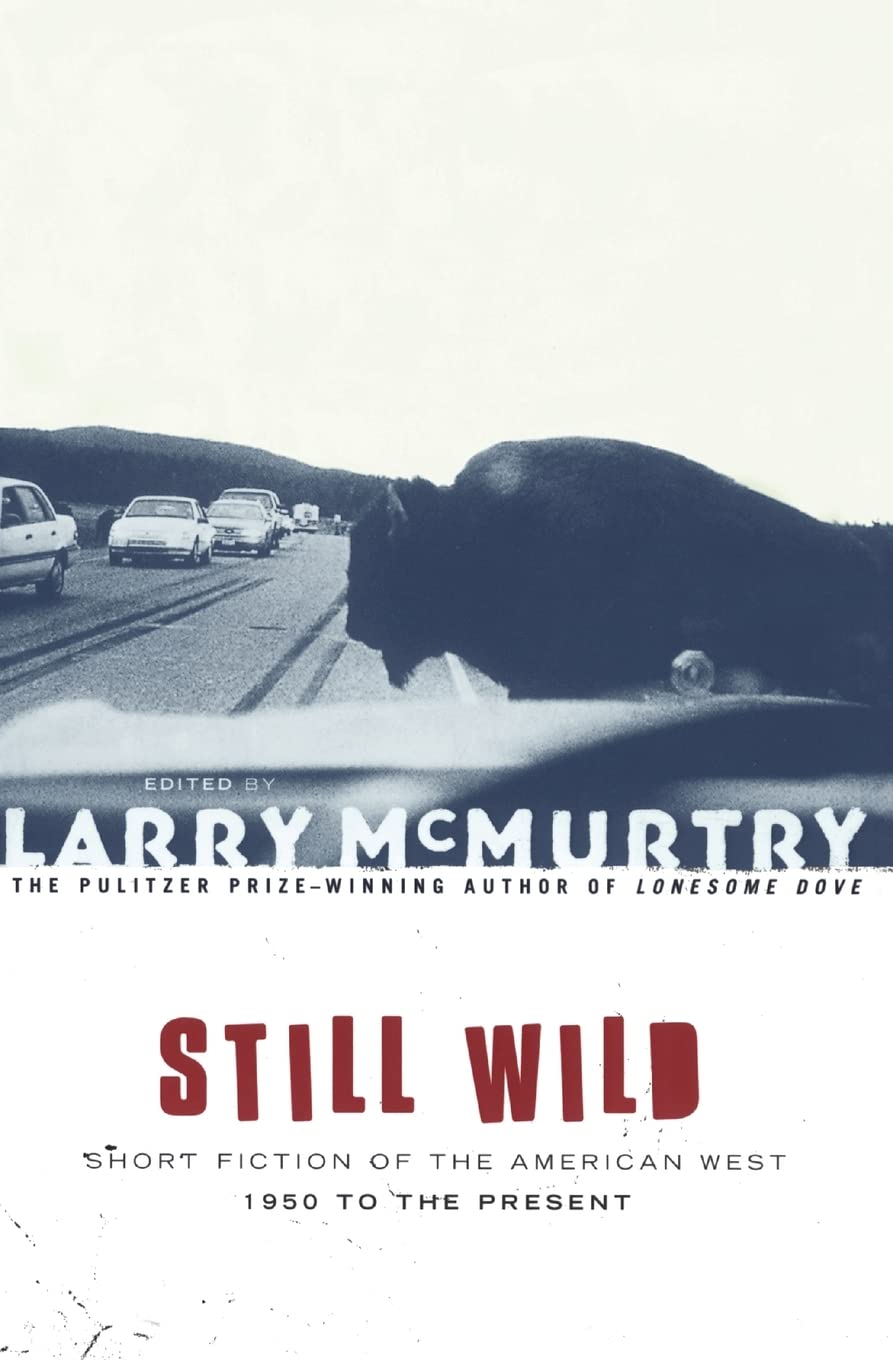
Still Wild : Short Fiction of the American West 1950 to the Present
$13.49
by Larry McMurtry



Larry McMurtry—the preeminent chronicler of the American West—celebrates the best of Western short fiction in this anthology that represents the coming-of-age of the legendary American frontier, featuring authors such as Jack Kerouac, Annie Proulx, and more. Featuring a veritable Who’s Who of the century’s most distinctive writers, this collection effectively departs from the standard superstars of the Western genre. McMurtry has chosen a refreshing range of work that, when taken as a whole, depicts the evolution and maturation of Western writing over several decades. The featured tales are not so concerned with the American West of history and geography as they are with the American West of the imagination—one that is alternately comic, gritty, individual, searing, and complex. Including authors such as Jack Kerouac, Wallace Stegner, Raymond Carver, Annie Proulx, and Diana Ossana, this collection captures the real Western canon like no other. Adam Woog The Seattle Times A fine collection....Every contributor, famous author or not, is strong and sure-footed. Sybil Downing The Denver Post It has been said that good short stories create a single impact that sticks with the reader. Every story in this anthology qualifies. Larry McMurtry (1936–2021) was the author of twenty-nine novels, including the Pulitzer Prize–winning Lonesome Dove , three memoirs, two collections of essays, and more than thirty screenplays. He lived in Archer City, Texas. Still Wild Short Fiction of the American West 1950 to the Present By Larry McMurtry Simon & Schuster Copyright © 2001 Larry McMurtry All right reserved. ISBN: 0684868830 Introduction Still Wild is meant to remind readers of, or introduce them to, short fiction by twenty good writers who, at one point or another in their careers, have taken as their subject life in the American West -- but taken it in a special way. Theirs is not so much the West of history or the West of geography as it is the West of the imagination: funny, gritty, isolate, searing, tragic, complex. Part of my intent as a compiler has been to assemble a coming-of-age anthology, because it seems to me that it has only been in the second half of the twentieth century that the West has come of age as a producer -- as opposed to an importer -- of first-rate writers. From the time of the California gold rush to at least the end of World War I, most of the writers who achieved popularity by writing fiction set in the West -- writers whose work aspired to be at least a rung or two above the dime novel or the family anecdote -- came from the East. Jack London was a native, but most were not, and the work of Owen Wister, Charles King, Zane Grey, Eugene Manlove Rhodes, and others reads now like dude-ranch fiction, a sort of white-collar pulp. Many of these writers loved the West deeply, and, once they found it, never left it, but, still, they wrote as outsiders: fans, rather than natives; and, as fans, they were likely to wax romantic about the western life that they saw, or, perhaps, imagined. Most of them wrote for the illustrated magazines of the late nineteenth and early twentieth century, where they were matched in their romanticism by two generations of equally romantic illustrators: Frederick Remington, Alfred Jacob Miller, Charles Schreyvogel, Frank Schoonover, Nick Eggenhofer, Edward Borein, Will James, and others. Most of the stories were quite flimsy; the writers needed the illustrators and perhaps were not aware to what an extent they were in competition with the artists whose drawings supported their stories. Indeed, competition with the image is a factor in the development of western writing that is seldom mentioned, though it was certainly serious. The grandeur of western landscape drew gifted painters immediately; gifted writers followed in their wake. Washington Irving's Tour of the Prairies (1835) contained some fairly vivid word pictures, but not as vivid as the actual paintings of George Catlin, Karl Bodmer, Alfred Jacob Miller, or Thomas Moran. Then, before the painters quit, the camera arrived, followed in only a few decades by the motion pictures, which, throughout the whole of the twentieth century, competed vigorously not just with western literature but with all literature, though it was probably in relation to the West that the challenge movies raised to literature was most acute. It takes a genius-level descriptive sentence to compete with the beauty of horses running, a pure kinetic joy that can be had in even the trashiest western films. Image-competition apart, there were other reasons why good writers, in any sort of critical mass, were slow to appear in the West, the main one being that until the 1950s much of the West either wasn't settled enough or hadn't been settled long enough to produce first-rate writers. The severities of pioneer life yield up no Prousts. The native peoples of the nineteenth-century West, whether of the plains, the